

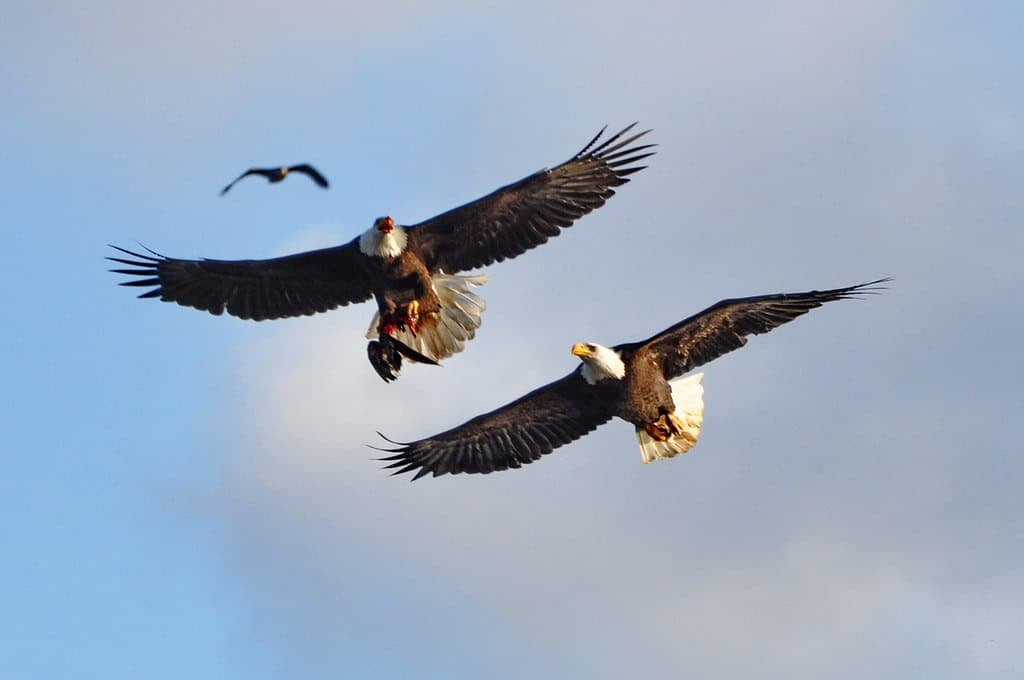
The bald eagle, America’s national bird and a symbol of freedom and strength, is surrounded by as much mythology as majesty. With its striking white head, powerful build, and impressive wingspan, this magnificent raptor has captured the imagination of Americans for generations. Yet despite its prominence in our national consciousness, many misconceptions persist about these remarkable birds. Some myths romanticize their abilities beyond reality, while others unfairly malign their nature. Understanding the truth about bald eagles not only deepens our appreciation for these incredible creatures but also helps inform conservation efforts to protect them.
In this article, we’ll explore ten common myths about bald eagles and debunk them with scientific facts. We’ll also highlight three widely-held beliefs that are actually true. From their hunting prowess to their family dynamics, prepare to have some of your long-held assumptions challenged as we separate eagle fact from eagle fiction.
Myth 10 Bald Eagles Are Actually Bald

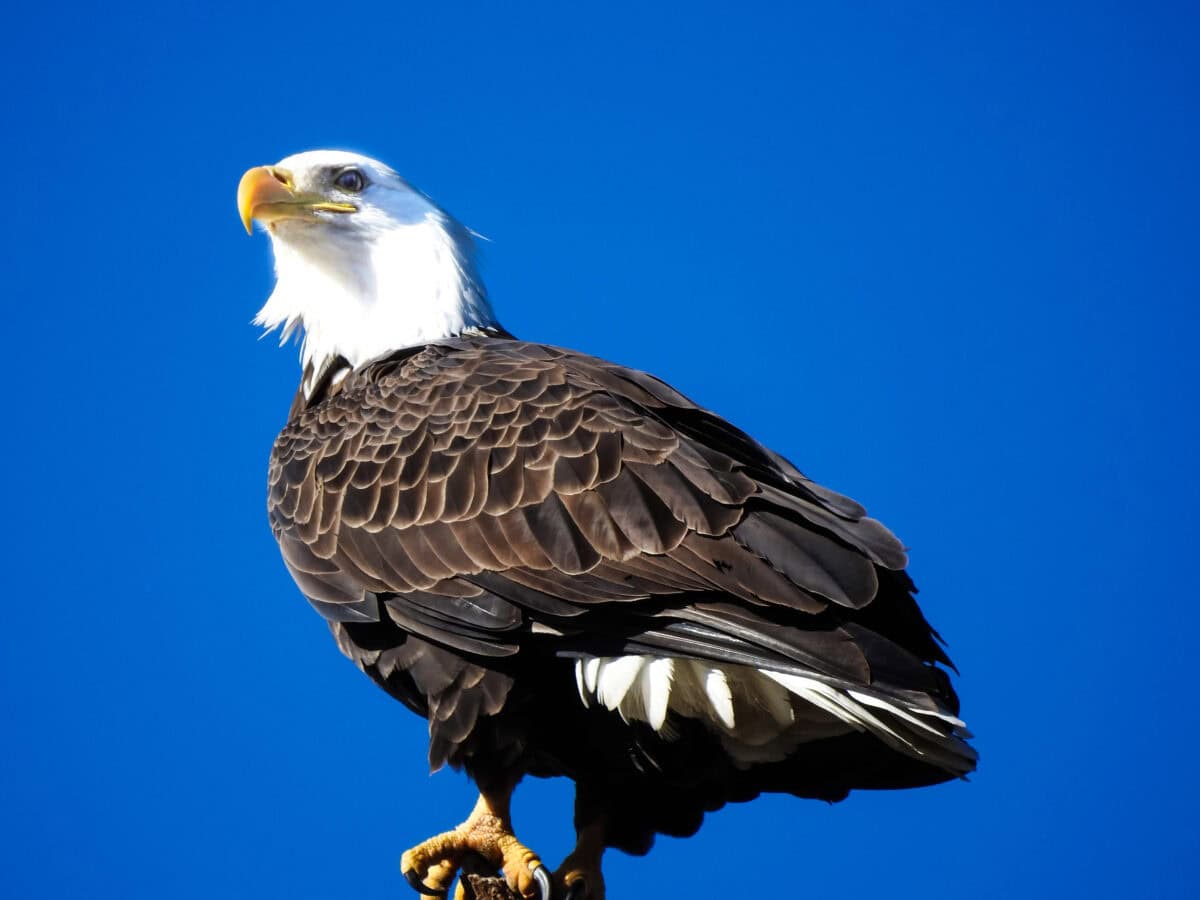
Despite their name, bald eagles are not bald at all. The misconception stems from the word “bald” in their name, which many people interpret literally. In reality, adult bald eagles have distinctive white feathers covering their head and neck. The name actually derives from an older meaning of the word “bald” that referred to something white or marked with white, rather than lacking hair or feathers. In Middle English, “balled” or “ballede” meant having a white patch or streak, which perfectly describes the eagle’s white-feathered head contrasting against its dark brown body.
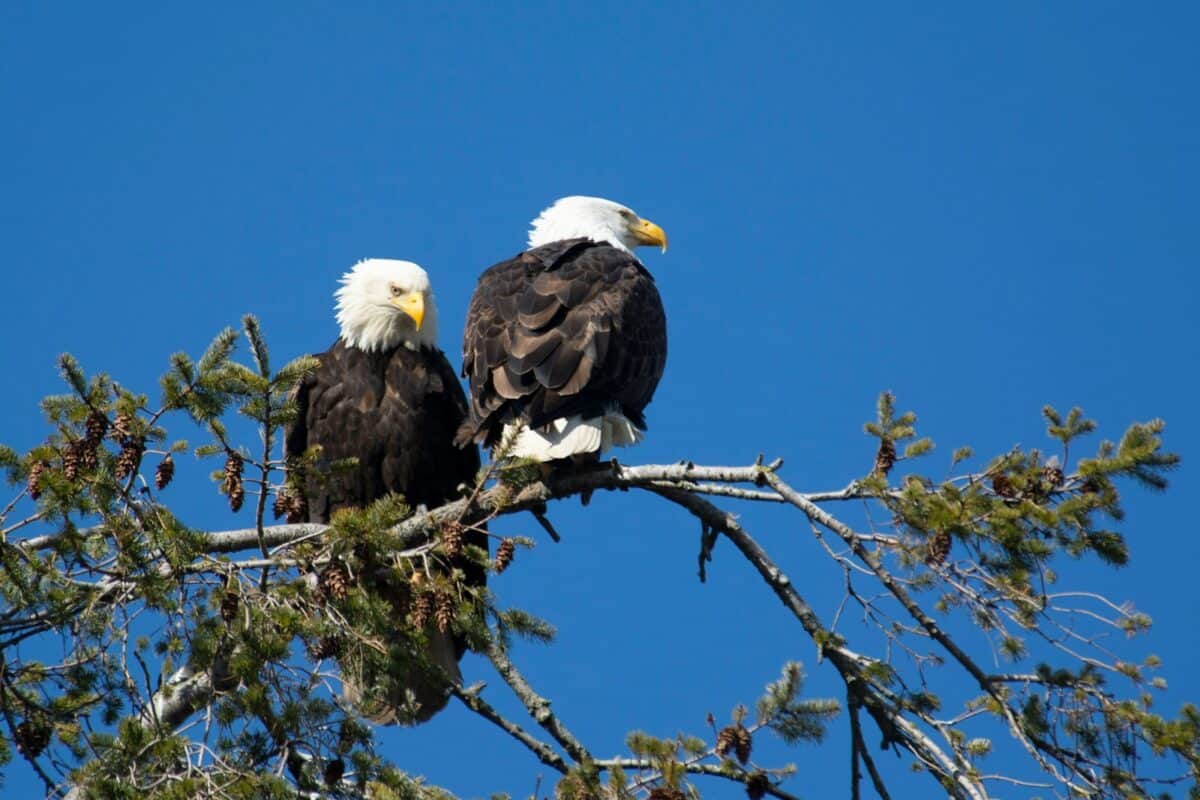
Young bald eagles don’t even have the iconic white head feathers until they reach maturity at around four to five years of age. Until then, juvenile bald eagles have predominantly brown plumage, including on their heads, which can lead to confusion with other large birds like golden eagles. The gradual transformation to their adult plumage, with the distinctive white head and tail, is one of nature’s most striking metamorphoses and signals the eagle’s readiness for breeding.
Myth 9 Bald Eagles Have Exceptional Eyesight That Can Spot a Fish From 3 Miles Away

While bald eagles do possess remarkable vision, the oft-repeated claim that they can spot a fish from three miles away is greatly exaggerated. Bald eagles have visual acuity that is 4 to 8 times better than that of humans, allowing them to see a rabbit-sized animal from about a mile away under ideal conditions. Their eyesight is indeed impressive – they can see fish swimming near the water’s surface from several hundred feet in the air – but the three-mile claim defies the physics of light and vision.
What makes eagle vision truly exceptional isn’t just its acuity but its adaptations for hunting. Eagles have forward-facing eyes that provide binocular vision, crucial for judging distances when diving for prey. Their retinas contain more light-sensitive cells than human retinas, and they possess two foveae (areas of sharp central vision) rather than one, allowing them to see forward and to the side simultaneously. They can also see a broader spectrum of colors than humans, including into the ultraviolet range, which may help them track prey by detecting urine trails that reflect UV light.
Myth 8 Bald Eagles Mate for Life and Die When Their Partner Dies

The romantic notion that bald eagles mate for life and that when one partner dies, the other spirals into grief and soon follows is more fairy tale than fact. While bald eagles do tend to form long-term pair bonds and often mate with the same partner for many years, they don’t literally mate “for life” in the absolute sense. If one member of a pair dies, the surviving eagle will typically seek a new mate rather than pine away in solitude. This behavior is driven by biology and survival instinct, not romantic sentiment.
Eagle pairs work together to build nests, incubate eggs, and raise young, making partnership advantageous. They often return to the same nesting territory year after year, reinforcing their bond. However, research has documented cases of eagles “divorcing” if breeding attempts repeatedly fail. The misconception about eagles dying of heartbreak likely stems from our human tendency to anthropomorphize animal behavior, projecting our own emotional responses onto wildlife. While eagles may show stress behaviors when separated from long-term mates, there’s no scientific evidence that they die from grief.
Myth 7 Bald Eagles Can Pick Up and Carry Off Children

One of the most persistent myths about bald eagles is that they’re strong enough to snatch and carry away small children. This frightening claim has fueled numerous urban legends and even some news stories, but it has no basis in reality. Bald eagles typically prey on fish weighing 1-3 pounds and have a lifting capacity generally limited to about 4-5 pounds – far less than the weight of even a small child. The average bald eagle weighs between 8-14 pounds, and the physics of flight make it impossible for them to lift anything close to their own body weight for any significant distance.
This myth likely persists due to the eagle’s fearsome appearance and our cultural association of eagles with power and strength. It may also be perpetuated by occasional documented attacks on small dogs or cats, though such incidents are extremely rare and typically occur only when eagles are desperate for food. Wildlife experts emphasize that bald eagles show no interest in humans as prey and generally avoid human contact whenever possible. The reality is that these magnificent birds pose virtually no threat to humans and prefer to hunt their natural prey in undisturbed habitats.
Myth 6 Bald Eagles Are Exceptional Hunters with Nearly Perfect Success Rates

Popular culture often portrays bald eagles as nature’s perfect predators, swooping down with deadly precision to capture prey in their powerful talons every time. In reality, bald eagles miss their targets far more often than they succeed. Studies of hunting bald eagles have found success rates closer to 20% – meaning they fail about four out of five hunting attempts. This relatively low success rate is actually common among many predators in the wild, as hunting requires considerable energy expenditure and prey animals have evolved their own evasive strategies.
Rather than being exceptional hunters, bald eagles might better be described as opportunistic feeders. They’re equally comfortable scavenging carrion as they are catching live prey, and they frequently steal food from other birds (a behavior called kleptoparasitism). Bald eagles are particularly notorious for harassing osprey until they drop their catch, which the eagle then retrieves. They’re also skilled at finding easy meals at garbage dumps or following fishing boats for discards. This adaptability in feeding strategies has contributed significantly to their recovery as a species, allowing them to thrive in various habitats, including those near human settlements.
Myth 5 The Bald Eagle’s Call Is a Fierce, High-Pitched Screech
If you’ve heard a powerful, piercing screech attributed to a bald eagle in movies or television, you’ve been misled by one of Hollywood’s most persistent wildlife inaccuracies. The majestic scream commonly used to represent bald eagles in media is actually the call of a red-tailed hawk, dubbed over eagle imagery because it sounds more impressive and aligned with our expectations of what a national symbol should sound like. The real vocalization of a bald eagle is surprisingly unimpressive – a series of high-pitched twittering, weak chirps, and whistling notes that some describe as similar to a gull’s call or even a giggle.
This audio substitution has been so pervasive in films, documentaries, and advertisements that many Americans have never heard the true voice of their national bird. Wildlife experts and ornithologists often point to this as a perfect example of how media can shape our perceptions of nature, sometimes creating expectations that reality cannot match. The disparity between the bald eagle’s fierce appearance and its relatively meek call serves as a reminder that nature doesn’t conform to human expectations of what is “appropriate” for certain species based on their size or symbolic status.
Myth 4 Bald Eagles Nearly Went Extinct Solely Due to Hunting
While hunting did contribute to the decline of bald eagle populations in the early 20th century, it wasn’t the primary threat that nearly drove them to extinction. The most devastating factor was the widespread use of the pesticide DDT (dichlorodiphenyltrichloroethane) after World War II. DDT didn’t kill adult eagles directly but accumulated in the food chain. When eagles consumed contaminated fish, the chemical interfered with calcium production in their bodies, causing them to lay eggs with shells so thin they would break during incubation. By the 1960s, there were fewer than 500 nesting pairs in the lower 48 states, down from an estimated 100,000 pairs before European colonization.
The bald eagle’s recovery story involves multiple conservation efforts, not just hunting restrictions. The banning of DDT in 1972, protection under the Endangered Species Act, habitat conservation, captive breeding programs, and reintroduction efforts all played crucial roles. Public education campaigns also helped reduce persecution and disturbance of nesting sites. Today, with populations rebounded to over 300,000 individuals continent-wide, the bald eagle represents one of America’s greatest conservation success stories. Understanding the complex factors behind their decline helps inform current conservation strategies for other threatened species facing multiple environmental pressures.
Myth 3 Bald Eagles Only Eat Fish

Though often portrayed as specialists that exclusively eat fish, bald eagles actually have a remarkably diverse diet. While fish do typically make up the majority of their food intake where readily available, bald eagles are opportunistic feeders that adapt their diet to local food sources and seasonal availability. They regularly consume waterfowl, small mammals like rabbits and muskrats, reptiles, and even smaller birds. During winter months in areas where water bodies freeze over, eagles may rely heavily on carrion, including road-killed animals and the remains of deer and other animals left by hunters.
This dietary flexibility has been crucial to the bald eagle’s recovery and expansion into diverse habitats across North America. In some regions, eagles have been documented feeding primarily on bird species rather than fish. On the Chesapeake Bay, for example, researchers have observed eagles preying heavily on gulls and ducks during certain seasons. In the Pacific Northwest, spawning salmon provide a seasonal feast, with eagles gathering in large numbers to feed on both live fish and carcasses. Their adaptable feeding strategies allow them to thrive in environments from coastal areas to inland lakes and rivers, demonstrating ecological resilience that many specialized feeders lack.
Myth 2 Bald Eagles Are Solitary Birds That Avoid Their Own Kind

Contrary to their portrayal as solitary, territorial creatures, bald eagles are actually quite social under certain circumstances. While they do defend breeding territories fiercely during nesting season, bald eagles regularly gather in large groups at abundant food sources. These gatherings, sometimes called congregations, can include dozens or even hundreds of eagles. The most famous examples occur along salmon runs in Alaska and the Pacific Northwest, where eagles assemble in astonishing numbers to feast on spawning fish. Similar congregations form at some wintering grounds where food is plentiful.
Young, non-breeding eagles are particularly social, often traveling and roosting together in loose associations before establishing their own territories. Even adult eagles may share communal roosts outside the breeding season, especially in winter when suitable roosting trees near food sources are limited. These social interactions likely serve multiple purposes, including information sharing about food sources and potential mate selection. The complex social behaviors of bald eagles challenge the common misconception that these birds are loners by nature, revealing instead a species with flexible social structures that adapt to environmental conditions and life stages.
Myth 1 Bald Eagles Have Always Been America’s National Bird

While the bald eagle has become synonymous with American national identity, it wasn’t an automatic or uncontested choice for the country’s emblem. When the Continental Congress assigned Benjamin Franklin, Thomas Jefferson, and John Adams to design the Great Seal of the United States in 1776, their initial designs didn’t include an eagle at all. It wasn’t until the third design committee in 1782 that the bald eagle was officially adopted. The popular story that Benjamin Franklin preferred the wild turkey over the “bald eagle” stems from a private letter he wrote criticizing the artistic rendering of the eagle on the Society of the Cincinnati medal, saying it looked more like a turkey and then proceeding to compare the moral characters of both birds.
Franklin did express concerns about the eagle’s character, noting in his letter that it was “a bird of bad moral character” that “does not get his living honestly” because it steals food from other birds and is “too lazy to fish for himself.” He contrasted this with the turkey, which he called “a much more respectable bird” and “a true original native of America.” Despite these private musings, there’s no evidence Franklin formally opposed the eagle as the national symbol during official deliberations. The bald eagle was chosen for its strength, majestic appearance, long life, and the fact that it was believed to exist only in North America, making it a uniquely American symbol.
Truth 3 Bald Eagles Build the Largest Nests of Any North American Bird

One widely-held belief about bald eagles that is absolutely true is that they construct the largest nests of any bird in North America. These massive structures, called eyries, are engineering marvels that reflect the eagles’ long-term commitment to their nesting sites. Bald eagle pairs typically return to the same nest year after year, adding new materials each breeding season. This continual construction results in nests that grow increasingly enormous over time. The average bald eagle nest measures about 5 feet in diameter and 2-4 feet deep, but long-established nests can reach truly spectacular dimensions.
The largest documented bald eagle nest was discovered in St. Petersburg, Florida, and measured 9.5 feet in diameter and 20 feet deep. It was estimated to weigh more than two tons – about the weight of a small car. Eagles construct these colossal homes using large sticks as the primary building material, lining the interior with softer items like grass, moss, feathers, and even seaweed in coastal areas. The impressive size serves practical purposes: it provides a secure platform for raising young, offers protection from predators and weather, and creates enough space for the eagles to maneuver around their offspring as they grow. These remarkable structures stand as testament to the eagles’ incredible building abilities and commitment to successful reproduction.
Truth 2 Bald Eagles Are Incredibly Devoted Parents

Another true fact about bald eagles is their exceptional dedication to parenting. Both male and female eagles participate equally in most aspects of raising their young, from nest building to feeding and protecting eaglets. This shared parenting begins during incubation, with both parents taking turns keeping the eggs warm for the 35-day incubation period, although females typically spend more time on the nest. After hatching, at least one parent remains with the young at all times for the first few weeks to protect them from predators and harsh weather conditions, while the other hunts for food to bring back to the nest.
Eagle parents are remarkably attentive, feeding their young multiple times per day and carefully shredding food into manageable pieces for small eaglets. As the chicks grow, parents gradually introduce them to larger food pieces and eventually whole prey items, helping prepare them for independence. The parental investment continues for 10-12 weeks while the young eagles develop flight feathers and learn critical survival skills. Even after fledging, parents continue to provide food and protection for another 4-6 weeks as the juveniles master flying and hunting. This extended care period, lasting about 4-5 months in total, represents one of the longest parenting commitments among North American birds and contributes significantly to the species’ survival success.
Truth 1 Bald Eagles Can Swim Using a Butterfly Stroke-Like Motion

Perhaps one of the most surprising but true facts about bald eagles is their ability to swim using a butterfly stroke-like motion with their wings. While not common behavior, bald eagles have been documented swimming when necessary, typically when they’ve captured prey too heavy to lift from the water. In these situations, the eagle will use its powerful wings to propel itself through the water toward shore, where it can safely consume its catch. Wildlife photographers and researchers have captured footage of this unusual behavior, showing eagles moving through water with surprising.
Conclusion:

Bald eagles have long captured the imagination of people across North America, leading to a mix of awe-inspiring truths and persistent myths. From exaggerated claims about their size and strength to misunderstandings about their calls and behaviors, many of these myths reflect more about human perception than biological reality. Separating fact from fiction not only deepens our respect for these raptors but also allows us to see them as complex, adaptive survivors rather than just national symbols.
At the same time, some of the stories we hear—such as their loyalty to nesting partners or their impressive eyesight—are rooted in scientific fact. These truths make the bald eagle all the more remarkable, showing that reality can be just as fascinating as legend. By learning what’s true and what’s not, we’re better equipped to support conservation efforts and foster a greater connection with the natural world that bald eagles so powerfully represent.

As a little kid, I fell in love with nature, wildlife, and animals. Living in the USA, South Africa, Italy, China and Germany gave me the opportunity to discover the world's Wildlife. My favorite animals are Mountain Gorillas, Siberian Tigers, and Great White Sharks.
I'm a certified PADI Open Water Diver, went to Everest Base Camp and Trekked Gorillas in Uganda. I hold a Master of Science in Economics and Finance.
Please send any feedback to feedback@animalsaroundtheglobe.com
- 15 Crocodile Facts That Prove They Have not Needed to Evolve - June 16, 2026
- 12 Signs a Koala Is Under Stress in Captivity - June 16, 2026
- 15 Ways Weather Changes Are Affecting Backyard Birds - June 16, 2026