


Birds of prey, also known as raptors, represent some of nature’s most sophisticated predators. These remarkable hunters have evolved specialized techniques that allow them to capture prey with astonishing efficiency and precision. From high-speed aerial dives to cooperative hunting strategies, raptors demonstrate the pinnacle of predatory evolution. This article explores thirteen extraordinary birds of prey and their incredible hunting tactics, showcasing the diverse and often surprising methods these birds employ to survive in their respective ecosystems. Each species has developed unique adaptations and behaviors that make them formidable hunters, perfectly adapted to their ecological niches and hunting requirements.
13. Peregrine Falcon The World’s Fastest Hunter

The Peregrine Falcon (Falco peregrinus) holds the title of the fastest animal on Earth, capable of reaching speeds exceeding 240 mph (386 km/h) during its hunting stoop. This remarkable bird spots prey from heights of up to 3,000 feet and initiates its iconic high-speed dive with wings partially folded back. The peregrine’s specialized respiratory system allows it to breathe efficiently during these incredible dives, while a small bony tubercle in each nostril deflects air pressure from the bird’s lungs. When striking prey—typically other birds in mid-flight—the falcon delivers a powerful blow with its clenched foot, often killing the target instantly from the impact before circling back to retrieve it. To protect their eyes during these high-velocity pursuits, peregrines have evolved specialized “third eyelids” that clear debris while maintaining vision during the stoop.
12. Harris’s Hawk Masters of Cooperative Hunting
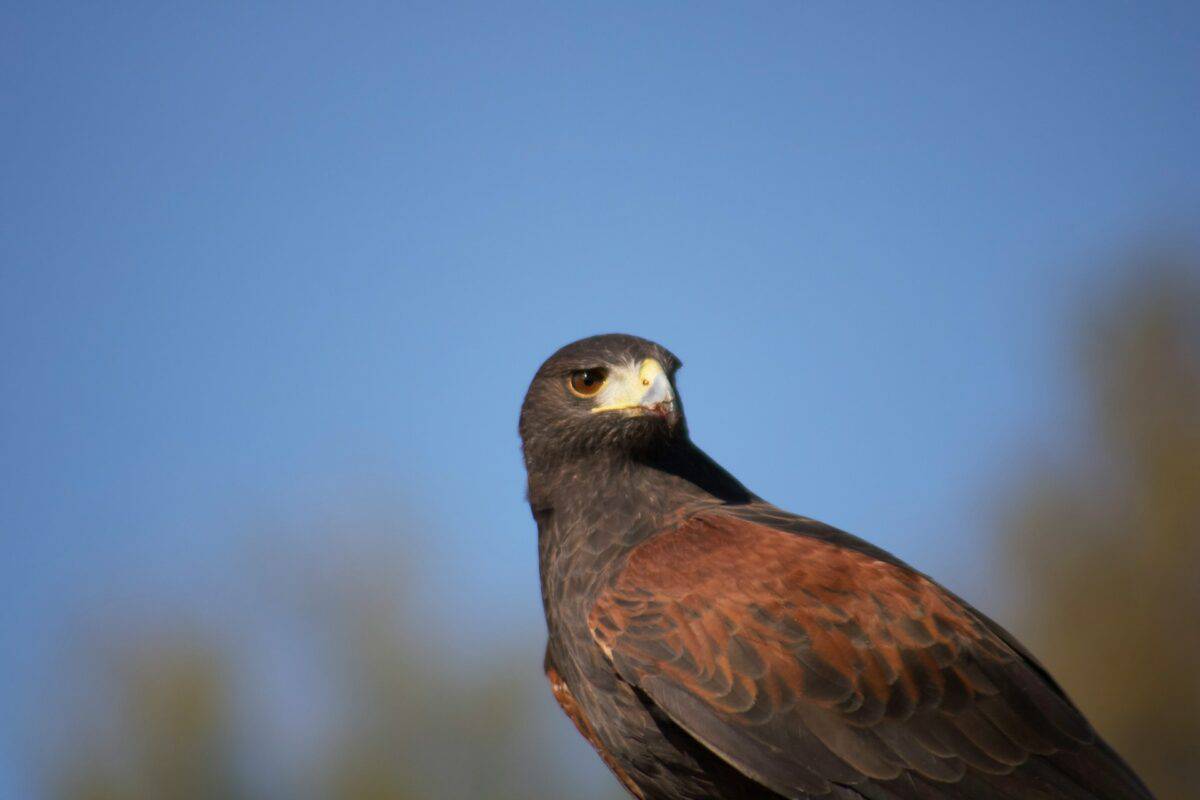
Harris’s Hawks (Parabuteo unicinctus) stand out among raptors for their extraordinary social hunting behavior—a tactic rarely observed in birds of prey. Native to the southwestern United States, Mexico, and parts of South America, these medium-sized hawks hunt in coordinated family groups of 2-7 individuals. Their cooperative strategy, sometimes called “relay hunting,” involves team members taking turns pursuing prey while others block escape routes or flush prey from hiding. This wolf-pack-like behavior allows them to capture prey that would otherwise be too difficult for a single hawk to catch, including rabbits and hares that can outmaneuver individual predators. Harris’s Hawks even engage in a unique behavior called “back-stacking,” where they literally stand on each other’s backs to form living towers, allowing the group to survey larger areas and spot prey more effectively in their desert and scrubland habitats.
11. Osprey The Specialized Fish Hunter

The Osprey (Pandion haliaetus) has evolved into perhaps the most specialized fish-hunting bird on the planet. With a nearly worldwide distribution, these raptors possess unique adaptations specifically for capturing slippery, underwater prey. Ospreys hover 30-100 feet above water bodies, scanning with their polarized vision that cuts through water glare to spot fish swimming below. When a target is identified, they plunge feet-first, sometimes completely submerging before emerging with their catch. Their success rate is impressive—studies show they succeed in around one of every four hunting attempts. Specialized physical adaptations support this fishing prowess: reversible outer toes allow them to grasp fish with two toes facing forward and two backward; spicules (small spines) on their footpads increase grip on slippery prey; and their nostrils close during dives. Perhaps most remarkable is the osprey’s habit of aerodynamically positioning captured fish headfirst during flight, reducing drag as they carry their prize back to perches or nests.
10. Secretarybird The Snake-Stomping Specialist

The Secretarybird (Sagittarius serpentarius) of African savannas employs one of the most unusual hunting techniques among raptors. Standing nearly 4 feet tall with distinctive black leg feathers resembling old-fashioned quill pens (hence the name “secretary”), these birds are specialized terrestrial hunters. Unlike most birds of prey that primarily use their talons and beaks to capture prey, secretarybirds are famous for their methodical stomping technique. They walk up to 20 miles daily across grasslands, deliberately stepping to flush out prey such as snakes, lizards, and small mammals. When prey is detected, the secretarybird delivers powerful, precision kicks with its long legs, striking with a force five times its body weight and at speeds faster than a human eye can track (15 milliseconds per strike). For venomous snakes, they repeatedly stomp the head to disable the threat before consumption. Their scale-covered legs provide protection against snake bites, allowing them to safely hunt prey that would be dangerous to most other predators.
9. Great Grey Owl The Phantom Predator

The Great Grey Owl (Strix nebulosa) exemplifies stealth hunting perfected through evolutionary adaptations. As North America’s largest owl by length, these “Phantoms of the North” have developed remarkable abilities to detect and capture prey beneath deep snow in their boreal forest habitats. Their large facial discs—composed of stiff feathers around their eyes—function as highly sensitive parabolic sound collectors, directing sounds to their asymmetrically positioned ears. This unique arrangement creates minute differences in sound arrival time, allowing great greys to pinpoint prey location with extraordinary precision—even under 18 inches of snow. Studies demonstrate they can detect a vole moving beneath snow from over 30 feet away. When hunting, these owls plunge through snow in a dramatic move called a “snow dive,” breaking through crusts strong enough to support a 180-pound human. Their exceptional low-frequency hearing detects the subsonic sounds made by small mammals, giving them a crucial advantage when visual hunting is impossible during harsh northern winters.
8. Lammergeier The Bone-Breaking Vulture

The Bearded Vulture or Lammergeier (Gypaetus barbatus) exhibits perhaps one of the most specialized feeding strategies in the avian world. Unlike other vultures that primarily consume soft tissues of carcasses, the lammergeier has evolved to specialize in eating bone marrow, with up to 90% of its diet consisting of bones. These massive birds, with wingspans reaching nearly 10 feet, employ a remarkable technique called osteophagy—they carry large bones high into the air (sometimes 150+ feet) and deliberately drop them onto rocky surfaces below. This precision bombing breaks bones into manageable fragments that the birds can swallow. Their powerful digestive system, containing stomach acid with a pH of about 1 (comparable to battery acid), can dissolve and digest bone fragments within 24 hours. Interestingly, lammergeiers also rub their feathers with iron-rich soils, giving them their characteristic rusty-orange coloration—a deliberate cosmetic behavior that scientists believe may signal dominance or breeding condition. Inhabiting mountainous regions across parts of Europe, Africa, and Asia, these unique vultures represent nature’s solution to utilizing nutrients that remain locked in skeletal remains long after other scavengers have abandoned a carcass.
7. Black-Skimmer The Touch-Sensitive Hunter
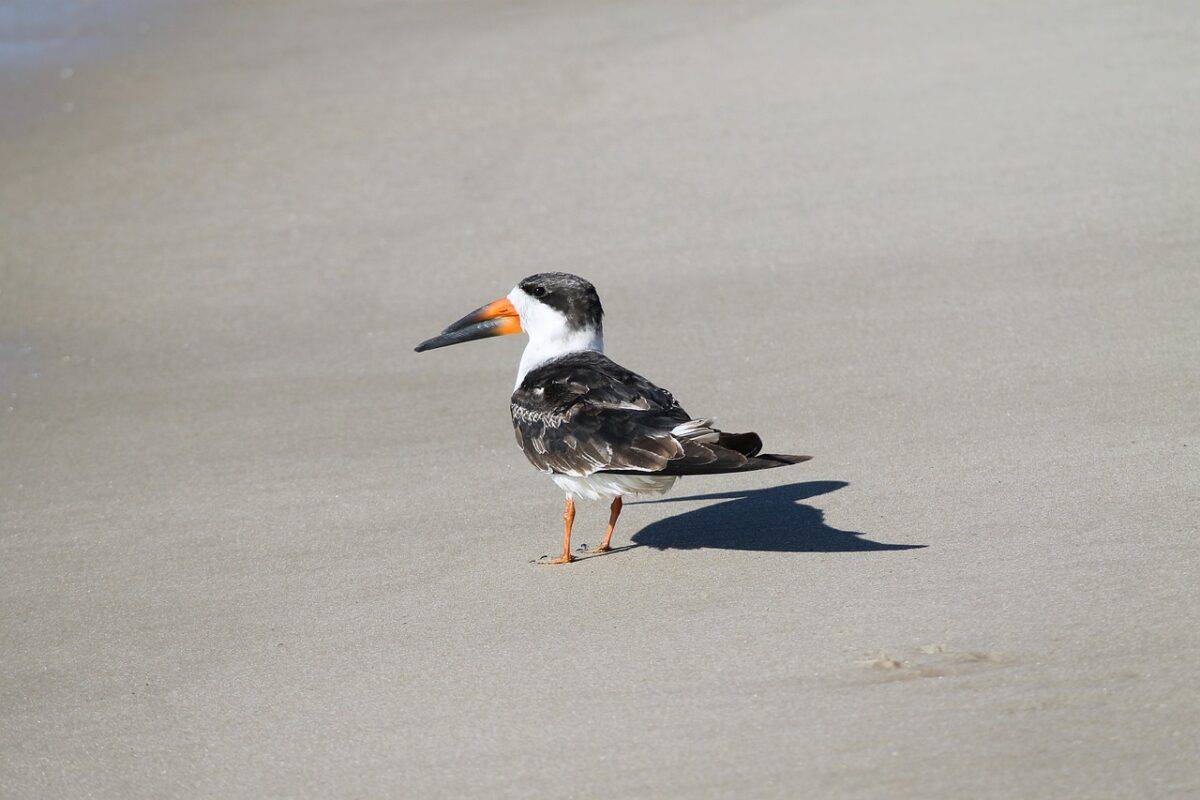
The Black Skimmer (Rynchops niger) employs what might be the most unconventional hunting technique among avian predators. These distinctive birds feature a highly specialized bill where the lower mandible extends significantly beyond the upper one—an adaptation unlike any other bird. While technically not classified as raptors in the strict sense, their predatory behavior earns them a place among remarkable aerial hunters. Black Skimmers hunt by flying low over water surfaces—sometimes just inches above—with their elongated lower bill partially submerged. As they “skim” along, the moment their bill touches a fish, a lightning-fast reflex snaps their head down, securing prey in their specialized bill. This tactile hunting occurs primarily during dawn, dusk, or nighttime, allowing them to hunt successfully even in complete darkness. Their eyes possess vertically narrow pupils similar to cats, providing enhanced vision in low light conditions. Additionally, they have developed exceptional night vision with a high concentration of rod cells in their retinas. This unique combination of sensory adaptations allows Black Skimmers to exploit feeding niches unavailable to most other fishing birds, operating effectively when visual hunters would be severely disadvantaged.
6. Northern Goshawk The Forest Phantom

The Northern Goshawk (Accipiter gentilis) represents the epitome of woodland hunting precision. These powerful, medium-sized raptors have mastered high-speed pursuit through densely wooded environments—a hunting environment that would be impossible for many other birds of prey. Goshawks employ a hunting strategy called “short-stay perch hunting,” where they move between hidden perches within the forest, waiting motionless before explosive acceleration toward detected prey. Their specialized anatomy supports this hunting style: relatively short but broad wings provide powerful thrust while allowing maneuverability between trees, and their long tail acts as a rudder for sharp directional changes. When pursuing prey, goshawks can navigate forest obstacles at speeds up to 38 mph (60 km/h)—the avian equivalent of high-speed racing through a complex obstacle course. Their remarkable spatial memory allows them to anticipate and navigate through forest gaps while maintaining visual focus on fleeing prey. Historically valued by falconers as among the most effective hunting birds, goshawks target diverse prey from squirrels and rabbits to other birds, displaying such determined pursuit that they sometimes follow prey into thick vegetation or even water—earning them a fearsome reputation within forest ecosystems.
5. Golden Eagle The Cliff Tactician

The Golden Eagle (Aquila chrysaetos) demonstrates hunting prowess that combines raw power with sophisticated strategy. Among the largest and most powerful true birds of prey, these magnificent raptors employ a hunting technique known as “contour hunting,” where they fly low along hillsides and mountain ridges, using the terrain as cover to surprise prey. One of their most impressive hunting behaviors targets mountain-dwelling mammals like ibex and chamois. Using terrain to their advantage, golden eagles have been documented deliberately flying at ungulates positioned near cliff edges, causing the startled animals to lose footing and fall to their deaths—after which the eagle retrieves the killed prey. With massive feet capable of exerting 440 pounds per square inch of pressure (more than enough to crush human bone), they can capture prey weighing up to 4 times their own body weight. In North America, pairs sometimes hunt cooperatively when targeting larger prey such as foxes and coyotes, with one eagle distracting the prey while the other attacks from behind. Their keen vision allows them to spot potential prey from over two miles away, making them efficient hunters across vast territories that can span over 60 square miles in mountainous regions.
4. Bald Eagle The Piratical Fisher

The Bald Eagle (Haliaeetus leucocephalus), America’s national bird, employs a surprisingly opportunistic hunting strategy that includes kleptoparasitism—essentially, food theft. While capable fishers who swoop down to snatch fish from water surfaces with their powerful talons, bald eagles frequently engage in aerial piracy, harassing other fishing birds like ospreys until they drop their catch. Using their superior speed and maneuverability, bald eagles can intercept falling fish mid-air before they reach the water. This energy-efficient strategy allows them to obtain food without expending energy on fishing themselves. Researchers studying this behavior in some locations have documented that up to 35% of an eagle’s diet may come from stolen catches. When actively fishing, bald eagles employ remarkable precision, calculating complex variables including water refraction, fish movement patterns, and flight dynamics. They can spot fish swimming up to one mile away and adjust their approach angle to account for light refraction at the water’s surface—a sophisticated understanding of physics. Interestingly, despite their fierce reputation, bald eagles are equally comfortable in the role of scavenger, often feeding on carrion and gathering in large numbers at abundant food sources like salmon runs.
3. Eurasian Sparrowhawk The Ambush Specialist
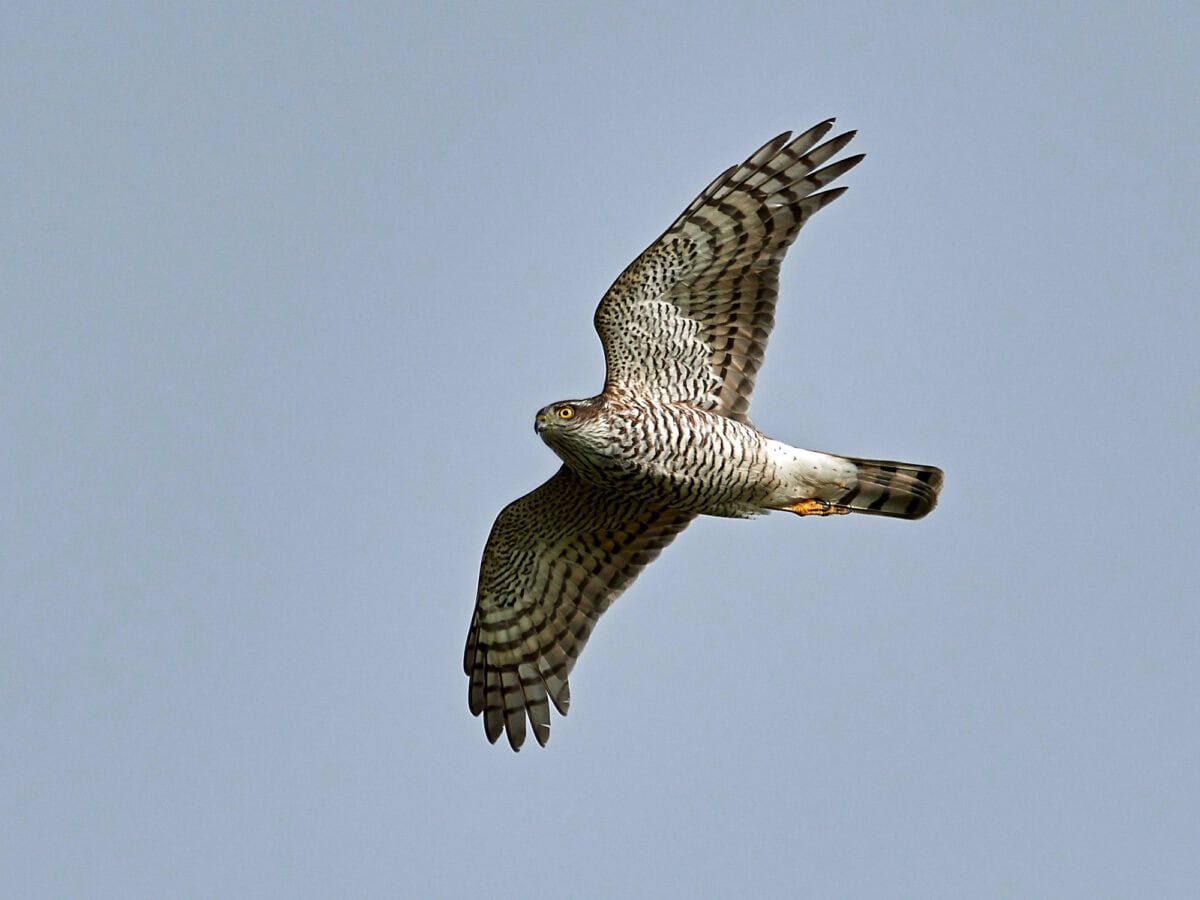
The Eurasian Sparrowhawk (Accipiter nisus) has perfected the art of ambush hunting in garden and woodland environments. These compact, agile raptors employ hunting techniques specifically adapted for capturing small birds, which constitute over 98% of their diet in most regions. Female sparrowhawks, being significantly larger than males (one of the most extreme examples of sexual dimorphism among raptors), typically target larger birds like thrushes and starlings, while males focus on smaller species like finches and tits. Their hunting strategy relies heavily on surprise—they approach feeding areas by flying low along hedgerows or buildings, then execute a rapid final approach with a burst of acceleration. Studies show they strategically use gardens with bird feeders as hunting grounds, approaching from directions that maximize concealment. Unlike falcons that rely on speed, sparrowhawks depend on stealth and short-range acceleration, capturing prey within seconds of breaking cover. Their success largely depends on the element of surprise, with hunt success rates dropping dramatically if they’re detected by potential prey. What makes their hunting particularly remarkable is their ability to navigate at high speed through complex environments—threading through tiny gaps between branches and buildings with split-second adjustments while in pursuit of agile songbirds.
2. Philippine Eagle The Primate Hunter
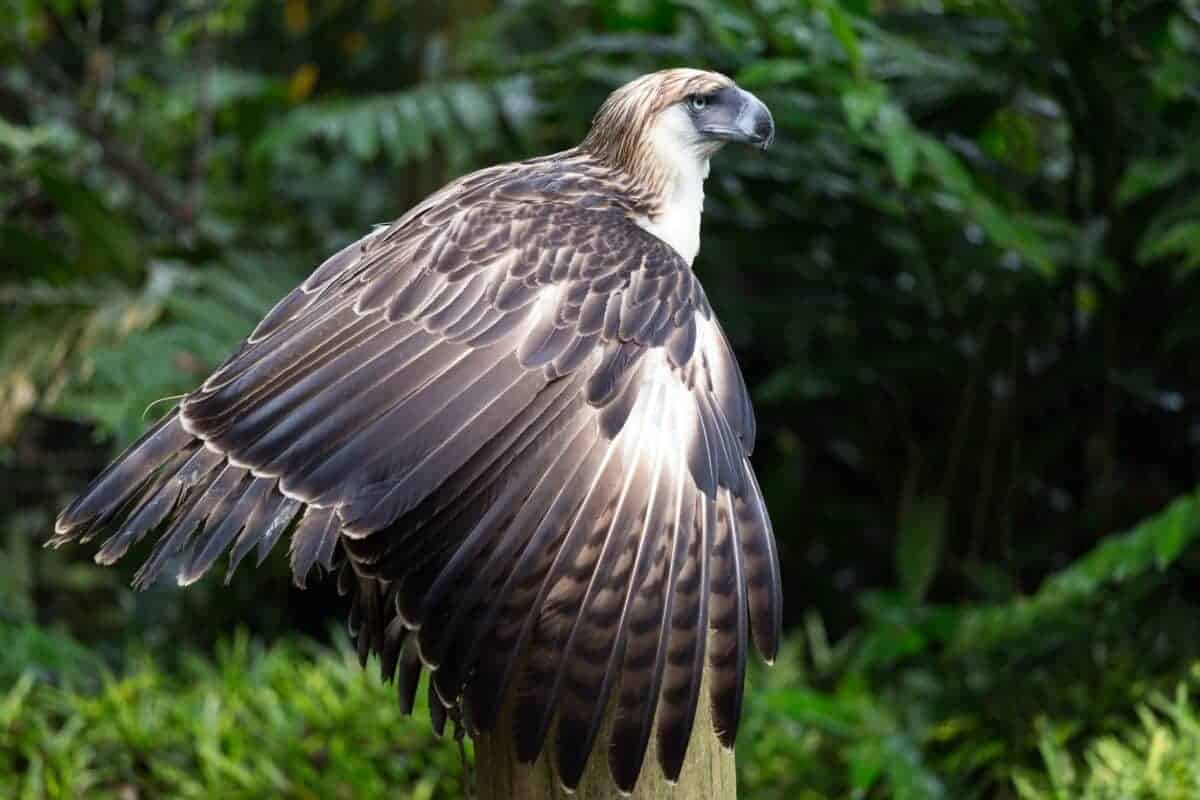
The Philippine Eagle (Pithecophaga jefferyi), one of the world’s largest and most powerful eagles, has evolved specialized hunting techniques for capturing primates in the dense rainforests of the Philippines. With a wingspan reaching 7 feet and standing over 3 feet tall, these critically endangered raptors employ a hunting strategy called “sit-and-wait” from perches concealed within the rainforest canopy. Unlike eagles that hunt in open areas, Philippine Eagles have developed remarkable patience—they can remain motionless for hours before striking. Their primary targets include Philippine flying lemurs, palm civets, and monkeys, particularly the Philippine macaque. When hunting monkeys, they demonstrate sophisticated tactical awareness—approaching from below rather than above, contrary to typical eagle hunting patterns. This strategy prevents monkeys from spotting them against the sky and takes advantage of the fact that many rainforest animals rarely look directly downward. Their massive, deep-curved talons can exert forces strong enough to instantly crush a monkey’s skull. Perhaps most impressive is their ability to extract prey from dense vegetation—they’ve developed techniques to reach through foliage and extract concealed prey without damaged their massive wings, showcasing remarkable spatial awareness and precision in complex three-dimensional environments.
1. Snail Kite The Mollusk Master

The Snail Kite (Rostrhamus sociabilis) demonstrates one of the most specialized feeding adaptations among all birds of prey. Unlike most raptors that target vertebrates, snail kites feed almost exclusively on a single type of prey—apple snails (genus Pomacea). Native to Florida and parts of Central and South America, these medium-sized hawks have evolved an extremely specialized bill shaped like a sharp, narrow hook, perfectly designed for extracting snail meat from shells. When hunting, snail kites fly slowly over freshwater marshes, scanning for snails near the water’s surface or on emergent vegetation. Once spotted, they swoop down and delicately pluck snails using their feet, then carry them to perches called “feeding roosts.” The real specialization becomes evident during feeding—using their precisely curved bills, they deftly extract the snail from its shell without breaking the shell itself, often completing the entire extraction in less than two minutes. This extreme dietary specialization makes them particularly vulnerable to environmental changes affecting snail populations. Interestingly, researchers have documented that juvenile snail kites have a learning period where their snail extraction efficiency gradually improves with practice, suggesting this specialized feeding technique requires both anatomical adaptation and learned skill development.
Conclusion: Nature’s Perfect Aerial Predators

The extraordinary hunting tactics displayed by these 13 birds of prey demonstrate the remarkable diversity of predatory adaptations that have evolved across avian species. From the peregrine falcon’s supersonic dive to the secretarybird’s methodical snake-stomping and the lammergeier’s bone-breaking strategy, these specialized techniques represent millions of years of evolutionary refinement. Each species has developed hunting methods perfectly suited to their ecological niche, prey type, and physical capabilities. These raptors not only showcase the incredible biodiversity of avian predators but also highlight the complex relationship between form and function in nature. As we continue to study and understand these magnificent birds, their hunting tactics provide valuable insights into predator-prey relationships, specialized adaptations, and the intricate balance of ecosystems worldwide—reminding us of the irre

As a little kid, I fell in love with nature, wildlife, and animals. Living in the USA, South Africa, Italy, China and Germany gave me the opportunity to discover the world's Wildlife. My favorite animals are Mountain Gorillas, Siberian Tigers, and Great White Sharks.
I'm a certified PADI Open Water Diver, went to Everest Base Camp and Trekked Gorillas in Uganda. I hold a Master of Science in Economics and Finance.
Please send any feedback to feedback@animalsaroundtheglobe.com
- 11 Close Calls With Avalanche Zones - August 4, 2026
- Top 10 Animals and Wildlife in the Maldives - August 4, 2026
- Where to see Penguins - August 4, 2026