


The bald eagle, America’s national bird and a symbol of strength and freedom, has captured the imagination of people for centuries. Despite its iconic status, this majestic raptor is often misunderstood, with numerous myths circulating about its appearance, behavior, and conservation status. Separating fact from fiction helps us better appreciate these magnificent birds and understand their true nature. From their hunting prowess to their nesting habits, bald eagles are fascinating creatures whose reality often exceeds the legends surrounding them. This article explores common misconceptions and reveals surprising truths about one of North America’s most impressive avian residents.
Myth 16 Bald Eagles Are Actually Bald

Despite their name, bald eagles are not bald at all. The term “bald” in their name comes from an old English word “balde,” meaning white, referring to their distinctive white head feathers that contrast sharply with their dark brown body. Adult bald eagles develop this characteristic white head and tail plumage only after reaching maturity at about 4-5 years of age. Until then, young bald eagles have mostly brown heads and bodies, often causing them to be mistaken for golden eagles by casual observers. This striking white “cap” serves an important function beyond mere aesthetics—it helps eagles recognize one another at great distances during flight.
Myth 15 Bald Eagles Have Poor Eyesight

Far from having poor vision, bald eagles possess some of the sharpest eyesight in the animal kingdom. Their visual acuity is estimated to be 4 to 8 times stronger than that of humans. A bald eagle can spot a rabbit-sized animal from a distance of about two miles when soaring at altitude. This remarkable vision comes from having a higher density of light-sensitive cells in their retinas, a larger pupil relative to eye size that allows more light to enter, and two foveae (areas of acute vision) instead of one as in humans. Additionally, eagles can see ultraviolet light, which humans cannot perceive, aiding them in tracking prey that leaves UV-reflecting urine trails. Their eyes are fixed in their sockets, but they compensate with a neck that can rotate 270 degrees, allowing for an impressive field of vision.
Myth 14 Eagle Talons Can Easily Lift Children

An enduring myth suggests that bald eagles are capable of snatching children and carrying them away. This is categorically false. While bald eagles are powerful birds, they generally cannot lift more than about 4-5 pounds (1.8-2.3 kg)—roughly the weight of a small rabbit or fish. An average human baby weighs 7-10 pounds at birth and grows rapidly after that, putting them well beyond an eagle’s carrying capacity. This myth likely persists due to exaggerated tales and dramatized representations in media. The strength of an eagle’s talons evolved specifically for catching and carrying appropriately sized prey like fish and small mammals, not for lifting objects many times their own weight. Bald eagles themselves typically weigh between 8-14 pounds, making it physically impossible for them to airlift children.
Myth 13 Bald Eagles Make the Screaming Sound Heard in Movies

The iconic piercing scream often attributed to bald eagles in movies and television is actually the call of a red-tailed hawk. This sound effect substitution has become so common in media that many people mistakenly believe it represents an eagle’s true voice. In reality, bald eagles produce a series of relatively weak-sounding chirps, whistles, and squeals that might seem underwhelming compared to their majestic appearance. Their most common call is a series of high-pitched twittering or chuckling sounds, quite different from the dramatic scream portrayed in film. Hollywood’s sound editors have historically preferred the more impressive hawk screech for dramatic effect, unintentionally creating one of the most persistent myths about eagle vocalizations. Next time you hear that familiar battle cry in a movie when an eagle appears on screen, remember you’re actually hearing a red-tailed hawk’s call.
Myth 12 Bald Eagles Were Never Really Endangered

The notion that bald eagles were never truly endangered is demonstrably false. By the mid-20th century, bald eagles had experienced a catastrophic population decline, with numbers plummeting from an estimated 300,000-500,000 in the 1700s to just 417 nesting pairs in the contiguous United States by 1963. This devastating drop resulted primarily from widespread use of the pesticide DDT, which accumulated in the eagles’ prey and caused them to lay eggs with shells too thin to support developing embryos. Additional threats included habitat destruction, illegal shooting, and lead poisoning. The Bald Eagle Protection Act of 1940, followed by the ban on DDT in 1972 and protections under the Endangered Species Act, were critical to their recovery. Today, with population estimates exceeding 300,000 individuals across North America, the bald eagle represents one of conservation’s greatest success stories—but their comeback required decades of dedicated protection and habitat restoration efforts.
Myth 11 Bald Eagles Mate for Life and Die When Their Partner Dies

While bald eagles do tend to form long-term pair bonds, the romanticized notion that they mate for life and die of heartbreak when their partner perishes is not accurate. Bald eagles typically practice monogamy and may remain with the same mate for many years, but this is primarily because of their strong territorial instincts and the advantages of working with a familiar partner for nesting and raising young. If one eagle dies, the surviving bird will usually find another mate rather than refusing to continue living. Researchers have documented eagles finding new partners within weeks or even days after losing their previous mate. The misconception about eagles dying of grief likely stems from a conflation with certain swan species’ behaviors or simply from human tendency to anthropomorphize animal relationships. In reality, eagles are pragmatic creatures driven by survival instincts rather than romantic notions of eternal partnership.
Myth 10 Bald Eagles Can Live Anywhere in North America

While bald eagles have expanded their range considerably following conservation efforts, they don’t thrive equally in all North American habitats. These birds have specific habitat requirements, primarily preferring areas near large bodies of open water with an abundant food supply and mature trees for nesting. Coastal areas, lakes, and river systems provide ideal habitat, explaining their concentration in places like Alaska (home to roughly half of North America’s bald eagles), the Pacific Northwest, the Great Lakes region, and parts of the Atlantic coast. Eagles generally avoid dense urban areas, deserts, and high mountain regions where their prey is scarce. Climate also plays a role in their distribution, with most eagles preferring temperate zones, though some populations have adapted to more extreme conditions. The eagles’ current range represents a significant recovery from their endangered period, but their distribution remains influenced by these specific ecological requirements rather than being uniformly spread across the continent.
Myth 9 Bald Eagles Only Eat Fish
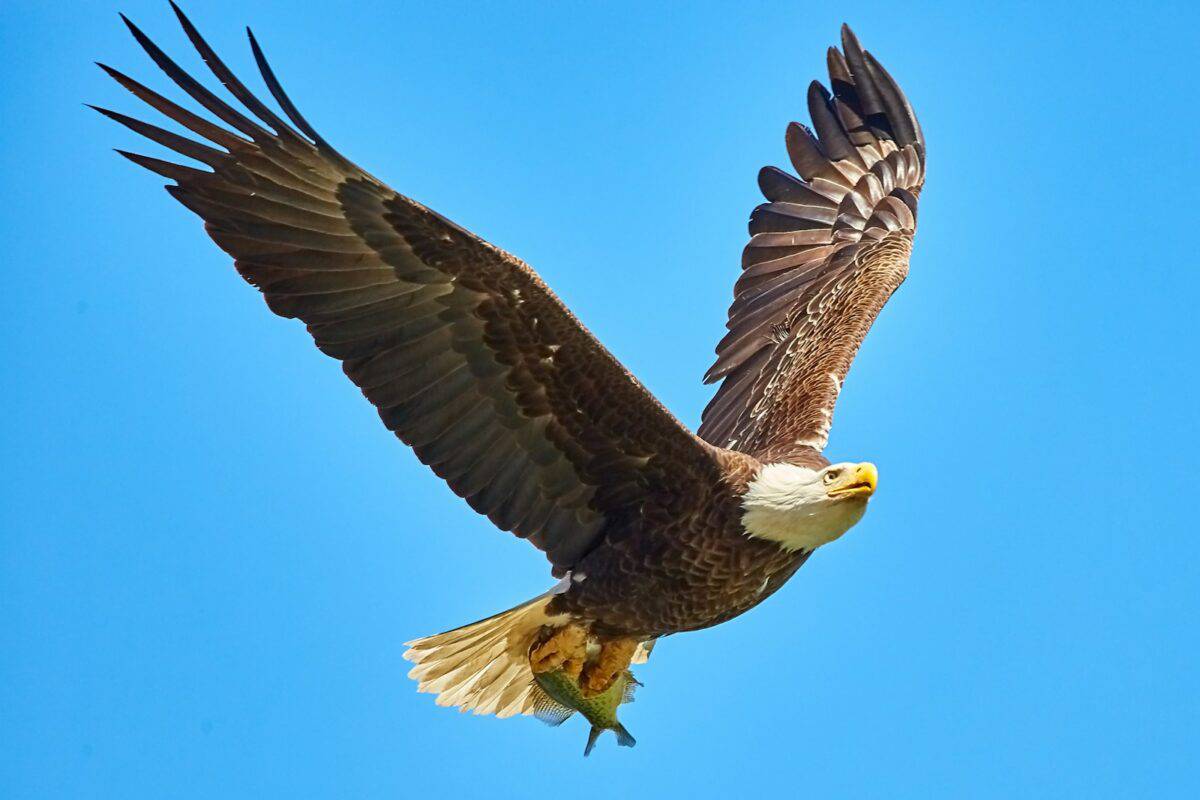
Although fish constitute a significant portion of the bald eagle’s diet—sometimes up to 90% in certain coastal regions—these adaptable predators are far from exclusive fish-eaters. Bald eagles are opportunistic feeders with remarkably flexible diets that vary by season, habitat, and prey availability. Beyond fish, they regularly hunt waterfowl, small mammals like rabbits and muskrats, and even reptiles and amphibians when available. Perhaps surprisingly, bald eagles are also accomplished scavengers, readily feeding on carrion (dead animals) they encounter or stealing meals from other predators like ospreys or smaller eagles—a behavior known as kleptoparasitism. During winter months when water bodies freeze over, eagles rely more heavily on these alternative food sources. In some regions, they’ve been observed feeding extensively on spawning salmon, gathering in large numbers during seasonal runs—one of nature’s most impressive feeding spectacles. This dietary flexibility has been crucial to the bald eagle’s successful recovery and adaptation to various habitats across North America.
Myth 8 Eagles Have Evolved to Naturally Avoid Human Developments

Contrary to the belief that bald eagles inherently avoid human presence, these adaptable birds have demonstrated remarkable flexibility in recent decades. While historically bald eagles were indeed sensitive to human disturbance—especially during nesting—many populations have gradually acclimated to human activity as their numbers have recovered. Eagles now successfully nest in surprising locations, including near highways, in suburban neighborhoods, and even in some urban parks with suitable trees and water access. Research shows that eagles can become habituated to predictable human activities while still maintaining wariness toward novel or direct disturbances. In Florida, Minnesota, the Chesapeake Bay region, and parts of the Pacific Northwest, eagles increasingly coexist with humans, though they typically maintain a buffer zone around their nests. This adaptation isn’t universal—eagles in less developed areas still tend to avoid human infrastructure—but their increasing tolerance for human presence represents an evolutionary and behavioral adaptation rather than an innate aversion. This adaptability has contributed significantly to their population recovery in developed landscapes.
Myth 7 Eagles Build New Nests Each Year

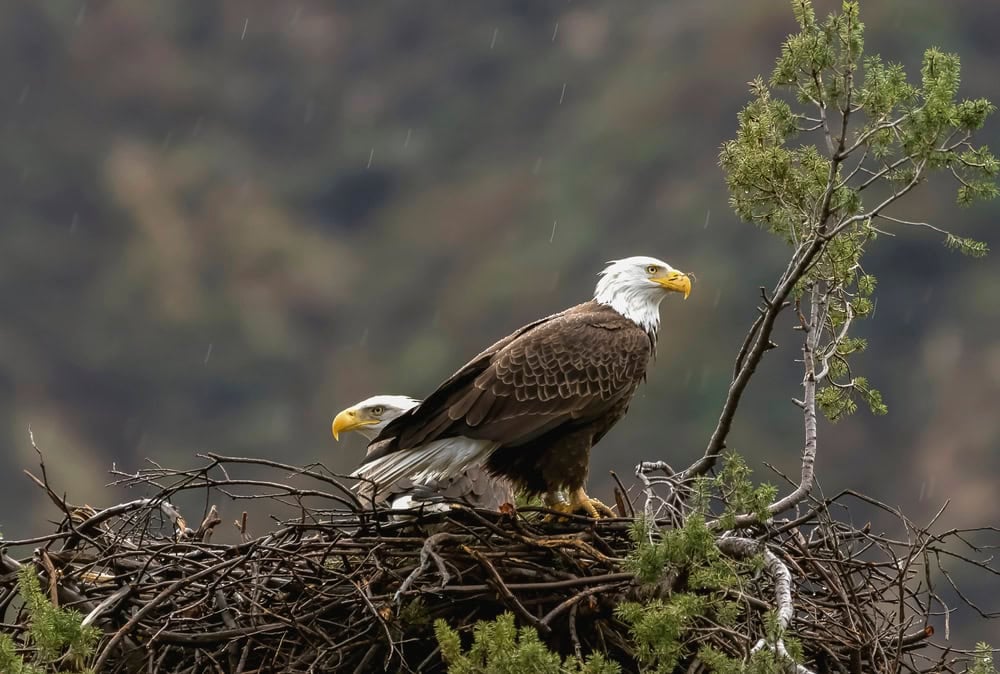
Rather than building new nests annually, bald eagles typically reuse and expand the same nest year after year. These impressive structures, called eyries, are among the largest bird nests in the world. A new eagle nest might start at around 5 feet in diameter and 2-4 feet deep, but as the pair returns each breeding season, they add new materials, gradually creating massive structures. The largest documented bald eagle nest, found in St. Petersburg, Florida, measured 9.5 feet in diameter, 20 feet deep, and weighed over two tons after being used and expanded for nearly 30 years! The primary building materials include large sticks for the exterior framework, with softer materials like moss, grass, feathers, and pine needles lining the interior. This nest-reusing behavior represents a significant energy investment strategy, as constructing these enormous nests requires substantial effort and resources. Established nests also signal territorial ownership to other eagles and may contribute to breeding success through familiarity with the nesting site. Some eagle pairs maintain alternative nests within their territory, occasionally rotating between them.
Myth 6 Bald Eagles Have Survived Unchanged for Millions of Years
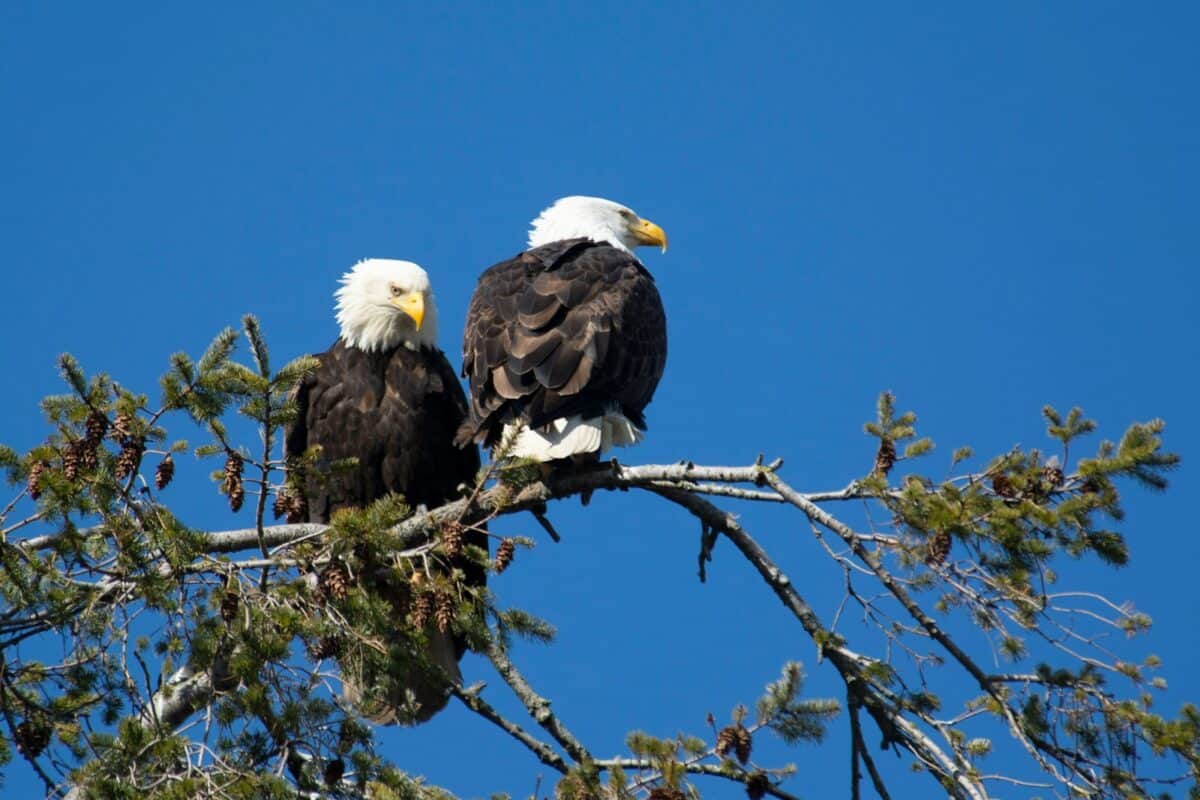
Despite their status as a symbol of enduring strength, bald eagles have not remained unchanged for millions of years as sometimes claimed. Genetic and fossil evidence indicates that the modern bald eagle (Haliaeetus leucocephalus) evolved relatively recently in evolutionary terms, likely diverging from its closest relative, the Eurasian white-tailed eagle (Haliaeetus albicilla), approximately 100,000-250,000 years ago during the Pleistocene epoch. This separation occurred when ancestral sea eagles colonized North America across the Bering land bridge that once connected Asia and North America. The genus Haliaeetus (sea eagles) itself is considerably older, dating back several million years, but the distinctive bald eagle species we recognize today is a much more recent development. Additionally, bald eagles have shown evolutionary adaptations to different North American ecosystems, with two recognized subspecies: the northern bald eagle (H. l. washingtoniensis) and the slightly smaller southern bald eagle (H. l. leucocephalus). Rather than being unchanging living fossils, bald eagles represent an ongoing evolutionary story of adaptation to changing environments and food sources.
Myth 5 Bald Eagles Have Superior Hearing Abilities

While bald eagles possess keen vision that outperforms most animals, their hearing capabilities are actually fairly average among birds. Eagles rely predominantly on their exceptional eyesight rather than auditory cues when hunting or navigating. Their ears, positioned on either side of the head and covered by feathers, lack the specialized structures found in nocturnal hunters like owls, which have asymmetrically positioned ear openings and facial disc feathers that funnel sound. Research indicates that bald eagles can hear within a frequency range similar to humans (approximately 1 to 20 kHz) but without our level of sensitivity to subtle variations in sound. This dispels the myth that eagles can hear prey moving underwater or detect sounds from extraordinary distances. Their hunting strategy is primarily visual: soaring high to spot prey, then diving at speeds reaching 100 mph. During courtship and nesting, eagles do communicate vocally using various calls, suggesting hearing plays an important role in social interactions even if it’s not their primary hunting sense.
Myth 4 All Bald Eagles Migrate South for Winter
The belief that all bald eagles migrate south during winter is a significant oversimplification of their complex movement patterns. Bald eagle migration behavior varies dramatically depending on age, geographic location, and food availability. Eagles in northern regions with frozen water bodies typically do migrate south when ice prevents access to fish, their primary food source. However, eagles living in areas with year-round open water—such as along the coasts, in the Pacific Northwest, or near power plant warm-water discharges—often remain in their territories throughout winter. Additionally, juvenile and subadult eagles generally demonstrate different migration patterns than established breeding pairs. Some populations exhibit partial migration, where some individuals travel while others remain resident. Tracking studies have revealed that individual eagles often follow the same migration routes year after year, with some traveling thousands of miles annually between summer and winter territories. Climate change is now altering these traditional patterns, with more eagles remaining year-round in areas that historically would have been abandoned during winter months as northern waters remain ice-free for longer periods.
Myth 3 Bald Eagles Always Have Perfect White Heads

The image of bald eagles with pristine white heads is so ingrained in popular culture that many people are surprised to learn this appearance isn’t universal or constant. Young bald eagles don’t develop their iconic white head and tail feathers until they reach sexual maturity at approximately 4-5 years of age. During their first years, juveniles display mottled brown plumage with irregular white patches that gradually transitions through several distinct immature plumages. Even among adult eagles, the “white” head feathers can vary considerably in appearance, sometimes appearing cream-colored, slightly mottled, or even stained depending on diet, health, and time since the last molt. Eagles that feed heavily on certain fish species may develop a yellowish or rusty tinge to their head feathers from natural oils and minerals in their prey. During their annual molt, head feathers are replaced gradually rather than all at once, occasionally resulting in a temporarily uneven appearance. Environmental factors like dust, pollen, and even smoke from wildfires can temporarily discolor the white feathers, further dispelling the myth of perpetually perfect white heads.
Myth 2 Bald Eagles Are Fearless and Have No Natural Predators

While adult bald eagles sit near the top of the food chain, they are neither fearless nor entirely free from natural threats as sometimes portrayed. Though rare, predation of adult eagles does occur. Great horned owls have been documented attacking adult eagles, particularly when competing for territory or nesting sites. Eagle eggs and nestlings face more substantial dangers, with raccoons, bears, wolverines, and other eagles posing significant threats. Beyond direct predation, bald eagles regularly engage in risk-avoidance behaviors, demonstrating that they experience fear like other animals. They typically maintain vigilance around larger mammals, including humans, and will abandon feeding sites when they perceive potential danger. Eagles also display distinct alarm calls when threats approach their nests. Interspecies competition represents another challenge, with eagles sometimes being harassed by groups of crows or ravens, particularly during nesting season. Rather than being fearless apex predators that nothing dares approach, bald eagles exist within complex ecological systems where they must remain alert to various threats and competitors—especially when protecting their vulnerable young.
Myth 1 Bald Eagles Can Close Their Talons with Enough Force to Crush Human Bones

A persistent myth suggests that bald eagles possess talon strength capable of crushing human arm bones or exerting thousands of pounds of pressure. Scientific measurements tell a different story. While impressive, a bald eagle’s grip strength typically ranges between 400-1000 pounds per square inch (psi)—significantly less than the 1100-1300 psi required to break human bone. For comparison, the bite force of a large dog like a German Shepherd (around 750 psi) is comparable to an eagle’s grip strength. What makes eagle talons particularly effective isn’t just their strength but their specialized design: each foot features three forward-facing toes and one rear,
Conclusion:

The bald eagle, long enshrined as a symbol of American freedom and power, is even more fascinating when stripped of the myths that have accumulated around it. As this article reveals, the true story of the bald eagle is one of resilience, adaptation, and ecological importance. From their exceptional eyesight to their flexible diet and evolving relationship with human environments, bald eagles are far more complex and remarkable than the legends suggest. Understanding the facts behind the myths not only deepens our appreciation for these majestic birds but also underscores the importance of science and conservation in preserving the natural world. As we continue to coexist with bald eagles, we honor their legacy not by clinging to fiction, but by celebrating their true nature.

As a little kid, I fell in love with nature, wildlife, and animals. Living in the USA, South Africa, Italy, China and Germany gave me the opportunity to discover the world's Wildlife. My favorite animals are Mountain Gorillas, Siberian Tigers, and Great White Sharks.
I'm a certified PADI Open Water Diver, went to Everest Base Camp and Trekked Gorillas in Uganda. I hold a Master of Science in Economics and Finance.
Please send any feedback to feedback@animalsaroundtheglobe.com
- 13 Aquatic Mammals That Don not Look It - July 10, 2026
- 15 Unlikely Hunters With Killer Instincts - July 10, 2026
- 10 Low-Maintenance Pets for Busy Owners - July 10, 2026