


The bald eagle, America’s national bird and a symbol of freedom and power, has captivated our imagination for centuries. While most people recognize these majestic raptors with their distinctive white heads and impressive wingspans, there’s much more to these remarkable birds than meets the eye. From surprising dietary habits to extraordinary physical capabilities, bald eagles harbor fascinating secrets that showcase why they’ve earned their iconic status. This article explores 15 lesser-known facts about bald eagles that highlight their remarkable adaptations, behaviors, and significance in both natural ecosystems and human culture.
Their “Baldness” Is Actually a Misnomer

Despite their name, bald eagles aren’t actually bald. The term “bald” in their name doesn’t refer to a lack of feathers but comes from an old English word “balde,” meaning white. This describes their distinctive white-feathered heads that contrast dramatically with their dark brown bodies and wings. Young bald eagles don’t develop this iconic white head and tail until they reach sexual maturity at around 4-5 years of age. Before that, juvenile eagles have mottled brown and white plumage that can sometimes lead to misidentification as golden eagles. This gradual transformation serves as a visual indicator of their maturity status within eagle communities.
They Build the Largest Nests of Any North American Bird

Bald eagles are record-breaking architects in the avian world. They construct the largest nests of any North American bird, creating structures that can weigh up to 2 tons and measure up to 13 feet deep and 8 feet wide. Even more impressive, bald eagles are committed to their homes, returning to the same nest year after year and continuously adding new materials. One famous nest in St. Petersburg, Florida, was used for over 30 years and grew to nearly 10 feet in diameter and 20 feet deep before the tree collapsed. These enormous nests, called eyries, provide a safe haven for eagle families and represent significant long-term investments in reproduction, with some active nests becoming multi-generational eagle family estates.
Their Grip Strength Is Extraordinary

The bald eagle’s talons are formidable weapons, equipped with a grip strength that would make professional athletes jealous. Their feet can exert pressure of approximately 400 pounds per square inch (psi), which is about ten times stronger than the average human hand grip. This tremendous force allows them to capture and carry prey weighing up to 4 pounds during flight. Each foot has four powerful toes equipped with razor-sharp talons reaching up to two inches in length. The arrangement of the toes—three facing forward and one backward—creates a perfect locking mechanism that enables eagles to grasp prey securely. This remarkable adaptation is essential for their hunting success, allowing them to snatch fish from water and maintain their hold even on slippery prey.
They’re Not Always the Hunters We Think They Are

While bald eagles are apex predators with impressive hunting abilities, they’re also opportunistic feeders who aren’t above scavenging. In fact, Benjamin Franklin famously criticized the choice of the bald eagle as America’s national symbol partly because of their scavenging habits, calling them birds of “bad moral character” for stealing food from other birds. Eagles frequently harass other birds like ospreys until they drop their catch, then swoop in to claim the meal. They’re also regular visitors to landfills and readily feast on carrion (dead animals) found along roadsides or shorelines. During salmon runs, eagles often focus on dead or dying fish rather than expending energy catching live ones. This adaptable feeding strategy helps eagles survive during harsh winters and periods when prey is scarce.
Their Vision Is Superhuman

Bald eagles possess some of the sharpest vision in the animal kingdom, with eyesight estimated to be four to eight times stronger than that of humans. Their eyes are nearly the same size as human eyes but in a much smaller skull, indicating their evolutionary importance. Eagles can spot a rabbit from about two miles away and can identify fish swimming beneath the water’s surface while soaring high above. This remarkable vision comes from a higher concentration of cone cells in their retinas, a deeper fovea (a pit in the retina that allows for sharp central vision), and the ability to see ultraviolet light. Additionally, they have two focal points (foveae) in each eye—one for looking forward and one for looking sideways—allowing them to see both ahead and to the side simultaneously.
They Form Life-Long Pair Bonds
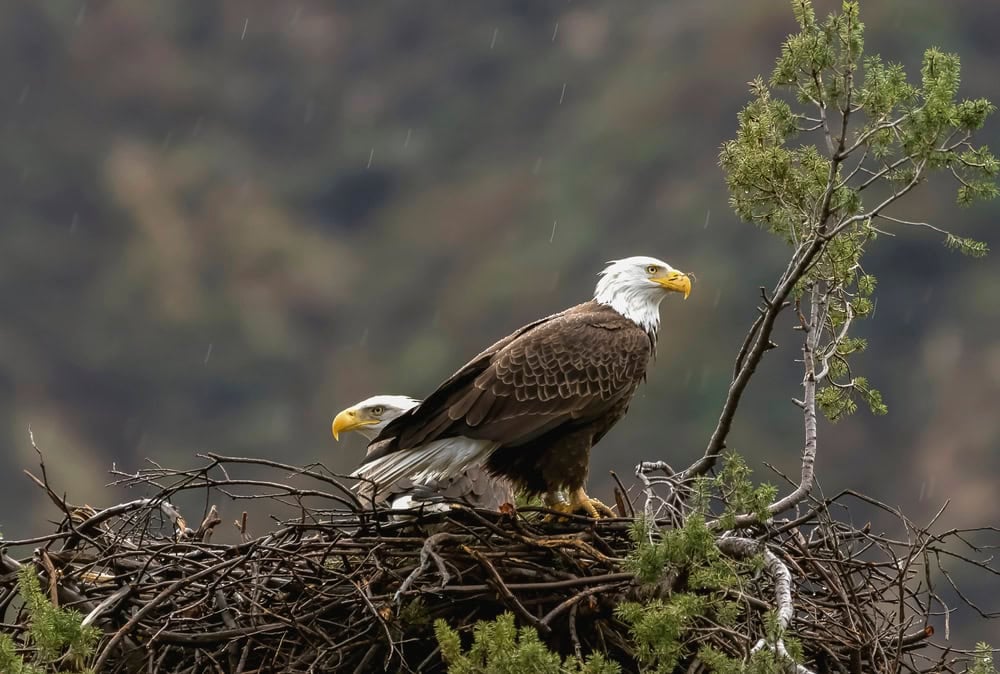
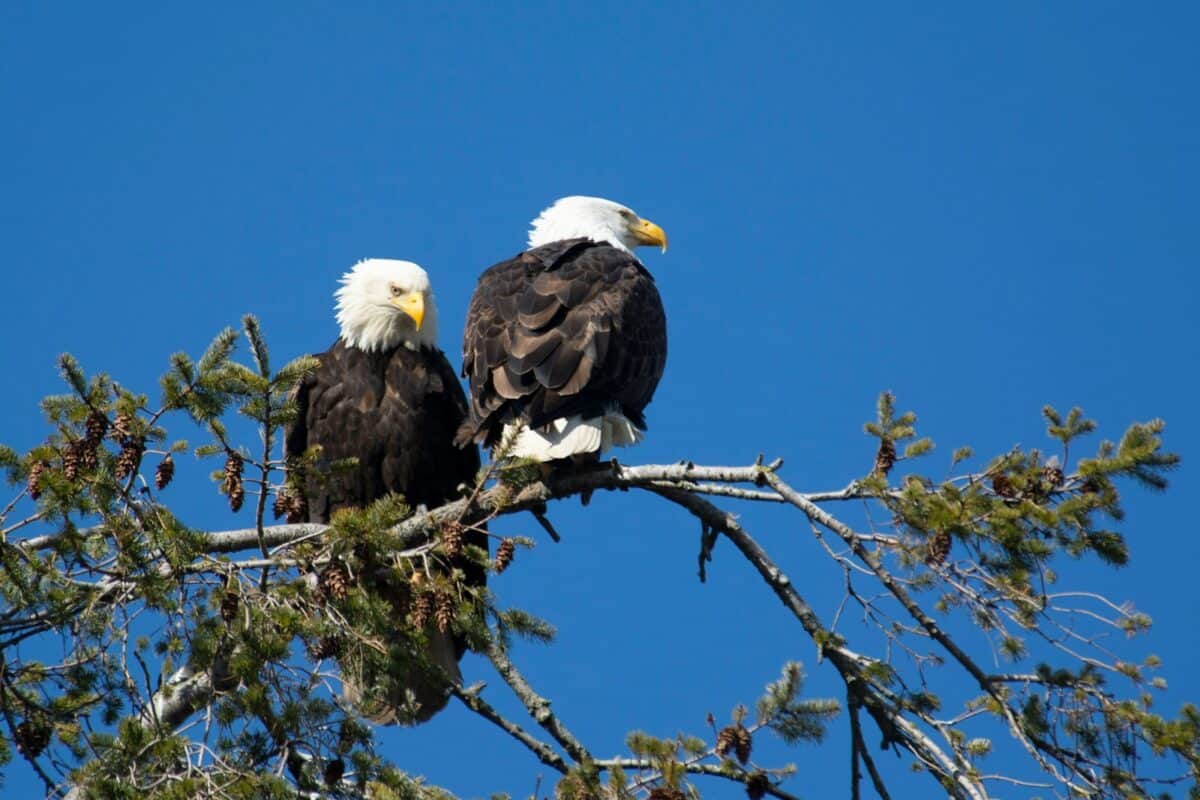
In a world where commitment often seems fleeting, bald eagles stand as a symbol of enduring partnership. These majestic birds typically mate for life, forming bonds that can last 20-30 years until one partner dies. The courtship process involves spectacular aerial displays where eagles lock talons, cartwheel through the sky, and free-fall in a death-defying spiral called a “death spiral” before separating just before hitting the ground. Once paired, eagle couples work together to build nests, incubate eggs, and raise their young. They also defend their territory as a team, with both males and females participating in territorial defense. However, if one partner dies, the surviving eagle will usually seek a new mate rather than living out its days alone, showing that while they value long-term bonds, survival and reproduction remain paramount.
Their Recovery Is a Conservation Success Story

The bald eagle represents one of the most remarkable conservation success stories in American history. In 1963, the population had plummeted to just 417 nesting pairs in the lower 48 states, primarily due to habitat destruction, hunting, and the devastating effects of DDT pesticide, which caused eagle eggshells to thin and break before hatching. After DDT was banned in 1972 and the Endangered Species Act provided crucial protections in 1973, the population began a remarkable recovery. By 2007, bald eagles had recovered sufficiently to be removed from the endangered species list, and today, there are estimated to be more than 316,700 bald eagles in the lower 48 states alone. This dramatic comeback demonstrates how effective conservation measures can reverse even seemingly hopeless situations when science-based policies are implemented and enforced.
They Make Surprisingly Unimpressive Sounds

Despite their magnificent appearance and status as a symbol of power, bald eagles produce vocalizations that many find disappointingly weak. Rather than the powerful, piercing scream often associated with them in films and television (which is actually the call of a red-tailed hawk dubbed over eagle footage), bald eagles typically emit a series of high-pitched whistling or chirping sounds that have been compared to seagulls. Their main call consists of a sequence of 5-8 notes described as “kee-kee-kee-kee-kee-ker,” which they use primarily during breeding season for territorial claims and communication between mates. Young eagles in the nest produce a high-pitched begging call when hungry. The disconnect between their imposing physical presence and their relatively weak-sounding vocalizations has led to Hollywood’s consistent substitution of more impressive sounds when featuring eagles in media.
They Have a “Third Eyelid”

Bald eagles possess a specialized membrane called a nictitating membrane, essentially a transparent “third eyelid” that moves horizontally across the eye from front to back. This adaptation serves multiple crucial functions in an eagle’s daily life. During flight, it protects their eyes from dust, debris, and wind damage while still allowing them to see. When diving into water to catch fish, the membrane acts like built-in goggles, protecting the eye while maintaining visibility underwater. The membrane also helps clean and moisten the eye regularly, similar to blinking in humans. Perhaps most importantly, this protective feature allows eagles to look directly at the sun without damaging their retinas—a vital ability for birds that spend much of their time soaring at great heights where solar glare can be intense.
Their Population Is Sexually Dimorphic

One of the less obvious characteristics of bald eagles is their sexual dimorphism—females are significantly larger than males. Female bald eagles typically weigh between 10-14 pounds with a wingspan reaching up to 8 feet, while males usually weigh between 7-10 pounds with a wingspan of about 6 feet. This size difference, where females are approximately 25% larger than their male counterparts, is common among raptors and is known as reverse sexual dimorphism. Biologists believe this adaptation evolved to divide nesting duties more efficiently—the larger females can provide better protection for the eggs and nestlings, while the smaller, more agile males are more energy-efficient hunters. Despite these physical differences, male and female bald eagles are virtually identical in plumage coloration, making size the most reliable way to distinguish between sexes in the field.
They Are Surprisingly Long-lived Birds
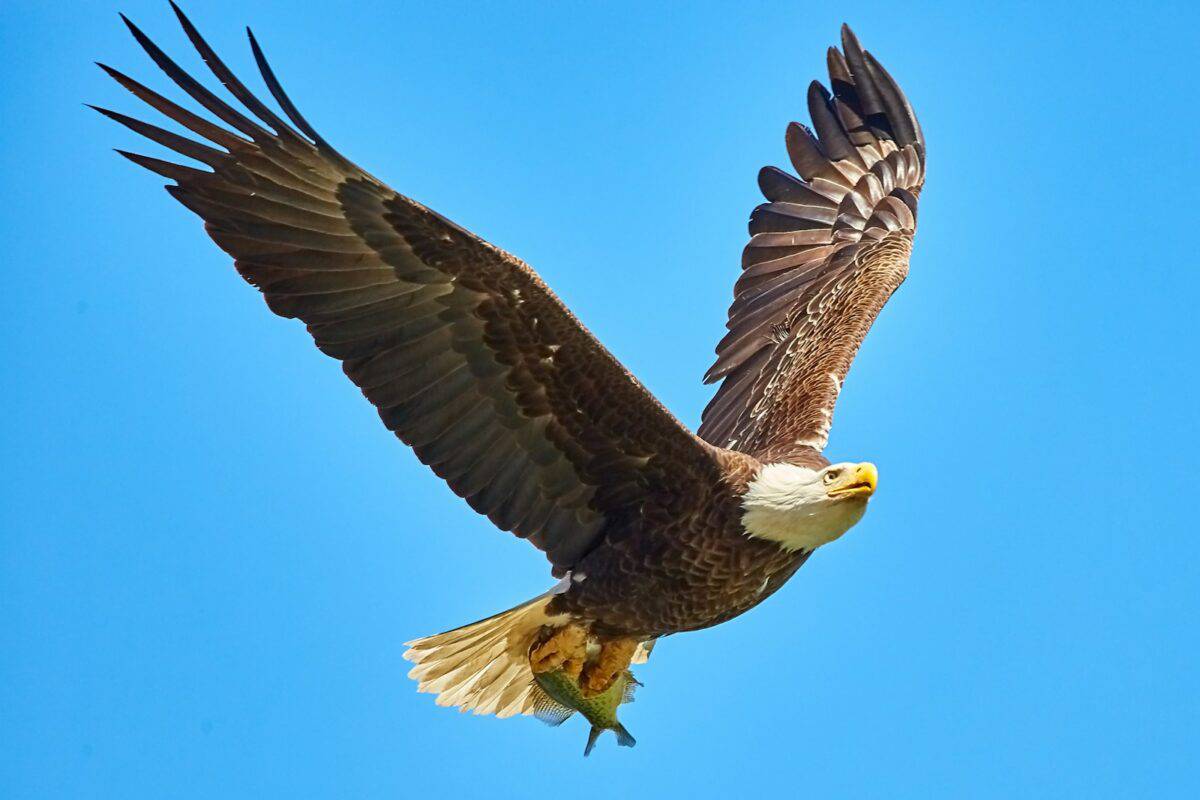
In the wild, bald eagles typically live 20-30 years, making them one of the longer-lived bird species in North America. However, in captivity, where they’re protected from predators, environmental hazards, and food shortages, they can live even longer, with some individuals reaching 50 years of age. The oldest confirmed wild bald eagle was at least 38 years old when it was hit by a car in New York in 2015. It had been banded as a nestling in 1977. This impressive lifespan is particularly remarkable considering the physical demands of their lifestyle, including long migrations, challenging hunting techniques, and the harsh environments many eagles inhabit. Their longevity contributes to their slow reproductive rate and relatively small clutch sizes—typically just 1-3 eggs per year—as they can reproduce over many breeding seasons throughout their extended lifespans.
They’re Excellent Swimmers

While most people associate bald eagles with powerful flight and soaring, few realize these birds are also remarkably adept swimmers. When an eagle catches a fish too heavy to lift from the water, rather than abandoning its meal, it often performs a breast stroke with its wings to row itself to shore, sometimes covering considerable distances. This swimming ability is not taught but appears to be instinctive. Eagles have been documented swimming up to a quarter-mile to reach land with large prey. Young eagles have even been observed swimming before they’ve learned to fly, using their wings as paddles to navigate across water. This little-known skill provides eagles with a survival advantage, allowing them to capture larger prey than they could otherwise carry in flight and escape potential drowning situations.
They Experience “Baldness” Later in Life

Young bald eagles don’t have the iconic white head and tail feathers that make the species so recognizable. For the first four to five years of their lives, juvenile bald eagles have mostly dark brown plumage, often with mottled white patches on their wings and bodies. Their beaks transition from dark gray to yellow as they mature. This dramatic transformation occurs gradually, with the head and tail feathers turning white between the fourth and fifth year as they reach sexual maturity. This delayed development of adult plumage serves several evolutionary purposes—it signals to other eagles that these individuals aren’t yet competitors for breeding territories, and the darker juvenile coloration may provide better camouflage for inexperienced hunters. The gradual plumage changes also help wildlife biologists determine the approximate age of eagles they observe in the field.
They Have a Strange Connection to the Moon
The bald eagle has a unique connection to space exploration and lunar history that few people know about. When Neil Armstrong and Buzz Aldrin landed on the moon during the Apollo 11 mission in 1969, their lunar module was named “Eagle,” and Armstrong’s famous words “The Eagle has landed” referenced the national bird. Additionally, the Apollo 11 mission patch featured a bald eagle carrying an olive branch to the moon, symbolizing America’s peaceful intentions in space exploration. In a less celebrated incident, a bald eagle once attacked a NASA weather balloon during a pre-launch test, causing minor damage that had to be repaired before the mission could proceed. This celestial connection extends the eagle’s symbolic reach beyond Earth’s atmosphere, cementing its status not just as a national emblem but as a symbol of humanity’s exploration of the cosmos.
They Hold Deep Cultural Significance Beyond American Symbolism

While most people associate the bald eagle primarily with American patriotism, these birds hold profound spiritual and cultural significance for many indigenous North American tribes long predating the United States. In many Native American traditions, eagle feathers are considered sacred objects used in religious ceremonies, healing rituals, and as symbols of honor. The Pueblo people associate eagles with the sky spirits and believe they carry prayers to the heavens. For the Navajo, the eagle is one of four sacred birds corresponding to the four cardinal directions. The Kwakiutl people of the Pacific Northwest feature eagles prominently in their elaborate totem poles. This rich cultural heritage led to the establishment of the National Eagle Repository, which collects eagles that die naturally and distributes their feathers exclusively to members of federally recognized tribes for religious purposes, acknowledging the bird’s profound significance beyond its role as a national symbol.
Conclusion
The bald eagle stands as a testament to nature’s ingenuity and resilience, embodying qualities that extend far beyond its role as America’s national symbol. From their remarkable physical adaptations like powerful grip strength and exceptional vision to their complex social behaviors including lifelong bonding and territorial defense, these birds continue to fascinate scientists and nature enthusiasts alike. Their dramatic recovery from the brink of extinction serves as an inspiring reminder that concerted conservation efforts can reverse even seemingly hopeless environmental crises. As we continue to learn more about these magnificent raptors, our appreciation deepens for the bird that Benjamin Franklin may have criticized but that has nonetheless captured the imagination and respect of generations of Americans and wildlife lovers worldwide.

As a little kid, I fell in love with nature, wildlife, and animals. Living in the USA, South Africa, Italy, China and Germany gave me the opportunity to discover the world's Wildlife. My favorite animals are Mountain Gorillas, Siberian Tigers, and Great White Sharks.
I'm a certified PADI Open Water Diver, went to Everest Base Camp and Trekked Gorillas in Uganda. I hold a Master of Science in Economics and Finance.
Please send any feedback to feedback@animalsaroundtheglobe.com
- 26 Popular Pets Vets Secretly Wish You’d Stop Choosing - July 11, 2026
- 13 Animals That Appear the Most in U.S. State Emblems - July 11, 2026
- 10 Weird Komodo Habits That Help Them Survive And 3 That Risk Their Lives - July 11, 2026