
Picture a tiny dragon soaring through the ancient rainforests of Southeast Asia, its colorful wings spread wide against the emerald canopy. While legends speak of fire-breathing beasts, is very much real and arguably more fascinating than any mythical creature. This remarkable lizard has mastered the art of flight without feathers or bird-like wings, instead using an ingenious system that would make any engineer marvel.
Scientifically known as Draco volans, this species belongs to the lizard family Agamidae and possesses the extraordinary ability to glide using wing-like lateral extensions of skin called patagia. Far from being a recent discovery, these creatures have been perfecting their aerial acrobatics for millions of years. Let’s explore the captivating world of these living dragons and uncover the secrets that make them one of nature’s most remarkable reptiles.
They’re Masters of Gliding, Not Flying
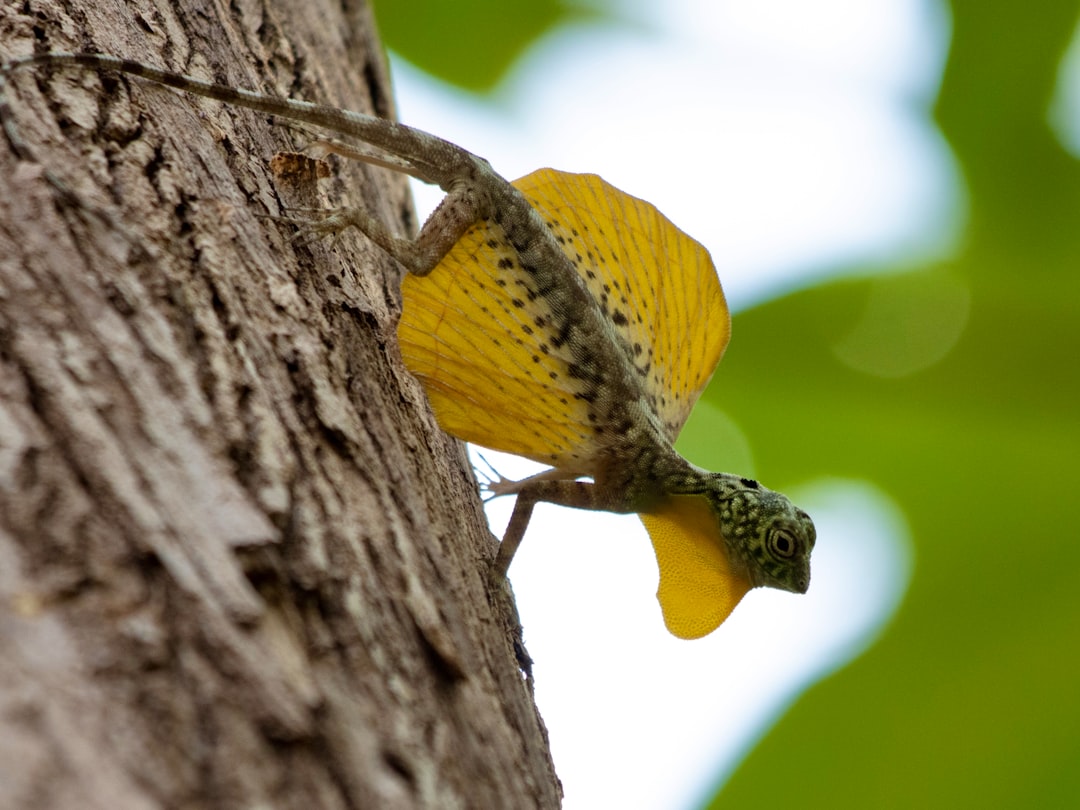
The term “flying dragon” is actually a bit misleading because these lizards don’t truly fly like birds or bats. This species is considered a passive glider, or parachutist, though previous studies have shown that it can also be considered a gliding animal, meaning it doesn’t have to deal with the aerodynamic and metabolic imperatives required for active flight. Think of them more like nature’s hang gliders.
These remarkable reptiles can glide distances of 20 to 60 meters (65 to 200 feet) in a single leap. They can glide at impressive speeds between 5.2 and 7.6 meters per second (about 17 to 25 feet per second). When they prepare to glide, they perform an almost ritualistic sequence, positioning their head downward before launching into their aerial journey.
Their Wings Are Actually Modified Ribs
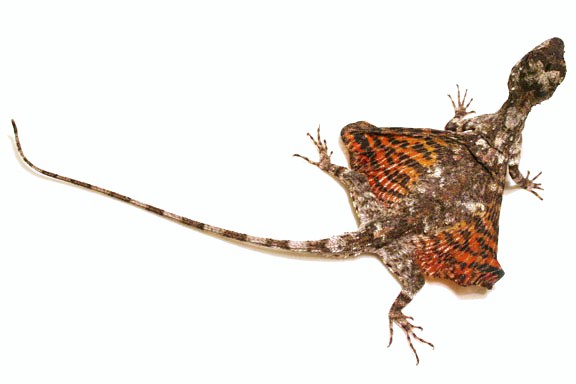
These so-called flying dragons have a set of elongated ribs, which they can extend and retract, forming membranes that may be extended to create wings (patagia), supported by an enlarged set of ribs. It is the only gliding animal whose patagia are supported by its ribs, making them unique among all gliding creatures on Earth.
The engineering behind this natural wing system is truly remarkable. The most distinctive feature of the Flying Dragon is its “wings,” which are extended ribs covered in skin, known as patagia, and these structures can be expanded and retracted, aiding in its gliding ability. When not in use, these wings fold neatly against their body, allowing them to navigate through dense forest branches with ease.
Males Are Living Billboards for Romance
The patagium of the male is tan to bright orange with dark banding, while the female’s patagium has irregular markings rather than banding. These colorful displays aren’t just for show – they’re essential tools for courtship and territorial communication.
The coloration of the patagia and the dewlap play key roles in the courtship of these dragons, with the males stretching out and displaying their patagia and dewlaps to get the attention of females. The dewlap is translucent, and deliberately orientated perpendicular to the orientation of the sun during display to enhance visibility. It’s like having a built-in spotlight for their romantic performances.
They’re Surprisingly Tiny Dragons
Despite their dramatic name, these creatures are remarkably small. The male flying lizard is approximately 195 mm in length while the female is 212 mm, including the length of the long slender tail which is approximately 114 mm on males and 132 mm on females. That’s roughly the size of a pencil, tail included.
Despite their monstrous name, this little reptile measures just eight inches long on average. The weight of the animal is about 0.73 ounces on average, making them lighter than most smartphones. Their diminutive size actually works to their advantage, allowing them to glide more efficiently and navigate through the intricate maze of forest branches.
They Live Almost Exclusively in Trees
These little reptiles rarely leave the trees if they can help it, and in fact, the only time they ever descend to the forest floor is to lay their eggs, which means males climb up the trees when they hatch and never return to the ground again. This arboreal lifestyle is so complete that some males literally never touch the ground after hatching.
Members of Draco are primarily arboreal, inhabiting tropical rainforests, and are almost never found on the forest floor. By being able to glide they are able to avoid going to the ground which enables them to avoid many predators. Living in the canopy is essentially their survival strategy, keeping them away from ground-dwelling threats while providing access to their preferred food sources.
Their Diet Is Surprisingly Specific
Flying dragons survive on a diet of almost exclusively ants and termites, primarily feeding on eusocial insects. Studies have found that the species feeds primarily on ants, though they also consume termites. This specialized diet might seem limiting, but it’s actually perfectly suited to their arboreal lifestyle.
They hunt by waiting near a tree trunk until ants come out and crawl close to its visual field; they grab their prey without moving themselves, as these small ambush predators will typically lay still and wait until prey comes close enough to catch it. Their patience is legendary – they can remain motionless for hours, waiting for the perfect moment to strike.
Mothers Are Surprisingly Devoted
Although Dracos usually avoid going to the ground, females still must descend to deposit eggs, using her pointed snout to create a small hole in the ground where she lays about five eggs and then covers the hole with dirt, remaining on the ground for about 24 hours, fiercely guarding the nest. This behavior is quite unusual among lizards, where parental care is typically minimal.
The female digs a hole in the soil to serve as a nest and lays 2-6 eggs in it, with the well-developed young hatching after approximately 30-32 days, and they are born fully independent and do not require parental care. After this brief but intense period of maternal devotion, the babies are completely on their own, ready to begin their lives in the treetops.
They Have Built-In Weather Sensors
This lizard is active from approximately 8:00 AM to 11:00 AM and then again after 1:00 PM into the afternoon, with a break from normal activity between 11:00 AM and 1:00 PM, which is believed to allow the lizard to avoid the greatest light intensity during the day. They’re essentially solar-powered creatures with an internal clock.
The lizard will never glide when it is raining or windy, and to escape danger, the lizard will always climb rather than glide. This weather awareness is crucial for their survival – gliding in poor conditions could be fatal. Instead, they wait for perfect atmospheric conditions before taking their aerial journeys, showing a level of environmental intelligence that would impress any meteorologist.
These miniature dragons remind us that evolution often creates solutions far more elegant than anything we could imagine. From their rib-supported wings to their weather-sensing abilities, every aspect of their biology tells a story of millions of years of refinement. They are abundant throughout their range and have no special conservation status, currently classified as Least Concern on the IUCN Red List, which means we can continue to marvel at these living legends for generations to come.
What other secrets might these remarkable creatures be hiding in the canopies of Southeast Asia? The more we learn about them, the more they challenge our understanding of what it means to truly master the art of flight.

- Which U.S. Predator Would Be Your Zodiac Sidekick in Real Life? - August 11, 2026
- 10 Incredible Facts About Raccoons That Make Them Backyard Geniuses - August 11, 2026
- 12 Shocking Facts About Dolphins That Will Make You See Them Differently - August 11, 2026