

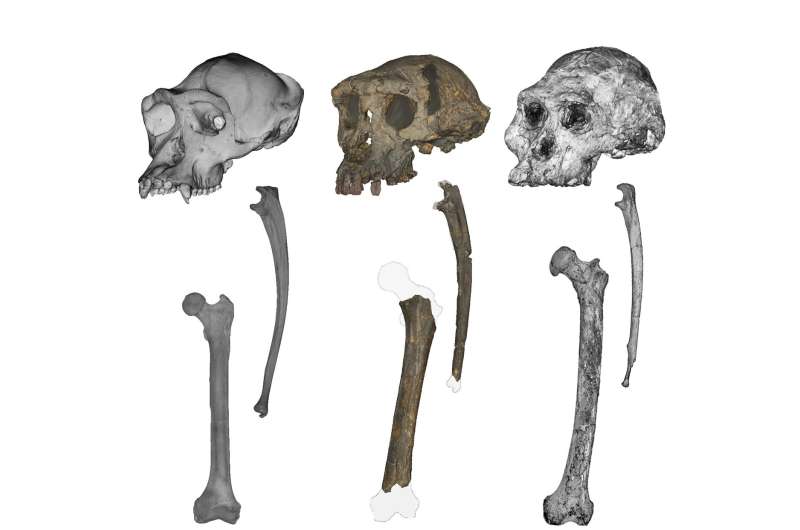
For decades, paleoanthropologists have debated one of the biggest questions in human evolution: when did our ancestors begin walking on two legs? A groundbreaking new study now offers powerful evidence that Sahelanthropus tchadensis, a hominin species that lived roughly 7 million years ago, may have already mastered upright walking, potentially making it the oldest known bipedal ancestor in the human lineage.
This discovery challenges long-held assumptions about the timing and context of bipedalism — one of the defining traits that set hominins apart from other primates — and suggests that the evolutionary shift toward upright locomotion may have occurred far earlier than previously thought. By closely analyzing fossilized limb bones with cutting-edge 3D imaging technology, researchers have revealed anatomical markers that point toward terrestrially adapted movement.
Sahelanthropus: A Fossil at the Root of Humanity
Sahelanthropus tchadensis was first unearthed in Chad’s Djurab Desert in the early 2000s and is dated to approximately 7 million years ago. Prior research highlighted its skull features — including a forward-positioned spinal opening — as hints that it may have walked upright, a trait associated with human ancestors.
However, until now the absence of clear evidence from the rest of the skeleton left scientists uncertain whether this ancient hominin truly stood and walked on two legs or moved more like an ape. The latest findings move the conversation forward by linking limb anatomy directly to locomotor behavior.
New Bone Clues Support Upright Walking
The research team conducted 3D geometric morphometric analyses and comparative studies of Sahelanthropus’s femur (thigh bone) and ulnae (forearm bones) alongside those of both fossil and living primates. They identified several features that align with habitual bipedalism — most notably the presence of a femoral tubercle, a structural point for the powerful iliofemoral ligament, which supports upright posture and gait in later hominins.
Additionally, the femoral antetorsion — a natural twist in the thigh bone — and the development of gluteal muscles indicate adaptations for stable, forward-oriented walking. These traits are much closer to what’s seen in early human ancestors like Australopithecus than in modern apes, whose limb anatomy supports tree-climbing and knuckle-walking.
Walking and Climbing: A Dual Lifestyle
Despite these terrestrial adaptations, researchers emphasize that Sahelanthropus likely still spent a significant portion of life in the trees. Its small brain, along with other apelike features, points to a mixed lifestyle in which upright walking and arboreal activity coexisted — a scenario that reflects a transitional stage in hominin evolution.
This hybrid mode of locomotion underscores that early human ancestors didn’t simply “step out” of the trees and onto two feet in one dramatic leap but rather blended mobility strategies to exploit diverse environments.
Implications for the Timeline of Human Evolution
If Sahelanthropus was indeed habitually bipedal, this pushes the onset of bipedalism back by at least a million years compared with earlier evidence from species like Orrorin tugenensis and Australopithecus afarensis. Such an early date brings the emergence of upright walking remarkably close to the estimated split between the human and chimpanzee lineages.
This revised timeline suggests that walking on two legs was among the earliest defining traits of the human lineage, rather than a later adaptation accompanying larger brains or sophisticated tool use.
Debates and Future Discoveries
Despite the compelling anatomical evidence, not all experts are convinced that Sahelanthropus unequivocally walked upright. Critics point to damage and distortion in the fossil bones and the fragmentary nature of the fossil record, arguing that more complete remains are needed to conclusively place Sahelanthropus within the human lineage.
The debate underscores a broader tension in paleoanthropology: interpreting ancient clues from incomplete evidence. Scientists plan further excavations in Chad’s Djurab Desert in hopes of uncovering additional bones that could confirm or challenge current interpretations.
Rethinking Our Ancestors’ First Steps
The latest evidence for bipedalism in Sahelanthropus tchadensis represents a major step in reconstructing the earliest moments of human evolution. It suggests that upright walking — a hallmark of humanity — emerged far earlier than many textbooks indicate and perhaps as a primary strategy rather than a secondary adaptation.
Yet we should approach this conclusion with cautious excitement. The fossil record is notoriously sparse, and fragmentary data can easily be overinterpreted without additional corroboration. Nonetheless, this study elevates Sahelanthropus from a curious early hominin to a central figure in understanding how our ancestors began to walk into their evolutionary destiny. As new discoveries come to light, they may well refine — or even redefine — the tapestry of human origins.

- Urban Coyotes Show Remarkable Adaptability, Learning to Thrive in City Environments - July 22, 2026
- Beavers Are Nature’s Engineers, Creating Vital Habitats for Other Wildlife Species - July 21, 2026
- The Recovery of the California Condor Offers Hope for Other Critically Endangered Birds - July 21, 2026