

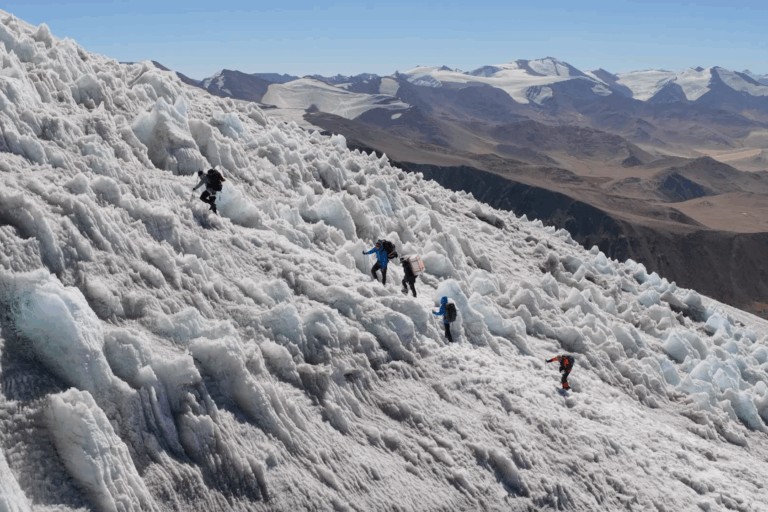

The Dawn of a Frozen Time Capsule (Image Credits: Imgs.mongabay.com)
Antarctica – In a bold effort to combat the irreversible loss of glacial records, researchers unveiled a groundbreaking repository on the frozen continent this week, designed to shield ancient ice samples from the advancing threat of global warming.
The Dawn of a Frozen Time Capsule
Scientists gathered at Concordia Station in the heart of the Antarctic Plateau to mark a historic milestone. On January 14, 2026, the Ice Memory Foundation officially opened the world’s first global archive for mountain ice cores. This initiative, spearheaded by a consortium of European research bodies, promises to store these delicate samples in a natural vault maintained at around -52°C, ensuring their integrity for centuries without relying on artificial power sources.
The ceremony, streamed live to audiences worldwide, highlighted the urgency of the project. As glaciers worldwide retreat at alarming speeds, the foundation has already collected cores from endangered sites, including those from the Alps. The first batch, featuring a slice of the Mont Blanc glacier, now rests in a specially excavated snow cave, protected from the elements that doom similar archives elsewhere.
Unveiling Earth’s Atmospheric Secrets
Ice cores serve as unparalleled windows into the planet’s climatic past. Each layer of ice traps air bubbles, pollutants, and isotopes that chronicle atmospheric conditions stretching back thousands of years. Researchers extract these cylinders from glaciers, revealing patterns of temperature shifts, volcanic eruptions, and human impacts on the environment.
By preserving these cores in Antarctica’s stable cold, the sanctuary allows future generations to analyze data that might otherwise vanish. The process involves careful drilling and transport to avoid contamination or melting during transit. Once secured, the samples become a baseline for modeling future climate scenarios, helping scientists predict sea-level rise and ecosystem changes with greater accuracy.
The Mounting Crisis of Glacier Loss
Global warming has accelerated glacier melt to unprecedented levels, erasing vital historical records in the process. Since 2000, regions have lost between 2% and 39% of their ice, with an average global decline of about 5%. This rapid disappearance not only contributes to rising oceans but also destroys the very archives needed to understand the crisis.
In response, the Ice Memory project, launched in 2015 by institutions like France’s CNRS and Italy’s CNR, has ramped up efforts to rescue at-risk cores. The Antarctic site offers a safeguard unmatched by facilities in warmer climates, where power failures could lead to thawing. Experts emphasize that without such measures, irreplaceable data on pre-industrial atmospheres would be lost forever.
- Alpine glaciers, like those in the European mountains, provide recent records of industrial pollution.
- Arctic and Himalayan cores offer insights into regional monsoons and biodiversity shifts.
- Andean samples track ancient precipitation patterns tied to human migrations.
- Polar ice from Greenland complements Antarctic holdings for hemispheric comparisons.
- Tropical glacier remnants capture unique volcanic ash layers from distant eruptions.
International Cooperation in Action
The repository’s creation underscores a rare unity among nations under the Antarctic Treaty System. Contributors from France, Italy, Switzerland, and beyond have pooled resources to build this non-profit endeavor. The foundation plans to expand the collection, inviting global participation to include cores from every major glaciated region.
Logistical challenges abound, from navigating extreme weather to ensuring ethical transport protocols. Yet the payoff is immense: a centralized hub that democratizes access to climate data for researchers worldwide. As one initiative, it aligns with broader calls for preserving natural heritage amid environmental upheaval. For more details on the project, see the AP News report.
Key Takeaways
- The sanctuary at Concordia Station stores ice cores at -52°C naturally, eliminating energy risks.
- It preserves atmospheric histories from melting glaciers, aiding long-term climate predictions.
- Global collaboration ensures diverse samples, from Alps to Andes, for comprehensive research.
This Antarctic vault stands as a testament to human foresight in the face of climate peril, securing Earth’s frozen memories for those who will inherit a warmer world. What steps do you believe are essential to protect our planet’s natural archives? Share your thoughts in the comments below.

As a little kid, I fell in love with nature, wildlife, and animals. Living in the USA, South Africa, Italy, China and Germany gave me the opportunity to discover the world's Wildlife. My favorite animals are Mountain Gorillas, Siberian Tigers, and Great White Sharks.
I'm a certified PADI Open Water Diver, went to Everest Base Camp and Trekked Gorillas in Uganda. I hold a Master of Science in Economics and Finance.
Please send any feedback to feedback@animalsaroundtheglobe.com
- 11 Most Endangered Insects Buzzing in America Today - July 22, 2026
- 10 Most Frequently Googled Animal Birth Facts - July 22, 2026
- 10 Incredible Migration Journeys in the Animal Kingdom - July 22, 2026