

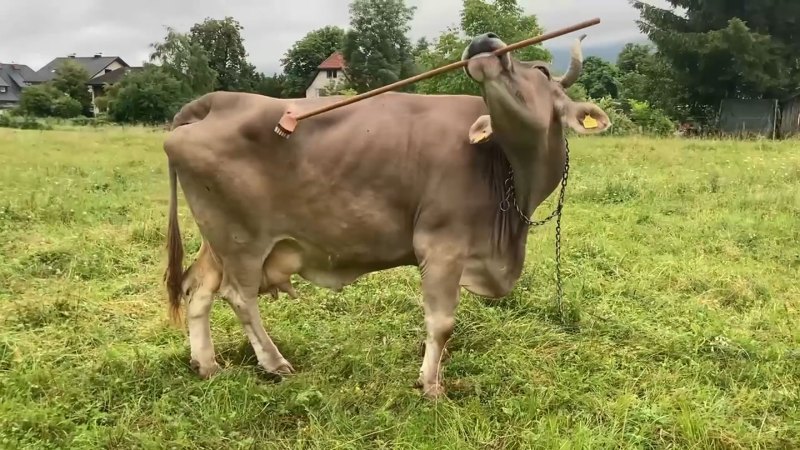
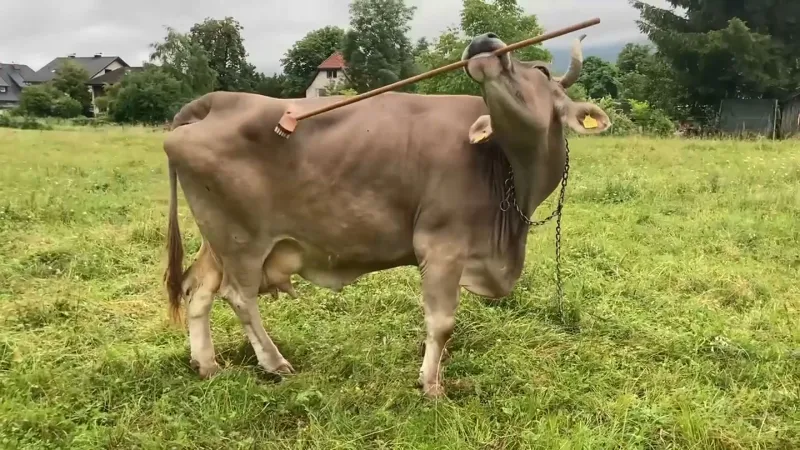
Veronika’s Remarkable Behaviors (Image Credits: Sciencenews.org)
Austria – A 13-year-old pet cow in the Alpine village of Nötsch im Gailtal has demonstrated behaviors that scientists now describe as the first confirmed instance of flexible tool use among bovines.
Veronika’s Remarkable Behaviors
Researchers observed Veronika, a Brown Swiss cow, employing a broom to scratch hard-to-reach spots on her back. This action required her to position the tool precisely and adjust it as needed, showcasing adaptability rarely associated with cattle. The cow’s owner had long noticed her curiosity, but systematic study confirmed the deliberate nature of these interactions. Unlike instinctual actions, Veronika’s approach involved planning and modification, traits previously documented only in primates like humans and chimpanzees.
Video footage captured multiple instances where Veronika maneuvered the broom handle between her horns or used her mouth to guide it. This flexibility extended beyond self-grooming; she also interacted with other objects in her environment in purposeful ways. Such observations prompted experts to revisit assumptions about cognitive limits in domesticated animals. The findings emerged from a controlled setup in her home pasture, ensuring the behaviors occurred naturally without human prompting.
Redefining Intelligence in Cows
Cattle have long been viewed as reactive creatures driven by basic instincts, but Veronika’s actions suggest deeper cognitive processing. Scientists argue this case indicates untapped problem-solving abilities in bovines, potentially linked to enriched living conditions. Unlike factory-farmed livestock, Veronika enjoys a free-roaming life, which may foster such skills. This discovery aligns with growing evidence that environmental factors influence animal intelligence, much like in wild species.
Previous studies hinted at cow social awareness and memory, yet tool use marks a significant leap. Experts from institutions studying animal behavior now call for broader research into livestock cognition. Veronika’s story highlights how pet or small-scale farming might reveal hidden potentials suppressed in intensive agriculture. These insights could influence welfare standards, emphasizing the need for stimulating environments.
Links to Wildlife Conservation Efforts
Understanding bovine intelligence extends beyond farms to wildlife conservation, where similar cognitive assessments aid species protection. For instance, recognizing problem-solving in related herbivores informs strategies for endangered bovids like the saola or wild yak. Veronika’s case underscores that intelligence varies with opportunity, a principle applied to conserving free-ranging animals in natural habitats. Conservationists use such knowledge to design enclosures that promote natural behaviors, enhancing survival rates.
In regions where livestock and wildlife coexist, like Austria’s Alps, these findings promote integrated management. By appreciating cow smarts, experts better predict interactions between domestic herds and wild populations, reducing conflicts. Programs now incorporate cognitive enrichment for captive animals, drawing parallels to Veronika’s experiences. This approach strengthens efforts to preserve biodiversity while supporting sustainable farming.
Key Behaviors Observed
To illustrate Veronika’s ingenuity, researchers cataloged her interactions systematically. The following list outlines the primary documented actions:
- Grasping a broom handle with her mouth to reach dorsal itches.
- Adjusting tool position mid-use for better leverage.
- Selecting specific objects from her surroundings over others.
- Demonstrating repeated success across multiple sessions.
- Extending tool use to non-grooming tasks, like nudging barriers.
These behaviors, observed over several months, met criteria for intentional tool employment. No prior bovine studies reported comparable flexibility, making this a benchmark for future analyses.
Key Takeaways
- Veronika’s tool use represents the first flexible example in cows, challenging stereotypes.
- Enriched environments likely boost cognitive development in livestock.
- Insights inform conservation by highlighting intelligence’s role in animal welfare.
This breakthrough with Veronika invites a fresh look at the minds behind the bovine gaze, urging better treatment across farms and wild spaces. As research expands, it promises to bridge gaps between domestic and wild animal care. What are your thoughts on animal intelligence? Share in the comments below.

- Urban Coyotes Show Remarkable Adaptability, Learning to Thrive in City Environments - July 22, 2026
- Beavers Are Nature’s Engineers, Creating Vital Habitats for Other Wildlife Species - July 21, 2026
- The Recovery of the California Condor Offers Hope for Other Critically Endangered Birds - July 21, 2026