

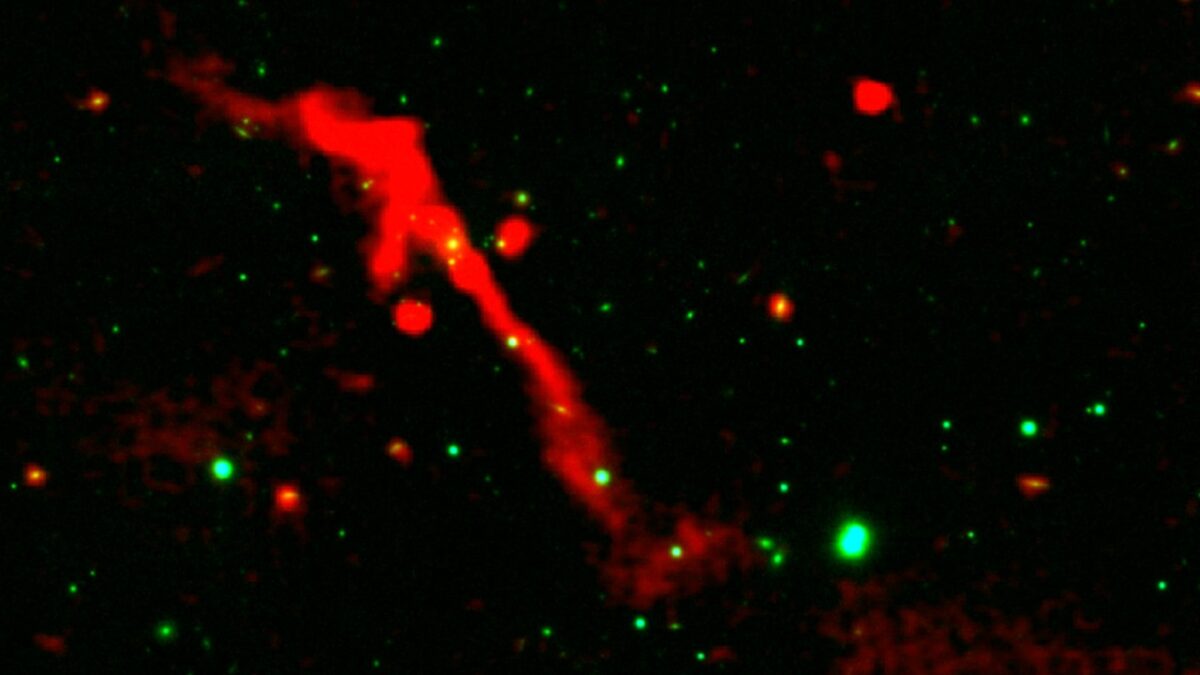
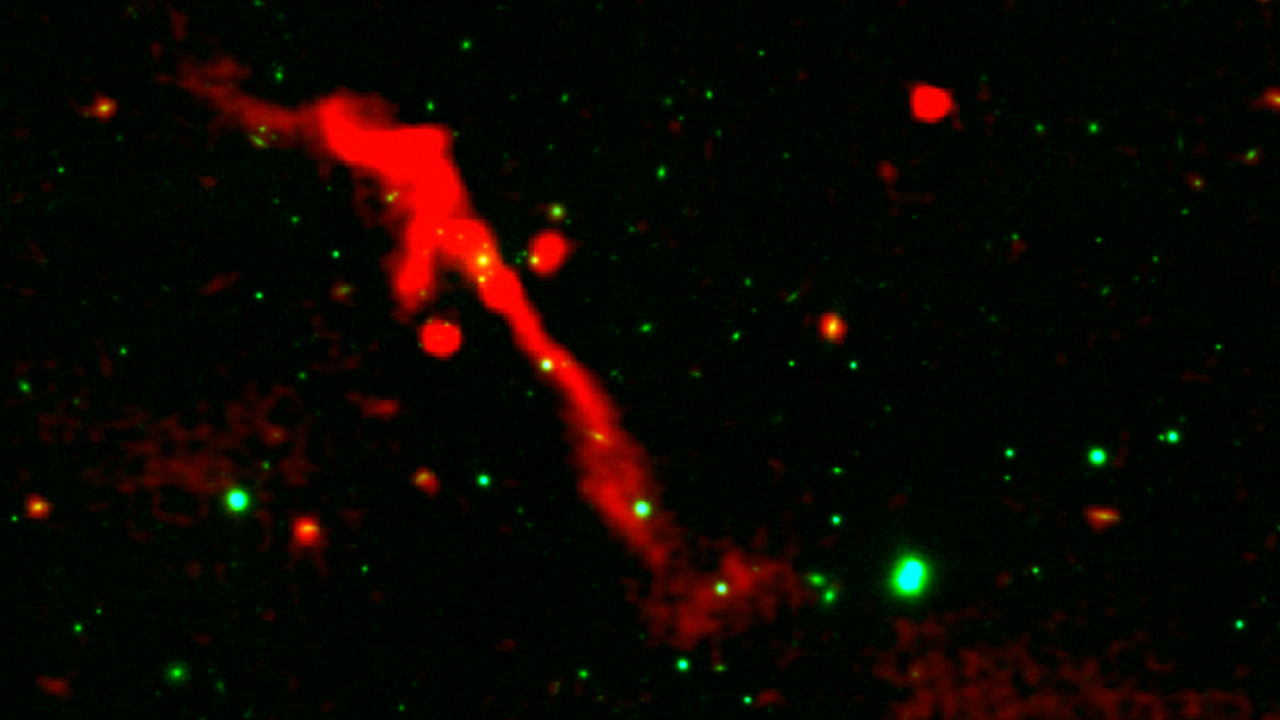
A Dormant Giant Awakens (Image Credits: Cdn.mos.cms.futurecdn.net)
Astronomers have unveiled a stunning revival of a supermassive black hole that lay dormant for nearly 100 million years before unleashing powerful jets across vast expanses of space.
A Dormant Giant Awakens
The supermassive black hole at the center of galaxy J1007+3540 had been quiet for an extraordinarily long period, but recent observations revealed its sudden resurgence. Scientists detected fresh radio emissions indicating that the black hole reignited its activity, spewing out high-energy plasma in twin jets. This event marked a rare glimpse into the intermittent nature of these cosmic powerhouses. The jets carved through surrounding space, interacting dramatically with the galaxy cluster’s dense environment.
Lead researcher Shobha Kumari of Midnapore City College in India described the phenomenon vividly. “It’s like watching a cosmic volcano erupt again after ages of calm – except this one is big enough to carve out structures stretching nearly a million light-years across space,” she said. The outburst created a chaotic interplay of gas, dust, and energy, spanning up to 1.5 million light-years in some measurements. This revival highlighted how black holes can pause and restart their feeding cycles unpredictably.
The Scale and Drama of the Eruption
The eruption’s reach extended far beyond the host galaxy, influencing intergalactic space on a massive scale. Radio images showed bright inner jets piercing an older cocoon of faded plasma from previous outbursts, creating a layered structure of ancient and new emissions. This “cosmic volcano” analogy captured the explosive release of material heated to millions of degrees. The black hole’s jets traveled at speeds close to that of light, pushing against the crushing pressure of the surrounding cluster.
Such episodic activity sets this system apart from continuously active black holes. Astronomers noted the messy struggle between the newborn jets and the cluster’s gravitational forces. The overall structure formed a gigantic radio galaxy, one of the largest observed. This event provided evidence of how black holes regulate galaxy growth through periodic bursts rather than steady output.
Advanced Tools Capture the Spectacle
Researchers relied on cutting-edge radio telescopes to map this distant drama. The Low Frequency Array (LOFAR) in the Netherlands and India’s upgraded Giant Metrewave Radio Telescope (uGMRT) delivered high-resolution images of the emissions. These instruments detected faint radio waves from the black hole’s jets, revealing details invisible to optical telescopes. The data compilation took meticulous effort, combining observations from both facilities to paint a complete picture.
The findings appeared in the journal Monthly Notices of the Royal Astronomical Society. For more details, see the Royal Astronomical Society announcement. This collaboration underscored the importance of international networks in probing deep space phenomena.
Unveiling Black Hole Life Cycles
This discovery offered fresh insights into the behavior of supermassive black holes, which power some of the universe’s most energetic processes. Unlike steady emitters, J1007+3540 demonstrated a “reborn” phase after prolonged inactivity, suggesting cycles driven by gas inflows. Such events can heat interstellar medium, suppressing star formation in host galaxies. The observation aligned with theories of episodic accretion, where black holes feast intermittently on surrounding material.
Astronomers identified key factors in this system’s evolution:
- The black hole’s mass, estimated in the billions of solar masses, enabled such powerful jets.
- The galaxy cluster’s density compressed the emissions, enhancing their visibility.
- Previous eruptions left a relic plasma shell, now disrupted by the new activity.
- The 100-million-year dormancy likely resulted from depleted fuel sources.
- Future bursts could reshape the cluster’s dynamics over cosmic timescales.
Key Takeaways
- This eruption spans nearly a million light-years, dwarfing the Milky Way’s diameter.
- It reveals black holes’ role in galaxy evolution through intermittent outbursts.
- Advanced radio telescopes like LOFAR and uGMRT were crucial for detection.
As telescopes grow more sensitive, events like this reborn black hole’s eruption remind us of the universe’s dynamic undercurrents, where silence often precedes spectacular renewal. What aspects of cosmic phenomena intrigue you most? Share your thoughts in the comments.

- Urban Coyotes Show Remarkable Adaptability, Learning to Thrive in City Environments - July 22, 2026
- Beavers Are Nature’s Engineers, Creating Vital Habitats for Other Wildlife Species - July 21, 2026
- The Recovery of the California Condor Offers Hope for Other Critically Endangered Birds - July 21, 2026