

Unprecedented Wobble Sparks Exomoon Hunt (Image Credits: Cdn.mos.cms.futurecdn.net)
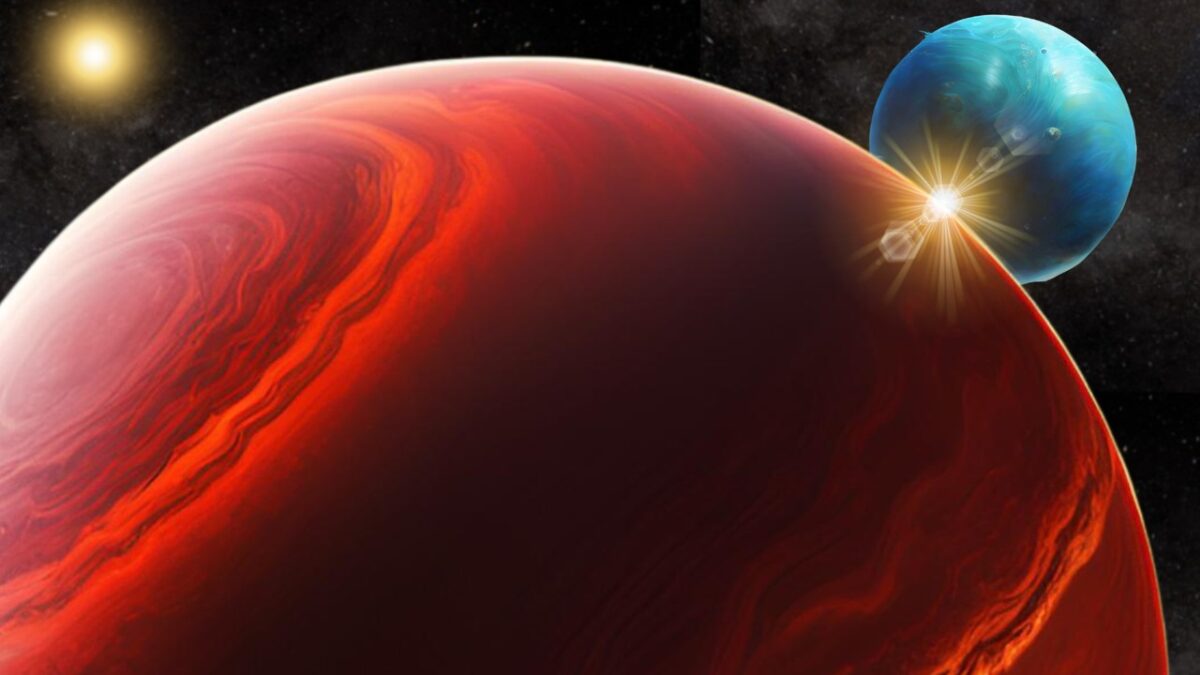
Astronomers recently observed an exoplanet exhibiting unusual wobbling motion, raising the possibility of an orbiting exomoon so large it challenges conventional definitions of moons.
Unprecedented Wobble Sparks Exomoon Hunt
The detection began with precise measurements of the exoplanet’s path around its star. Researchers noted deviations in its timing and position that standard models could not explain. This irregularity pointed to gravitational influences from a substantial companion.
Such wobbles occur when a massive satellite tugs on the planet, altering its trajectory. In this case, the effect suggested an exomoon far larger than any known in our solar system. Teams analyzed data from space telescopes to confirm the anomaly persisted across multiple observations.
Why Size Matters in the Exomoon Debate
Traditional moons, like Earth’s or Jupiter’s largest, pale in comparison to planets. Yet this candidate exomoon’s estimated mass approaches that of smaller planets, blurring the line between satellite and world. Astronomers debate whether objects of this scale qualify as moons at all.
The discovery prompts questions about formation processes. Exomoons likely form from circumplanetary disks, similar to how planets emerge around stars. A body this massive would require unique conditions, perhaps capturing a rogue planet or coalescing from abundant material.
Detection Methods Fueling the Excitement
Spotting exomoons remains challenging due to their faint signals amid brighter hosts. Transit timing variations, where the planet’s shadow shifts unexpectedly, provided the key clue here.
Other techniques complement these findings:
- Radial velocity measurements track star wobbles induced by the planet-moon system.
- Direct imaging seeks thermal emissions from the moon’s surface.
- Atmospheric spectroscopy hunts for moon-specific chemical signatures during transits.
- Mutual event timing observes eclipses between planet and moon.
- Long-baseline stellar occultations reveal shadow perturbations.
Combining these approaches strengthens the case for the hidden companion.
Broader Implications for Cosmic Understanding
If confirmed, this exomoon could reshape theories on planetary system stability. Massive satellites might stabilize planetary climates or drive geological activity through tidal forces. Habitability models would need revision, as such moons could harbor their own atmospheres.
The find also highlights gaps in current surveys. Most exoplanet hunts focus on planets; moons often escape notice. Future missions aim to target systems with wobbling signatures systematically.
Key Takeaways
- A wobbling exoplanet suggests a companion moon of extraordinary mass.
- This could force a rethink of what constitutes a “moon” versus a planet.
- Advanced detection methods pave the way for more such discoveries.
This potential breakthrough underscores the universe’s complexity, where even distant worlds hold surprises that redefine our knowledge. As observations continue, confirmation could open new chapters in exoplanetary science. What do you think about this massive exomoon candidate? Tell us in the comments.

As a little kid, I fell in love with nature, wildlife, and animals. Living in the USA, South Africa, Italy, China and Germany gave me the opportunity to discover the world's Wildlife. My favorite animals are Mountain Gorillas, Siberian Tigers, and Great White Sharks.
I'm a certified PADI Open Water Diver, went to Everest Base Camp and Trekked Gorillas in Uganda. I hold a Master of Science in Economics and Finance.
Please send any feedback to feedback@animalsaroundtheglobe.com
- The Lizard That Can Run on Water – Nature’s Real-Life Jesus Lizard - July 29, 2026
- Why Some Fish Can Live in Both Freshwater and Saltwater - July 29, 2026
- 8 Things Komodo Dragons Hunt — And 3 They Avoid - July 29, 2026