

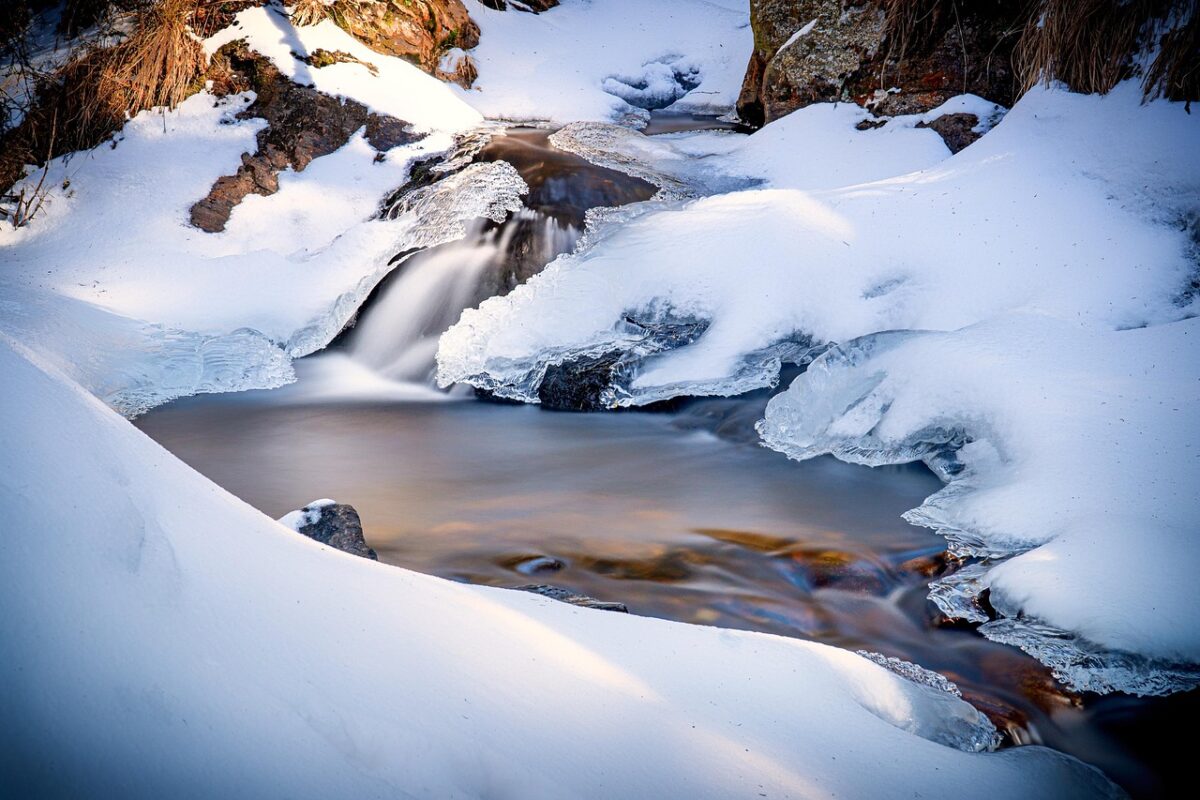
Orbital Cycles Drive Predictable Ice Ages (Image Credits: Pixabay)
Recent studies reveal that humanity’s release of greenhouse gases has significantly altered the planet’s long-term climate trajectory, potentially averting the next glacial period for millennia.
Orbital Cycles Drive Predictable Ice Ages
Earth’s climate has swung between intense cold spells and milder intervals for over a million years, driven by subtle shifts in the planet’s orbit around the sun.[1][2]
Researchers identified clear patterns linking the growth and retreat of Northern Hemisphere ice sheets to three key orbital parameters: the shape of Earth’s orbit, known as eccentricity; the wobble of its rotational axis, called precession; and variations in axial tilt, or obliquity.[1]
These Milankovitch cycles dictate the amount of summer sunlight reaching high northern latitudes, where ice buildup tips the balance toward glaciation.
- Eccentricity changes every 100,000 to 400,000 years, amplifying other effects.
- Precession occurs over about 21,000 years, influencing seasonal contrasts.
- Obliquity varies every 41,000 years, directly affecting polar insolation.
The analysis confirmed that each of the past 900,000 years’ glaciations followed this reproducible rhythm, ending the notion of chaotic natural variability.[1]
Natural Timeline Points to Imminent Cooling
Without interference, the current interglacial epoch – the Holocene, which began 11,700 years ago – neared its midpoint. Scientists projected the onset of the next glacial advance in roughly 10,000 years, based on the alignment of orbital forcings.[1][2]
“We found a predictable pattern over the past million years for the timing of when Earth’s climate changes between glacial ‘ice ages’ and mild warm periods like today,” stated Lorraine Lisiecki of the University of California, Santa Barbara.[1] Past transitions showed ice sheets expanding gradually from polar regions, lowering sea levels by hundreds of feet and cooling global temperatures by several degrees Celsius.
Human ancestors endured the last major glaciation through adaptation, but modern society occupies vulnerable latitudes.
Greenhouse Gases Rewrite the Script
Industrial emissions since the 1800s – over 1.5 trillion tons of carbon dioxide – have elevated atmospheric levels far beyond natural interglacial peaks. This surplus warmth disrupts the feedback loops that amplify cooling, delaying ice sheet formation by 50,000 years or more under moderate scenarios.[3][4]
NASA scientists emphasized that even potential solar minima pale against this forcing, with emissions six times stronger than any offsetting chill.[5] Doubled emissions could push glaciation beyond 100,000 years, while maximum output might extend warmth up to 200,000 years before inevitability sets in.
Geoengineering Emerges as a Future Tool
Advanced civilizations may deploy geoengineering to fine-tune climate on short timescales, countering any residual cooling triggers. Techniques like solar radiation management or carbon removal could sustain habitability as orbital cycles demand.
Experts noted that polar ice advances slowly – over centuries – offering adaptation windows, unlike abrupt weather events.[3] Gregor Knorr of the Alfred Wegener Institute warned that human-induced changes already divert the climate from its natural path, with enduring consequences.[2]
Key Takeaways
- Orbital cycles predictably paced ice ages over the past million years.
- Next glaciation loomed in 10,000 years naturally.
- Emissions delay it by 50,000–200,000 years, possibly averting it entirely.
Humanity stands at a crossroads where past emissions bought time against frozen futures, yet underscore the need for deliberate climate stewardship. What role should geoengineering play in shaping tomorrow’s world? Share your thoughts in the comments.

- Urban Coyotes Show Remarkable Adaptability, Learning to Thrive in City Environments - July 22, 2026
- Beavers Are Nature’s Engineers, Creating Vital Habitats for Other Wildlife Species - July 21, 2026
- The Recovery of the California Condor Offers Hope for Other Critically Endangered Birds - July 21, 2026