

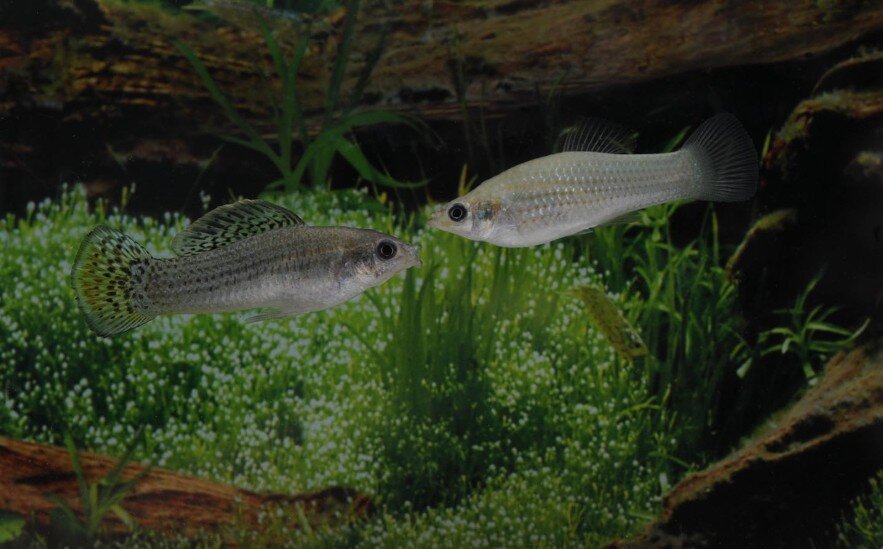
Poecilia formosa Survives by Copying Itself (Image Credits: Dr. Manfred Schartl)
In evolutionary biology, sexual reproduction is widely viewed as the engine that keeps species alive across generations. By mixing genes from two parents, populations maintain genetic diversity and purge harmful mutations. Yet in rare corners of nature, some organisms appear to defy these rules. One of the most intriguing examples is the all-female fish species known as the Amazon molly (Poecilia formosa), a tiny freshwater fish that reproduces clonally.
Scientists long believed such clonal species were evolutionary dead ends. Without genetic mixing, harmful mutations should accumulate over time—a process described by the principle known as Muller’s ratchet. But a new genomic study suggests the Amazon molly has found a way around this biological trap, surviving and thriving for more than 100,000 years despite reproducing almost entirely through cloning.
A Fish That Shouldn’t Exist
The Amazon molly is unusual because every individual in the species is female. Instead of producing offspring through standard sexual reproduction, these fish create genetic copies of themselves, giving birth to live young that are essentially clones of the mother.
This reproductive strategy resembles forms of vertebrate asexual reproduction such as gynogenesis or parthenogenesis, where eggs develop with minimal genetic input from males. Among vertebrates, such systems are extremely rare and often unstable over evolutionary timescales.
Because of this limitation, evolutionary theory predicted that species like the Amazon molly should accumulate harmful mutations and gradually decline. Yet the species has persisted for tens of thousands of years—long enough to challenge long-standing assumptions about how genomes survive in clonal organisms.
The Evolutionary Problem: Muller’s Ratchet
The main threat facing clonal species is the steady buildup of harmful mutations. Without the reshuffling of genes that occurs during sexual reproduction, natural selection has fewer opportunities to eliminate damaging genetic changes.
This process, known as Muller’s ratchet, predicts that genomes in purely clonal populations should gradually deteriorate. Over generations, the accumulation of these mutations should reduce survival and reproductive success until extinction becomes inevitable.
For decades, scientists assumed the Amazon molly was simply delaying the inevitable. But the species’ continued survival—and apparent ecological success—suggested something more complex was happening within its genome.
A Genomic Investigation Into an Evolutionary Mystery
To solve this puzzle, researchers conducted detailed genomic mapping of the Amazon molly. By comparing its DNA with that of related sexually reproducing species, they reconstructed how the fish’s genome has changed across evolutionary time.
The findings revealed something surprising: despite reproducing clonally, the species accumulates mutations faster than some of its sexual relatives, yet it does not show the expected signs of functional genetic decay.
This discovery indicated that some internal mechanism must be repairing or filtering out damaging mutations. Without such a mechanism, the genome would have deteriorated long ago.
Gene Conversion: Nature’s Genetic Repair Tool
The key to the Amazon molly’s survival appears to be a process called gene conversion. This mechanism allows one DNA sequence to overwrite another similar sequence, effectively correcting mutations within the genome.
In the Amazon molly, gene conversion appears to act as a genetic maintenance system. Harmful mutations can be replaced with healthier versions of the same gene, slowing the destructive cycle predicted by Muller’s ratchet.
By enabling both positive and negative natural selection to operate within a clonal genome, this process helps maintain functional genes while eliminating defective ones. In effect, the fish has evolved a way to mimic some benefits of sexual reproduction without actually reproducing sexually.
Why This Fish Still Needs Males
Despite being an all-female species, Amazon mollies still interact with males from closely related fish species during reproduction. Their eggs require activation by sperm from those species, although the sperm’s genetic material is typically not incorporated into the offspring.
This process allows the eggs to develop while maintaining the clonal genome of the mother. As a result, each generation remains genetically almost identical to the previous one.
The strategy may appear parasitic from an evolutionary standpoint, but it allows the species to maintain reproduction while preserving its unique genetic lineage.
Rethinking the Evolutionary Limits of Clonal Species
The discovery that gene conversion can counteract mutation buildup reshapes how scientists think about clonal organisms. For decades, asexual vertebrates were seen as evolutionary anomalies that would inevitably disappear.
The Amazon molly suggests otherwise. With the right genetic safeguards, clonal lineages may survive far longer than expected—potentially reshaping evolutionary theory about how species persist without sexual reproduction.
The findings also raise broader questions about genome maintenance, mutation repair, and the evolutionary advantages of different reproductive strategies.
Conclusion: A Small Fish With Big Lessons for Evolution
The story of the Amazon molly is a reminder that biology rarely follows simple rules. Evolutionary theory often describes averages and probabilities, not strict laws—and occasionally, nature finds a loophole.
This tiny fish shows that life can innovate even within constraints that seem absolute. By evolving a genomic repair system powerful enough to offset mutation buildup, the Amazon molly has turned what should have been an evolutionary disadvantage into a surprisingly durable strategy.
In many ways, the species serves as a living experiment in evolution. It suggests that the divide between sexual and asexual survival may not be as rigid as scientists once believed. And if a small clonal fish can rewrite the rules of genetic survival, there may be many more evolutionary surprises waiting to be discovered beneath the surface of the natural world.

- Urban Coyotes Show Remarkable Adaptability, Learning to Thrive in City Environments - July 22, 2026
- Beavers Are Nature’s Engineers, Creating Vital Habitats for Other Wildlife Species - July 21, 2026
- The Recovery of the California Condor Offers Hope for Other Critically Endangered Birds - July 21, 2026