

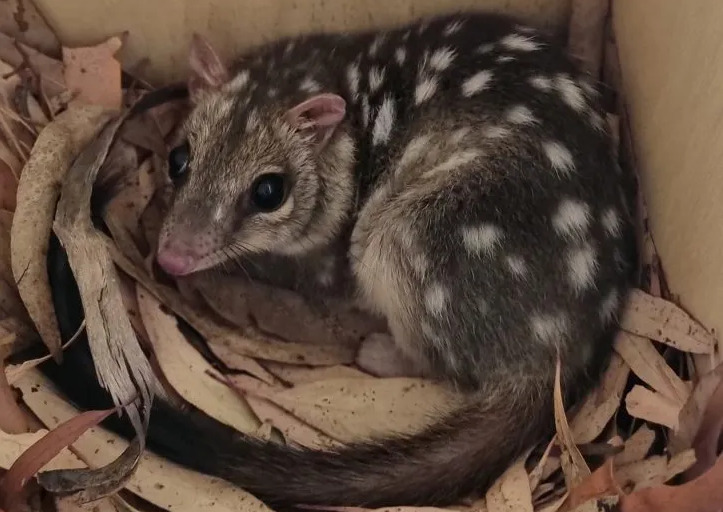
Unlikely Stowaway Joins the Road Trip (Image Credits: Facebook)
Northern Queensland – A family’s Christmas road trip in December 2025 turned into an unexpected wildlife adventure when a young northern quoll stowed away in their vehicle. The Lyons family drove 2,400 kilometers south to Dubbo, New South Wales, oblivious to their tiny passenger hidden among the luggage.[1][2] What began as a routine journey amid heavy rains ended with a daring rescue effort that highlighted the resilience of this endangered marsupial.
Unlikely Stowaway Joins the Road Trip
The Lyons family – Dan, Peta, their daughter Aleisha, 22, son Jack, 20, and cattle dog Smudge – loaded their car for the long haul from northern Queensland toward Dubbo. Heavy downpours forced them to drive through the night, covering the vast distance without stops. Their dog showed unusual interest in the back, pawing at the luggage, but the family attributed it to restlessness.[1]
Dan Lyons later recalled the moment: “Smudge was trying to get into the back with the luggage, but we still didn’t pick up that there was something in there and because it was raining so heavily, we just kept driving through the night until we got to Dubbo.” Unseen amid the bags, a juvenile northern quoll had climbed aboard, embarking on an epic, unintended voyage.[1]
Shock Discovery Unfolds in Dubbo
Aleisha Lyons reached for her bag upon arrival in Dubbo and froze. “Oh, there’s a quoll in here!” she exclaimed, spotting the small, wide-eyed marsupial peering out. The family quickly contacted experts at Taronga Western Plains Zoo for help. The quoll, however, proved elusive, darting into the car’s lining and refusing to leave.[1]
Zoo staff set up a trap baited with meat, but the clever creature escaped multiple times overnight. Technicians modified the trap the next morning, finally securing the quoll without harm. Dubbed Stowie by the family, the animal appeared stressed from the ordeal but otherwise intact after the grueling trip.[3]
Recovery at Taronga Wildlife Hospital
At Taronga Wildlife Hospital in Dubbo, veterinarians conducted a thorough health check on Stowie. Estimated at four to five months old, the quoll weighed in healthy despite the trauma. Senior Veterinarian Dr. Alisa Wallace noted, “I think his journey was probably quite stressful for him, being in a very strange environment with people, but considering all of that he actually held up beautifully.”[1]
Over six weeks, Stowie thrived under care, devouring meals and doubling his body weight. The team monitored him closely, ensuring he regained strength for release. This period allowed coordination with authorities, including Queensland’s Department of the Environment, Tourism, Science and Innovation, and New South Wales’ National Parks and Wildlife Service.[1]
Homeward Bound: Flights and Final Release
Returning Stowie required precise logistics: two flights and a four-hour drive from Cairns back to northern Queensland. Wildlife officers released him near his likely origin point, close to where the Lyons family had started their trip. Dr. Wallace expressed relief: “We’re really glad that we’ve been able to help him get back to where he’s supposed to be and hopefully go and breed in the wild. He’s finally back out there where he’s meant to be.”[1]
The successful reunion underscored effective collaboration between zoos, families, and government agencies. Stowie’s story, one of 837 wildlife cases at the hospital in 2025, stood out as particularly unusual.[4]
Spotlight on Northern Quolls
Northern quolls rank as Australia’s smallest carnivorous marsupials, native to the continent’s northern regions. These nocturnal hunters prey on insects, small vertebrates, and birds, using sharp teeth and agile bodies to navigate rocky terrains and woodlands. Listed as endangered by the IUCN Red List, their populations face threats from habitat loss, invasive species, and toxins.[1]
Stowie’s misadventure drew attention to these elusive creatures, reminding the public of ongoing conservation needs. Encounters like this highlight how human activities can inadvertently impact wildlife, yet also showcase opportunities for positive intervention.
- Size: Smallest of Australia’s four quoll species, weighing up to 1 kg.
- Habitat: Northern Australia, from Queensland to Western Australia.
- Diet: Carnivorous, favoring insects and small prey.
- Status: Endangered, with declining numbers due to multiple threats.
- Behavior: Nocturnal and solitary, known for climbing skills.
Key Takeaways
- Stowie survived a 2,400km journey hidden in a car, proving remarkable resilience.
- Teamwork between family, zoo, and authorities ensured his safe return.
- The case spotlights the vulnerability of endangered northern quolls.
Stowie’s hitchhiking tale captures the wild unpredictability of nature intersecting with human paths, ending on a hopeful note for one small survivor. As he roams free again, his story inspires greater awareness for the fragile ecosystems that sustain such unique animals. What do you think about Stowie’s adventure? Tell us in the comments.

- Urban Coyotes Show Remarkable Adaptability, Learning to Thrive in City Environments - July 22, 2026
- Beavers Are Nature’s Engineers, Creating Vital Habitats for Other Wildlife Species - July 21, 2026
- The Recovery of the California Condor Offers Hope for Other Critically Endangered Birds - July 21, 2026