

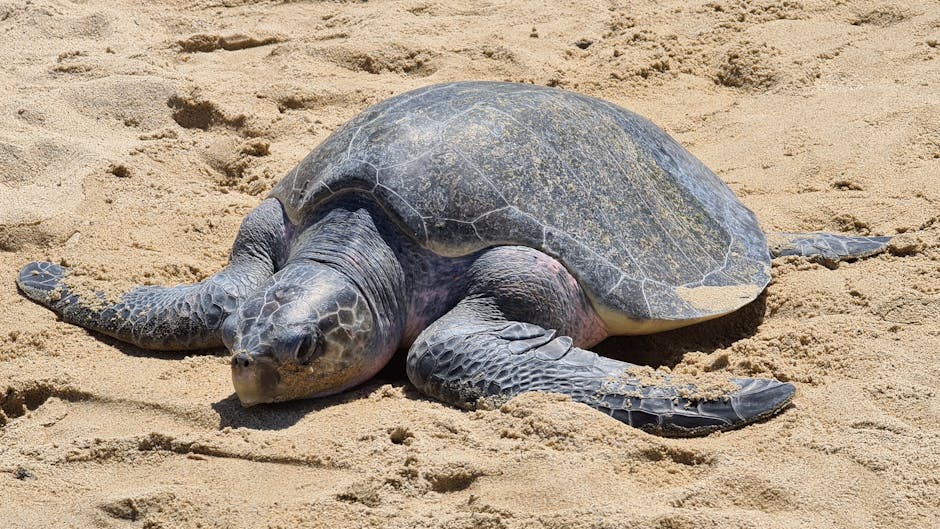
A Fierce Encounter Sparks Rescue (Image Credits: Pexels)
Juno Beach, Florida – An 82-pound adult female Kemp’s ridley sea turtle named Amelie returned to the Atlantic Ocean on March 25 after seven weeks of rehabilitation at the Loggerhead Marinelife Center.[1][2] The resilient reptile, missing her right foreflipper from a predator attack, now carries a satellite tracker to reveal how amputee turtles fare in the wild. Researchers hope the data illuminates survival strategies for this endangered species.
A Fierce Encounter Sparks Rescue
Amelie stranded in early February 2026 near Port St. Lucie, Florida, bearing severe predator wounds on her right front flipper.[1] The Inwater Research Group discovered her and transported the adult Kemp’s ridley to the Loggerhead Marinelife Center in Juno Beach. Staff suspected a shark inflicted the traumatic amputation that left her with three functional flippers.
Upon arrival on February 2, Amelie weighed about 85 pounds and measured 66 centimeters in curved carapace length.[3] She also suffered from pneumonia, complicating her condition. The center classified her initial prognosis as poor, marking the start of a challenging recovery.
Intensive Rehab Transforms a Patient
Veterinarians performed surgical debridement to clean and close the mangled flipper wound.[1] Amelie received antibiotics, wound care, and supportive treatments, including a feeding tube when she refused food initially. Her condition improved gradually from poor in mid-February to fair by mid-March.
An ultrasound later confirmed the turtle was developing eggs, heightening interest in her post-release behavior.[2] Force-feeding and daily offerings helped her maintain strength. By release time, staff deemed her ready for the open ocean despite the permanent loss.
Tech-Equipped Launch into Freedom
On March 24, researchers Justin Perrault and Sarah Hirsch affixed a satellite tag to Amelie’s shell.[2] The device features a saltwater switch that activates upon surfacing to breathe, sending location data to satellites. Updates appear online after a 24-hour delay.
The next day, onlookers gathered on Juno Beach as Amelie paused briefly before crawling seaward amid cheers.[1] View her progress at the interactive tracker.[4] Early data showed her covering 23 miles at 0.7 mph within the first day.[4]
Valuable Lessons for Turtle Conservation
The Loggerhead Marinelife Center partners with the Smithsonian Conservation Biology Institute on this tracking initiative.[1] Amelie marks the fourth amputee sea turtle monitored this way. Scientists seek details on dive patterns, migrations, and nesting potential for injured individuals.
“We do know that they can be successful in the wild because we have seen them on our nesting beaches, but we really want to understand their dive behaviors, how they’re migrating once they’re back in the wild,” said Sarah Hirsch, the center’s research director.[1] A prior three-limbed turtle, Pyari, traveled nearly 700 miles since January.
Kemp’s ridleys rank as the world’s rarest sea turtle species, primarily inhabiting the Gulf Coast yet appearing on Florida’s Atlantic side.[2] Here are other turtles currently tracked by the program:
- Olivia: Loggerhead, released March 26, 2026
- Pyari: Loggerhead, released March 4, 2026
- Toad: Green turtle, released July 21, 2025
- Eunice: Leatherback, released July 21, 2025
Hirsch added, “They’ve been through a lot. They’ve gotten a lot of medical care here, and to see them be able to go back out and contribute to the population is really rewarding.”[2]
Key Takeaways
- Amelie’s egg development offers rare insights into reproduction among injured Kemp’s ridleys.
- Satellite tags transmit only on surfacing, conserving battery for long-term monitoring.
- This collaboration builds data to refine rehab protocols for endangered sea turtles.
Amelie’s journey underscores nature’s tenacity and human dedication to fragile marine life. As her signal pings across the Atlantic, it promises knowledge to bolster Kemp’s ridley recovery. What path do you predict for her next? Share in the comments.

- Urban Coyotes Show Remarkable Adaptability, Learning to Thrive in City Environments - July 22, 2026
- Beavers Are Nature’s Engineers, Creating Vital Habitats for Other Wildlife Species - July 21, 2026
- The Recovery of the California Condor Offers Hope for Other Critically Endangered Birds - July 21, 2026