

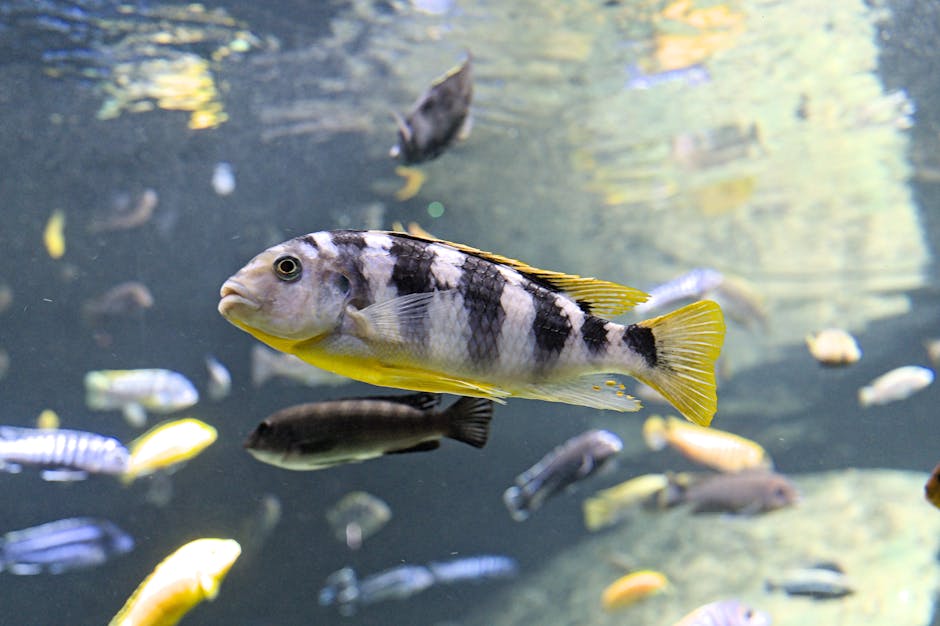
A Surprising Twist in Fish Architecture (Image Credits: Pexels)
Lake Tanganyika – Deep in the clear waters of Africa’s oldest rift lake, shell-dwelling cichlids construct elaborate nests from discarded snail shells. These small fish reveal a fascinating blend of hardwired behaviors and acquired skills, as new research demonstrates their ability to improve nest quality over time. Observations of neural activity further suggest parallels with learning mechanisms observed in more complex animals.
A Surprising Twist in Fish Architecture
Few would expect fish to exhibit such sophisticated construction techniques, yet shell-dwelling cichlids arrange shells with precision to create protective homes. Initial efforts often result in loose piles, but repeated attempts lead to more stable and efficient structures. This progression points to experience playing a key role alongside innate drives.
Researchers noted that young or inexperienced fish struggled with basic assembly, while seasoned individuals produced nests that better shielded eggs and fry from currents and predators. Memory appears crucial, allowing the fish to recall effective arrangements from past builds. Such adaptability challenges the long-held view that fish behaviors stem purely from genetics.
Neural Insights from the Depths
Brain imaging during nest-building tasks uncovered heightened activity in regions analogous to mammalian learning centers. These areas activated more intensely as fish refined their techniques, indicating active memory formation and skill enhancement. The findings bridge a gap between simple instincts and higher cognitive processes in aquatic species.
This neural overlap suggests evolutionary conservation of learning pathways across vertebrates. While cichlids lack the brain complexity of mammals, their responses during construction mirror patterns seen in rodents mastering mazes or birds perfecting songs. The study underscores how even small-brained animals leverage experience for survival advantages.
Key Behaviors in Nest Construction
Shell-dwelling cichlids follow a sequence that starts instinctively but improves with practice:
- Select empty snail shells of suitable size and shape.
- Position shells mouth-to-mouth or in stacked formations for stability.
- Adjust alignments to optimize water flow and protection.
- Test and reinforce weak points through trial and error.
- Maintain the nest over multiple breeding cycles, incorporating lessons learned.
These steps highlight a feedback loop where failures inform future successes. Inexperienced builders often overlooked shell orientation, leading to collapses, but veterans rarely repeated such errors.
Broader Implications for Animal Cognition
The discovery reframes how scientists view intelligence in fish. Lake Tanganyika’s cichlids, known for their diversity, now exemplify behavioral flexibility in a wild setting. This could influence studies on other species with similar parental care routines.
Understanding these mechanisms might also inform aquaculture practices, where optimizing environments could enhance breeding success. The research emphasizes that dismissing fish as instinct-driven overlooks their capacity for growth and adaptation.
Key Takeaways:
- Nest-building in cichlids combines innate instincts with learned refinements.
- Fish improve through experience, memory, and trial-and-error.
- Brain activity resembles mammalian learning patterns.
As research into aquatic cognition advances, these underwater architects remind us that intelligence manifests in unexpected forms. Their story invites closer scrutiny of the wild’s hidden complexities. What other behaviors in fish might reveal similar depths? Share your thoughts in the comments.

- Urban Coyotes Show Remarkable Adaptability, Learning to Thrive in City Environments - July 22, 2026
- Beavers Are Nature’s Engineers, Creating Vital Habitats for Other Wildlife Species - July 21, 2026
- The Recovery of the California Condor Offers Hope for Other Critically Endangered Birds - July 21, 2026