

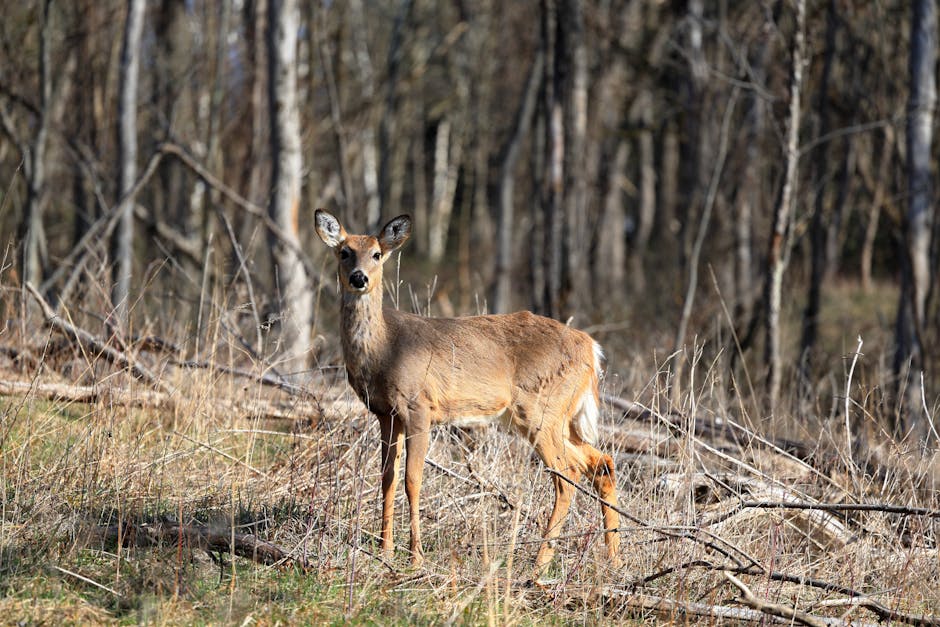
Advisory Committee Sounds Alarm on Forest Decline (Image Credits: Pexels)
Fair Haven Fields – This 40-acre natural haven, representing 40 percent of the borough’s public open space, stands on the brink of irreversible damage. Surging white-tailed deer populations have stripped away understory vegetation, blocking forest regeneration and allowing invasive species to dominate meadows. Local leaders formed an advisory committee in 2022 to tackle the problem, but challenges persist as state biologists underscored the severity in 2024.[1][2]
Advisory Committee Sounds Alarm on Forest Decline
The Fair Haven Fields Natural Area Advisory Committee identified deer overpopulation as the primary threat in its 2025 annual report. Committee members observed relentless browsing that prevents young trees and plants from surviving. David Bordelon, vice chair of the committee, highlighted the urgency during recent discussions.[1]
“The Natural Area is under stress right now; the primary cause of that stress is the deer,” Bordelon stated. He raised a pressing question: “We’re really wondering, how long can the forest last with that level of depredation?” The group, which includes volunteers and council liaisons, has pushed for borough-wide strategies since its inception. Efforts include volunteer cleanups, such as a spring event planned for April 18 and 19.[1]
State Experts Confirm Overpopulation and Recommend Action
Biologists from the New Jersey Department of Environmental Protection’s Division of Fish and Wildlife visited Fair Haven in 2024. They conducted site assessments and presented management options to borough officials during a council meeting on May 13. The experts strongly favored lethal methods, such as controlled bow hunts, over alternatives like sterilization or relocation.[2][1]
Biologist Brian Schumm explained that bow hunting carries safety protocols comparable to contact sports, with trained participants required. Megan Mills added that even targeted efforts in small areas like Fair Haven Fields could influence broader populations, as deer move freely. Borough administrator Christopher York followed up with state officials after a March 23 meeting, though no formal plan has advanced yet. Neighboring towns Rumson and Little Silver opted out of joint initiatives.[2]
Ecological and Public Health Toll Mounts
Deer consume roughly 10 pounds of forage daily, decimating native plants and paving the way for invasives. In Fair Haven Fields, about two acres of Moraller’s Meadow succumbed to deer-resistant weeds by 2025, demanding years of restoration work. Understory damage extends across the wooded sections, as noted by the advisory committee and Monmouth County Parks observers.[1][3]
Beyond ecology, risks include vehicle collisions and tick-borne illnesses. Lyme disease rates in New Jersey surpassed 60 cases per 100,000 residents since 2022. Mayor Josh Halpern voiced worries about ticks entering homes via deer. “It’s a big problem beyond just the Natural Area. I’m worried about human life,” he said. The borough secured a $15,000 state grant in 2024 for a forest health survey to quantify the damage.[1]
Exploring Solutions Amid Community Concerns
Local environmental commission meetings have debated multiple approaches. Private landowners adjacent to the natural area could hunt under existing rules, while state-coordinated bow hunts offer processed meat donations through programs like Hunters for the Hungry. Non-lethal tactics, such as those tested in Princeton, proved ineffective against persistent herds.[3]
Other ideas include eight-foot fencing with access gates and planting resilient species, though costs and invasiveness risks loom large. The borough reviews a NJDEP-approved forestry report and consults public works experts. Ordinance 2024-237 addresses deer management regulations, potentially enabling structured programs. Details on volunteer-led restoration and funding via open space taxes also surfaced in recent commission talks.[4]
- Lethal hunts: Targeted bow hunting in safe zones, with professional oversight.
- Fencing: High barriers to exclude deer, paired with maintenance plans.
- Plantings: Deer-resistant natives to bolster regeneration.
- Relocation or sterilization: Less favored due to high costs and limited success.
- Private hunting: Encouraging abutters to participate legally.
Key Takeaways
- Deer overpopulation halts forest renewal in Fair Haven Fields, a core green space.
- State biologists endorse controlled hunts as the most viable fix.
- Impacts span ecology, traffic safety, and public health via ticks.
As Fair Haven weighs these paths, the natural area’s fate hinges on swift, balanced decisions. Protecting this legacy site demands collaboration between residents, officials, and experts. What strategies would you support for deer management here? Share your thoughts in the comments.

- Urban Coyotes Show Remarkable Adaptability, Learning to Thrive in City Environments - July 22, 2026
- Beavers Are Nature’s Engineers, Creating Vital Habitats for Other Wildlife Species - July 21, 2026
- The Recovery of the California Condor Offers Hope for Other Critically Endangered Birds - July 21, 2026