

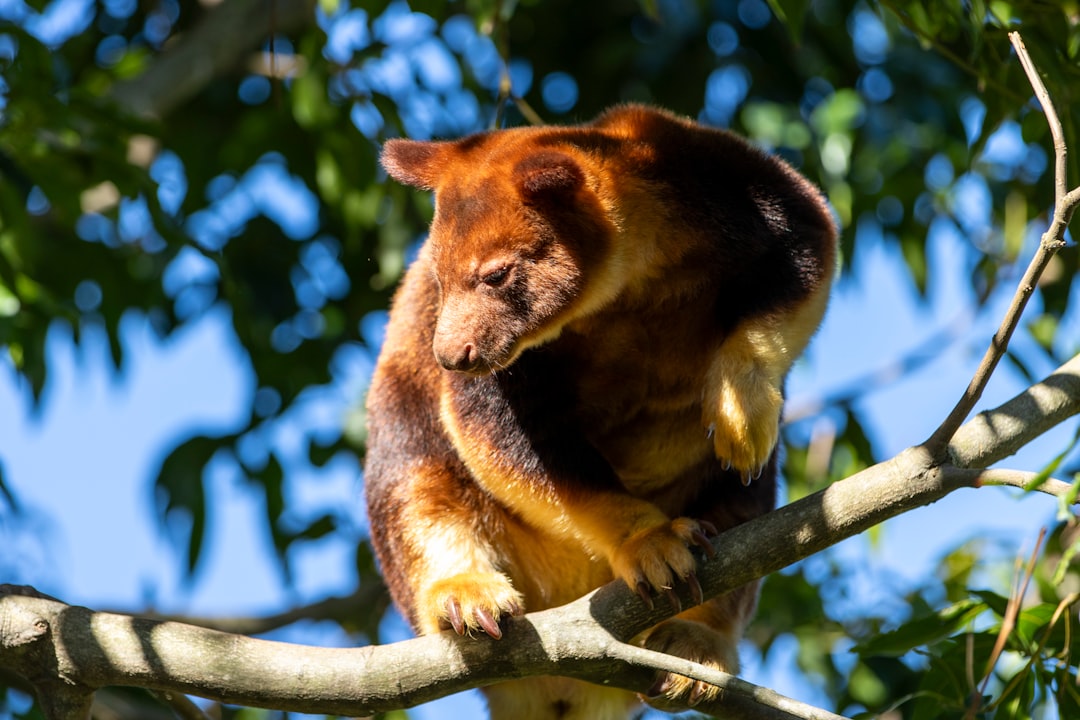
Leaps That Defy Expectations (Image Credits: Unsplash)
In the dense tropical rainforests spanning Papua New Guinea, Indonesia, and northern Australia, tree-kangaroos pursue a secretive existence high among the branches.[1][2] These marsupials, closely related to the familiar ground kangaroos, have carved out a niche in the treetops through specialized adaptations. Their world, however, teeters on the edge as habitat pressures mount.
Leaps That Defy Expectations
Tree-kangaroos demonstrate extraordinary agility that sets them apart from their terrestrial relatives. They bound up to 30 feet between branches and plummet from heights of 60 feet to the forest floor without serious injury.[3][1] Shorter, stockier limbs, longer forelimbs, and rubbery pads on their paws enable precise climbing on slick bark. Long, cylindrical tails provide crucial balance during these daring maneuvers.
Unlike ground kangaroos, tree-kangaroos move quadrupedally on the forest floor, hopping slowly with a forward lean. In trees, they ascend by hugging trunks with forelimbs while propelling upward with powerful hind legs. This dual proficiency allows them to evade predators like pythons and feral dogs effectively.
Species Thriving in Isolated Forests
Approximately 14 species populate the genus Dendrolagus, each suited to specific rainforest zones from lowlands to mountains.[1][4] In Australia, Lumholtz’s tree-kangaroo inhabits the Atherton Tablelands, while Bennett’s occupies areas north of the Daintree River. New Guinea hosts the majority, including Matschie’s on the Huon Peninsula and the elusive Wondiwoi in remote mountains.
Sizes vary notably; Lumholtz’s measures 48-65 cm in body length and weighs around 7 kg, whereas larger species like Doria’s reach 14.5 kg. Fur colors range from grizzled gray to golden-mantled patterns, aiding camouflage in dappled light.
| Species | Location | Status |
|---|---|---|
| Lumholtz’s | Australia | Near Threatened |
| Bennett’s | Australia | Near Threatened |
| Matschie’s | Papua New Guinea | Endangered |
| Golden-mantled | New Guinea | Critically Endangered |
Foraging and Family Life in the Heights
These herbivores sustain themselves on leaves, fruits, bark, flowers, and occasionally bark sap gathered from the canopy.[1] A specialized stomach ferments tough plant matter over extended periods. Most remain solitary and nocturnal, descending rarely to scavenge or drink.
Females give birth to tiny joeys after a 44-day gestation, which crawl into the pouch for up to nine months of development. Weaning follows, with young mastering climbing skills alongside mothers. Maturity arrives at two years for females and later for males, supporting low population growth rates.
Threats Shadowing a Fragile Existence
Habitat destruction from logging, agriculture, and mining fragments their forested homes, exposing them to new dangers.[2][4] Hunting by local communities for meat and fur accelerates declines, particularly in Papua New Guinea. Climate-driven wildfires and droughts compound these pressures.
In Australia, vehicles and domestic predators claim lives, as studies of Lumholtz’s revealed road strikes and dog attacks among leading causes. Many species now occupy less than one percent of their original ranges.
- Deforestation for palm oil and coffee plantations
- Illegal logging in protected areas
- Overhunting with dogs
- Climate change impacts like extended dry seasons
- Human expansion into remote mountains
Conservation Initiatives Gain Momentum
Organizations like WWF combat illegal logging and promote sustainable forestry.[2] The Tenkile Conservation Alliance protects Torricelli Mountain species through community partnerships. Captive breeding programs for five species support reintroduction efforts.
Protected areas expand in key regions, while awareness campaigns reduce hunting. Recent rediscoveries, such as the Wondiwoi in 2018, underscore potential for recovery with sustained action.
- Tree-kangaroos embody evolutionary flexibility, returning to trees after kangaroo ancestors left them.
- Immediate threats demand habitat safeguards and hunting curbs.
- Community-led programs prove vital for long-term survival.
Tree-kangaroos remind us of nature’s ingenuity amid vulnerability; their persistence hinges on collective resolve to preserve rainforest integrity. What steps can we take to support these canopy dwellers? Share your thoughts in the comments.

- Urban Coyotes Show Remarkable Adaptability, Learning to Thrive in City Environments - July 22, 2026
- Beavers Are Nature’s Engineers, Creating Vital Habitats for Other Wildlife Species - July 21, 2026
- The Recovery of the California Condor Offers Hope for Other Critically Endangered Birds - July 21, 2026