

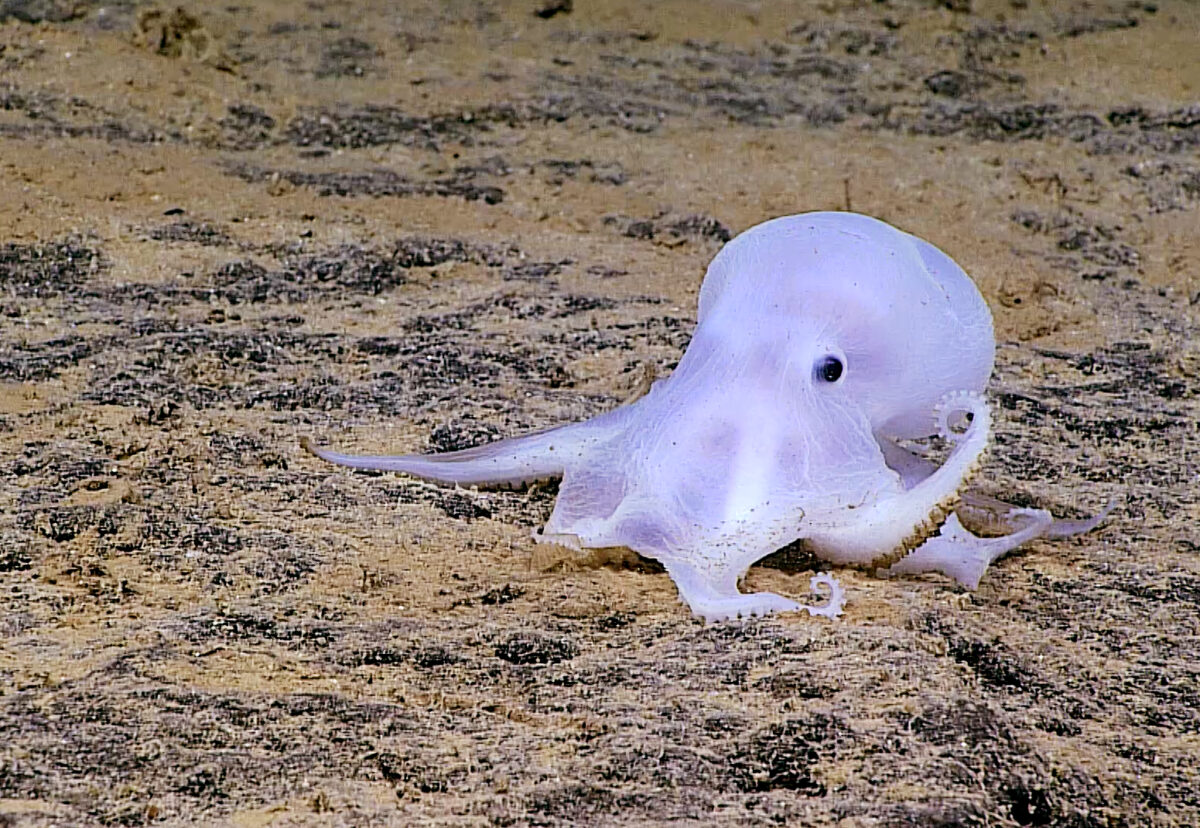
A Translucent Marvel in the Abyss (Image Credits: Upload.wikimedia.org)
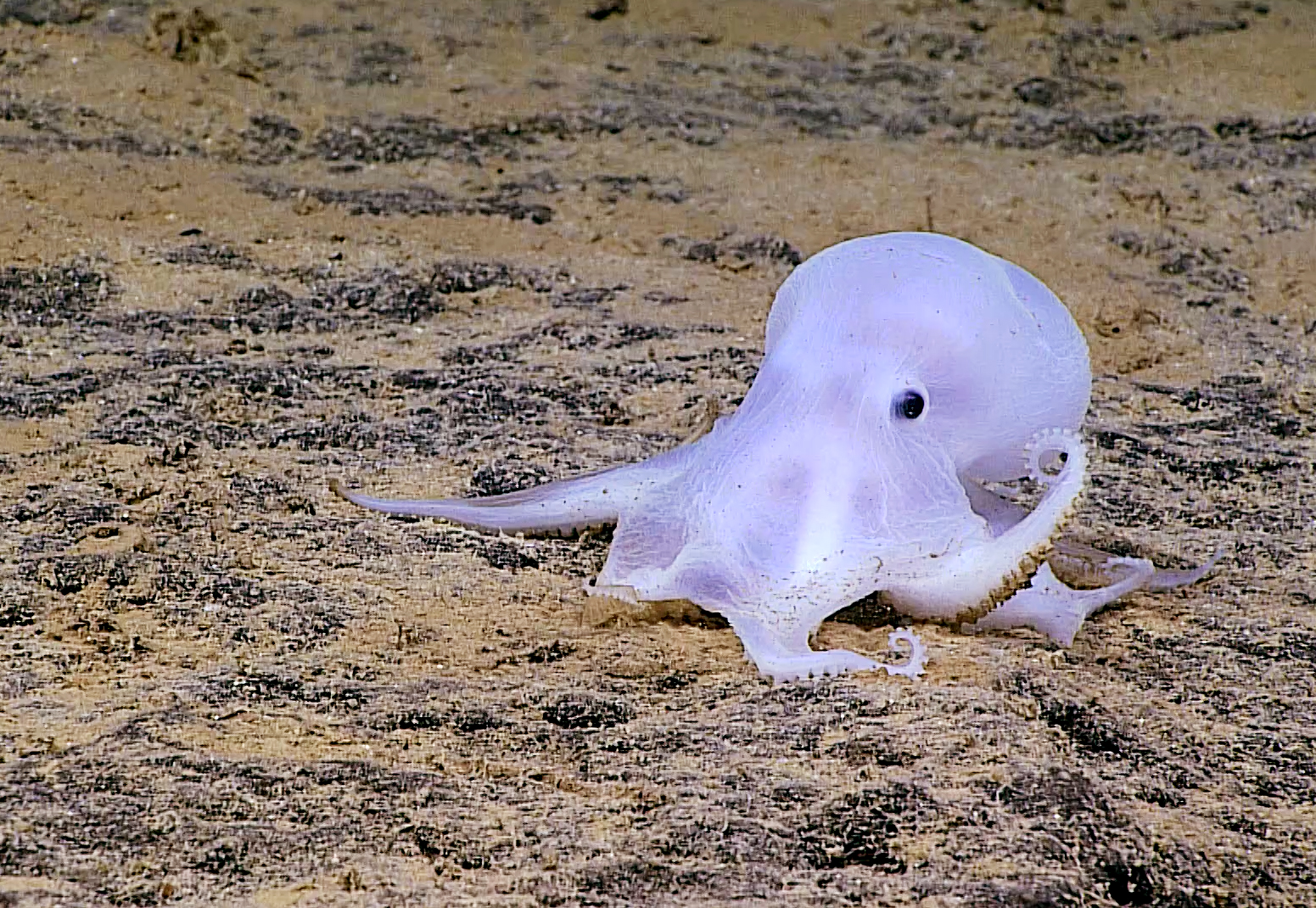
In the pitch-black expanses of the Pacific Ocean’s Clarion-Clipperton Zone, a translucent creature known as the ghost octopus, or Casper, tends to its eggs on ancient manganese nodules. These metallic lumps, formed over millions of years, provide the only suitable substrate for the sponges on which the octopus broods its young. A recent joint investigation by Mongabay and CNN revealed aggressive exploration by Chinese vessels in such areas, raising alarms for this rare species and the fragile deep-sea ecosystem.[1][2]
A Translucent Marvel in the Abyss
Researchers first encountered the ghost octopus in 2016 at depths exceeding 4,000 meters, its ethereal, jelly-like form earning it the nickname Casper after the friendly ghost. This incirrate octopus, unlike its shallow-water relatives, lacks fins and ink sacs, adapted perfectly to extreme pressure and darkness. Females guard their eggs for extended periods, attaching them to dead sponge stalks rooted on polymetallic nodules rich in manganese, nickel, cobalt, and copper.[3]
These nodules dot the seafloor in vast fields, essential not just for octopuses but for a web of unknown deep-sea life. Mining operations target precisely these formations, which regenerate too slowly to sustain extraction. The discovery underscored the vulnerability of abyssal species to human encroachment, as nodules serve as anchors for biodiversity in an environment evolving over eons.[4]
China Leads the Charge in Seabed Exploration
China secured five exploration contracts from the International Seabed Authority, spanning 225,000 square kilometers, more than any other nation. State-owned entities like the China Ocean Mineral Resources Research and Development Association dispatched eight research vessels between January 2021 and January 2026. These ships logged 814 days and traveled 102,000 kilometers within or near designated zones – equivalent to more than twice Earth’s circumference.[1]
Yet the investigation uncovered a twist: the vessels devoted only 6% of their open-water time to these contract areas. Instead, they crisscrossed militarily sensitive waters, from the Bering Sea to Taiwan’s east coast. Examples included the Xiang Yang Hong 01 zigzagging over nodule fields before vanishing into Russian waters, and the Hai Yang Di Zhi Liu Hao lingering near undersea cables in Palau’s exclusive economic zone.[2]
Environmental Toll on Delicate Deep-Sea Life
Deep-sea mining disrupts habitats irreversibly. Tests in the Clarion-Clipperton Zone showed a 37% drop in animal abundance, with biodiversity failing to recover after 44 years. Noise from multibeam echosounders, used by these vessels for seafloor mapping, harms whales and potentially octopuses by altering sound propagation across vast distances.[1]
For the ghost octopus, nodule removal spells catastrophe. Without these structures, sponges collapse, leaving eggs exposed and broods abandoned. Scientists documented octopuses brooding on nodule-dependent sponges, highlighting a direct link between mining targets and reproductive survival. Broader impacts ripple through food webs, threatening hadal microbes and macrofauna discovered only recently.[5]
- Manganese nodules form over millions of years, too slowly for renewal.
- Octopus eggs attach to sponges anchored by nodules.
- Extraction creates sediment plumes smothering vents and trenches.
- Noise pollution silences cetaceans and disrupts deep-sea communication.
- Unknown species – 90% new to science – face extinction risks.
Geopolitical Shadows Over the Ocean Floor
The vessels’ patterns fueled suspicions of dual-use missions under China’s military-civilian fusion strategy. Ships disabled AIS transponders hundreds of times, evaded exclusive economic zones, and surveyed submarine chokepoints near Guam and the Aleutian Islands. Experts noted alignments with ports tied to the People’s Liberation Army Navy.[2]
“They want to know what’s going on at the bottom of the sea, where U.S. submarines might go,” observed Raymond Powell of SeaLight. The U.S. responded by fast-tracking its own mining licenses and investing billions, escalating a resource race. In the Cook Islands, China’s 2025 research pact drew counter-moves from Washington and Wellington.[1]
Key Takeaways
- China’s fleet spent minimal time in mining zones but probed strategic seas extensively.[1]
- Ghost octopuses rely on mineable nodules for brooding, facing habitat loss.
- Early tests confirm lasting ecological damage from extraction.
As superpowers vie for ocean riches, the ghost octopus embodies the unseen stakes. Forty nations now urge a mining moratorium to protect these depths. What steps should regulators take next? Share your thoughts in the comments.

- Urban Coyotes Show Remarkable Adaptability, Learning to Thrive in City Environments - July 22, 2026
- Beavers Are Nature’s Engineers, Creating Vital Habitats for Other Wildlife Species - July 21, 2026
- The Recovery of the California Condor Offers Hope for Other Critically Endangered Birds - July 21, 2026