

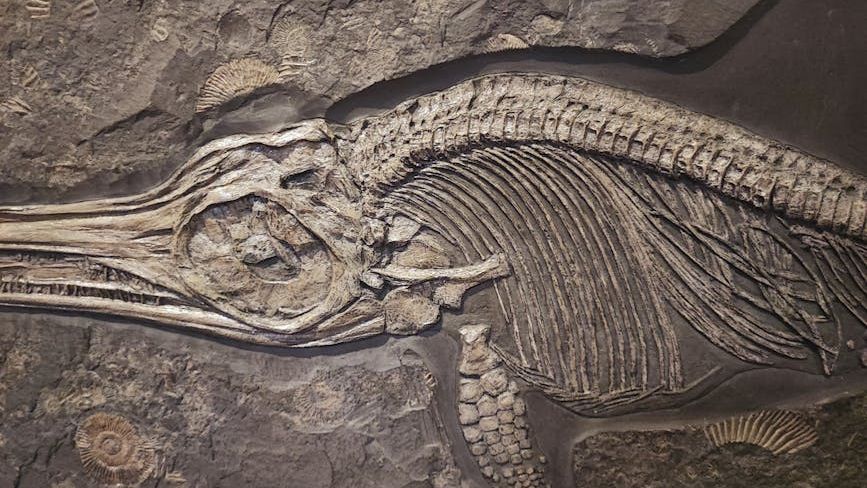
Mistelgau, Germany — A massive marine reptile from the Early Jurassic era endured wounds that would have felled most predators, according to analysis of its exceptionally preserved fossil. Discovered in a local clay pit, the skeleton provides rare evidence of resilience in ancient oceans, where survival demanded more than brute strength.[1][2] Researchers now see hints of behavioral flexibility that allowed this creature to persist long after trauma struck.
The Remarkable Find in Northern Bavaria
Paleontologists at the Urwelt-Museum Oberfranken unearthed the partial skeleton during routine excavations in the Mistelgau clay pit near Bayreuth. The site has yielded fossils since 1998 as part of a long-term project under the Bavarian State Collections of Natural History. This specimen dates to the upper Toarcian stage of the Early Jurassic, approximately 180 million years ago.[1]
Belonging to the genus Temnodontosaurus cf. trigonodon, the animal measured around 6.6 meters in length, with a skull alone reaching 1.5 meters. Its three-dimensional preservation stands out, capturing fragments of the skull, lower jaw, shoulder girdle, forefins, vertebrae, and over 100 teeth. Such detail reveals intricate structures in the palate, orbital region, and fins, offering a window into its anatomy.[2]
Evidence of Devastating Trauma
The fossil bears clear signs of severe injuries that reshaped its skeleton. Modifications appear in critical areas, particularly the shoulder and jaw joints, which likely hampered locomotion and feeding. These traumas would have severely limited the reptile’s ability to hunt effectively in the competitive Jurassic seas.[1]
Team members noted that the damage resembled force-induced pathologies common in large marine predators. Past studies on Temnodontosaurus from southern Germany documented similar bite marks and impacts with healing signs, often from conspecific aggression or environmental hazards.[3] Here, the battering proved extensive enough to alter joint functions permanently.
Proof of Prolonged Survival
Despite the injuries, the ichthyosaur lived on, as indicated by heavily worn teeth. This wear suggests continued feeding over time, a testament to its determination. Preparators identified gastroliths—stomach stones—in the abdominal region, a feature extremely rare in this genus.[2]
Such stones typically aid digestion, and their presence implies the animal adapted its habits post-injury. Stefan Eggmaier, a preparator at the museum, observed: “The injuries likely significantly limited the animal’s ability to catch prey. The fact that it nevertheless survived is evidenced, among other things, by its heavily worn teeth and gastroliths.”[1]
- Shoulder girdle alterations, impairing swimming efficiency.
- Jaw joint disruptions, complicating prey capture.
- Overall skeletal remodeling, consistent with healing after trauma.
- Dental abrasion from extended use.
- Gastroliths, signaling dietary adjustment.
An Unexpected Twist in Survival Tactics
The gastroliths point to a potential shift in diet, perhaps toward softer or smaller prey that required grinding assistance. Eggmaier speculated that necessity drove this change, allowing the predator to sustain itself when speed and power failed. Dr. Ulrike Albert, a SNSB paleontologist, added context: “Our Temnodontosaurus fossil is one of the youngest finds of this ichthyosaur genus to date. Until now, representatives of this genus have mainly been known from older geological layers.”[1]
This specimen extends the known range of the genus in the Southwest German Basin, challenging prior timelines. Future analyses of teeth and bones will clarify its ecology further.
Lessons from a Resilient Predator
The discovery underscores adaptability’s role in prehistoric survival, mirroring patterns in modern wildlife. In the harsh Jurassic marine realm, where apex hunters faced constant threats, this ichthyosaur’s story highlights behavioral innovation over physical dominance. As excavations continue in Mistelgau, more fragments may refine our view of these ancient giants.
Ultimately, the fossil reminds us that endurance often stems from flexibility, a principle that echoes across epochs.

- Urban Coyotes Show Remarkable Adaptability, Learning to Thrive in City Environments - July 22, 2026
- Beavers Are Nature’s Engineers, Creating Vital Habitats for Other Wildlife Species - July 21, 2026
- The Recovery of the California Condor Offers Hope for Other Critically Endangered Birds - July 21, 2026