

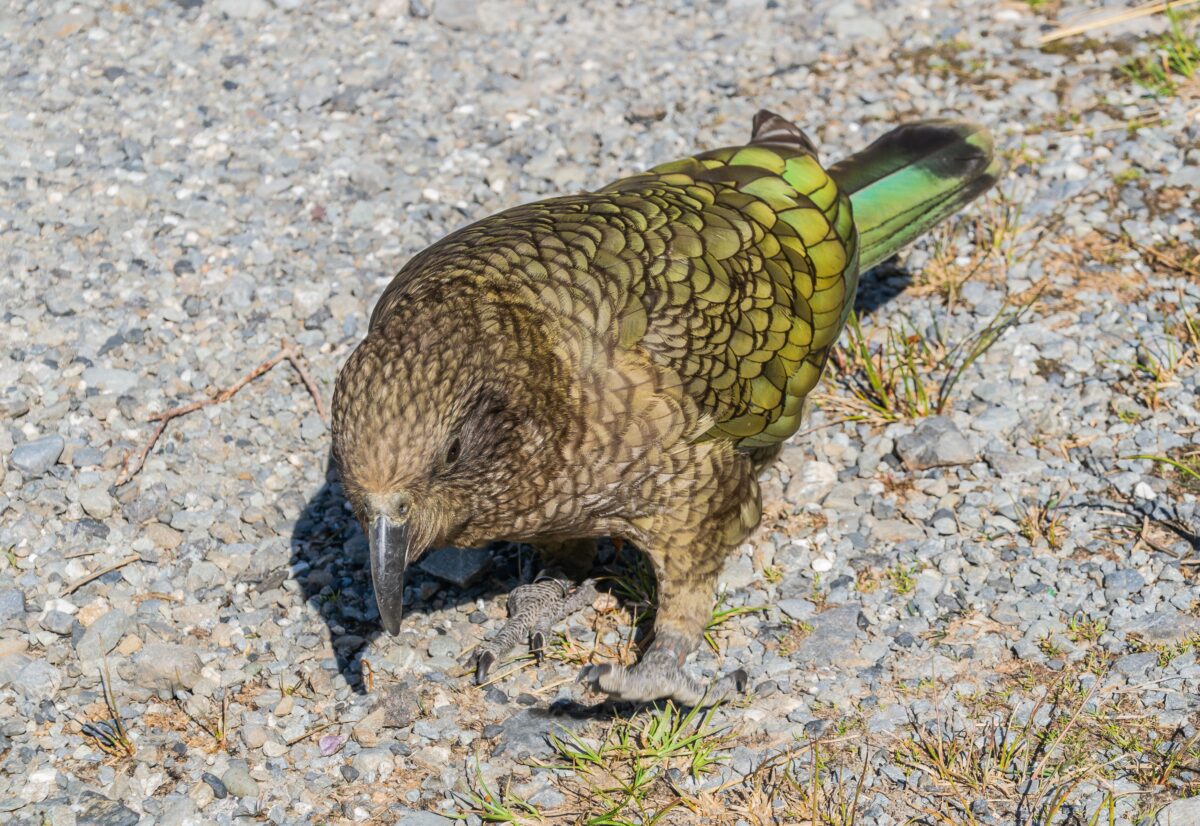
Christchurch, New Zealand – A kea parrot named Bruce has captured attention for overcoming a severe physical handicap to become the undisputed leader of his group. Missing his entire upper beak since a youthful accident, this intelligent bird developed a unique fighting style that secured his position at the top. Researchers documented his success in a study published in Current Biology, highlighting the power of behavioral innovation in the animal kingdom.[1][2]
An Unlikely Champion Emerges
Bruce resides in a spacious aviary at Willowbank Wildlife Reserve alongside nine males and three females, forming what scientists call a “circus” of kea parrots. Over four weeks, observers recorded 162 male-versus-male interactions, with Bruce participating in 36. He emerged victorious in every single encounter, defying expectations set by traditional contest theory that favors physically superior opponents.[1]
This triumph marked Bruce as the first known disabled animal to achieve alpha status independently, without relying on alliances. Visitors to the reserve often express pity upon seeing his exposed lower beak. Yet data revealed he maintained the lowest levels of stress hormones among the group, measured through droppings.[2]
The Secret Weapon: Beak Jousting
Bruce’s dominance stemmed from a novel technique dubbed “beak jousting.” While intact kea typically bite downward onto rivals’ necks in 67% of attacks, Bruce thrust forward with his protruding lower beak. He targeted backs, heads, wings, and legs in 83% of cases, often combining thrusts with kicks.[1]
From close range, he extended his neck for precise jabs. At a distance, Bruce charged, leaped, and struck. This approach repelled opponents effectively 73% of the time via jousting alone, compared to 48% with kicks. His innovation turned a liability into a lethal advantage.
Reaping the Rewards of Leadership
As alpha male, Bruce enjoyed clear privileges within the flock. He gained first access to four central feeding stations 83% of the time. On several occasions, subordinates granted him 15 minutes of exclusive feeding before approaching leftovers themselves.[2]
Subordinate males also provided allopreening, grooming his beak to remove debris he could not reach. Such behavior, rare among kea outside mating pairs, underscored his elevated rank. These perks contributed to his relaxed demeanor and minimal stress.
- Priority feeder access, reducing competition for food.
- Grooming from lower-ranked birds, aiding hygiene.
- Lowest glucocorticoid levels, indicating reduced anxiety.
- No need to constantly defend against challengers.
Behind the Science: A Closer Look
The research team, led by behavioral ecologist Alex Grabham of the University of Canterbury, analyzed interactions and hormone samples. Their findings appeared in Current Biology on April 20, 2026.[1] Grabham noted, “Bruce shows us that behavioral innovation can help bypass physical disability, at least in species with the cognitive flexibility to develop new solutions.”
This work built on a 2021 study where Bruce demonstrated tool use by wedging pebbles between his lower jaw and tongue for self-preening. Caretakers opted against prosthetics, fearing added stress. Comparable cases remain scarce, including a polio-afflicted chimpanzee who reached beta rank via alliances and an aged macaque sustained by a female partner.
Lessons for Animals and Welfare
Bruce’s story challenges views on disability in socially complex species. Kea, renowned for problem-solving, exemplify how large brains enable flexibility. “He knows that he isn’t going to be followed around and beaten up or bullied or chased,” Grabham explained regarding Bruce’s low stress.[2]
Comparative psychologist Amalia Bastos remarked, “Bruce has now shown twice that being different is not necessarily disadvantageous.” The case prompts welfare debates: human interventions like prosthetics may hinder natural adaptations. While Bruce thrives in captivity, wild hierarchies fluctuate, raising questions about his survival amid scarce winter foods.
| Fighting Style | Intact Kea | Bruce |
|---|---|---|
| Primary Target | Neck (67%) | Non-neck (83%) |
| Main Tactic | Biting downward | Forward thrusting/jousting |
| Win Rate (Bruce’s fights) | N/A | 100% (36/36) |
- Behavioral innovation can overcome physical limitations in intelligent species.
- Alpha status brings food priority, grooming, and lower stress.
- Well-meaning aids like prosthetics warrant caution in adaptive animals.
Bruce proves resilience knows no bounds, reshaping our understanding of dominance and disability. His journey from accident survivor to flock king inspires reflection on adaptation’s role in nature. What do you think about Bruce’s ingenuity? Tell us in the comments.

- Urban Coyotes Show Remarkable Adaptability, Learning to Thrive in City Environments - July 22, 2026
- Beavers Are Nature’s Engineers, Creating Vital Habitats for Other Wildlife Species - July 21, 2026
- The Recovery of the California Condor Offers Hope for Other Critically Endangered Birds - July 21, 2026