

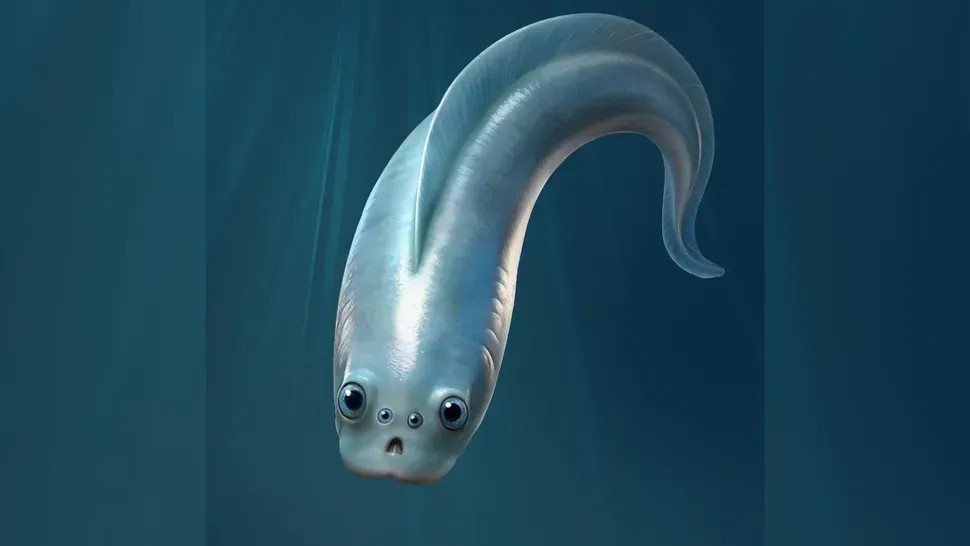
Imagine a creature that looks like a swimming noodle with eyes. Not one pair of eyes. Four. This is not science fiction, and it’s not some deep-sea oddity from today’s oceans. This is your ancestor. Or at least, one of the earliest relatives of the entire vertebrate lineage that eventually led to fish, amphibians, reptiles, and yes, humans.
Scientists have uncovered remarkable fossils that are rewriting what we thought we knew about the dawn of complex animal life. The details are genuinely jaw-dropping, and the creature at the center of it all is as strange as it is fascinating. Let’s dive in.
A Tiny, Worm-Like Animal That Carries Enormous Evolutionary Weight
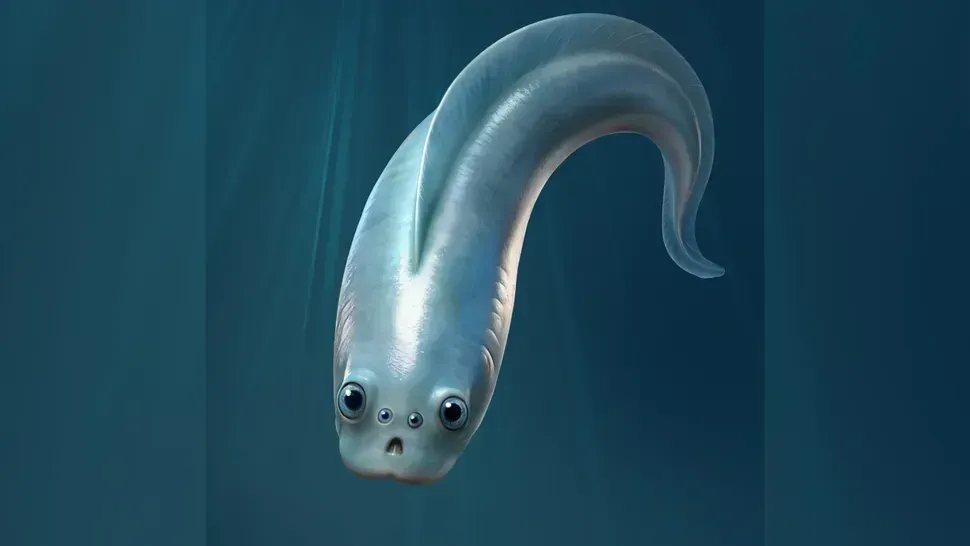
The creature in question is called Moscorhinus, and it lived roughly 500 million years ago during the Cambrian period, one of the most explosively creative moments in the history of life on Earth. It belonged to a group known as yunnanozoans, which have been debated among scientists for years. Were they vertebrates? Were they something else entirely? The fossils have been helping answer that question in a big way.
What makes this discovery so striking is the sheer detail preserved in the fossils. Researchers were able to identify soft tissue structures that rarely survive across geological time, giving us an unprecedented window into what this animal actually looked like on the inside and outside.
The Four-Eye Mystery And Why It Matters
Here’s the thing about having four eyes: it sounds excessive, almost cartoonish. Yet the evidence suggests this creature had two pairs of eyes, a trait that seems bizarre by modern standards but may have provided serious survival advantages in a Cambrian ocean absolutely teeming with predators and competitors.
The front pair of eyes are believed to have functioned differently from the rear pair, possibly serving distinct visual roles, much like how some modern insects use compound eyes for wide-angle awareness while other eye structures handle fine detail. Honestly, the more you think about it, the more elegant it seems. Evolution doesn’t waste energy on things that don’t work.
What The Fossils Actually Revealed
The fossils were found in Yunnan Province in southern China, a region that has become something of a treasure chest for Cambrian-era discoveries over the decades. The level of preservation is extraordinary. Researchers could identify what appear to be gill structures, a primitive notochord (essentially a precursor to the backbone), and those now-famous four eye-like structures arranged along the head region.
This level of anatomical detail is rare. Most ancient soft-bodied creatures simply dissolve into nothing over millions of years, leaving behind only impressions or fragments. The fact that these specimens retained enough structure to analyze puts them in a very exclusive club of paleontological finds.
The Debate Over Where This Creature Fits In The Family Tree
Yunnanozoans like this fossil have been fiercely contested in the scientific community. Some researchers argued they were invertebrates. Others positioned them as early deuterostomes, a broader group that includes vertebrates. The new anatomical evidence from these fossils leans heavily toward placing them very close to the vertebrate stem, meaning they sit just outside the direct vertebrate lineage but are close enough to be deeply informative.
Think of it like a distant cousin rather than a direct grandparent. They don’t appear in your family portrait, but their existence helps explain how your family came to look the way it does. It’s a subtle distinction, but in evolutionary biology, it matters enormously for understanding the sequence of traits that eventually produced animals with spines, skulls, and complex nervous systems.
The Cambrian Explosion: When Life Got Wildly Creative
To truly appreciate this discovery, you need to understand the Cambrian explosion. Roughly 538 to 485 million years ago, animal life on Earth diversified at a pace that still baffles researchers. Before this period, most life was relatively simple. Afterward, the ocean was filled with creatures bearing eyes, limbs, shells, claws, and body plans that still echo in the animals alive today.
This noodle ancestor was swimming right in the middle of that explosion. It wasn’t alone, either. It shared its world with creatures like Anomalocaris, a large predatory animal, and Hallucigenia, which looks like it was designed by someone who had never seen an animal before. Life was experimental, weird, and brilliant all at once.
Why Four Eyes Could Have Been A Survival Superpower
Let’s be real: the Cambrian ocean was a dangerous place. Predators were evolving rapidly. Camouflage, speed, and sensory awareness were all under intense evolutionary pressure. Having four eyes could have offered a significant edge in detecting threats from multiple angles simultaneously, reducing blind spots in a way that a single pair of eyes simply cannot.
I think this is one of those moments where nature’s logic becomes quietly amazing. We often assume our two-eye setup is somehow optimal because it’s what we know. Yet here is evidence that a four-eyed configuration existed and apparently worked well enough for these creatures to survive and contribute to the lineage that eventually produced us. That should give anyone pause.
What This Discovery Means For Our Understanding Of Vertebrate Origins
The implications of this fossil study extend well beyond a single weird-looking ancient creature. They push researchers closer to understanding exactly when and how vertebrate-defining features began to appear. Structures like paired eyes, a notochord, and organized gill slits are all hallmarks of early vertebrate evolution, and seeing them clustered in a 500-million-year-old animal is scientifically electric.
It also serves as a humbling reminder that the story of life on Earth is far older and stranger than most people realize. We tend to anchor our sense of history to human civilization, which spans only a few thousand years at best. This fossil is from half a billion years ago, and it was already experimenting with complexity, symmetry, and sensory sophistication. The journey from that noodle creature to the person reading this article is one of the most extraordinary stories ever told by the natural world. What does it feel like to know that something with four tiny eyes, swimming in an ancient sea, was part of your origin story? Sit with that thought for a moment.

- Urban Coyotes Show Remarkable Adaptability, Learning to Thrive in City Environments - July 22, 2026
- Beavers Are Nature’s Engineers, Creating Vital Habitats for Other Wildlife Species - July 21, 2026
- The Recovery of the California Condor Offers Hope for Other Critically Endangered Birds - July 21, 2026