

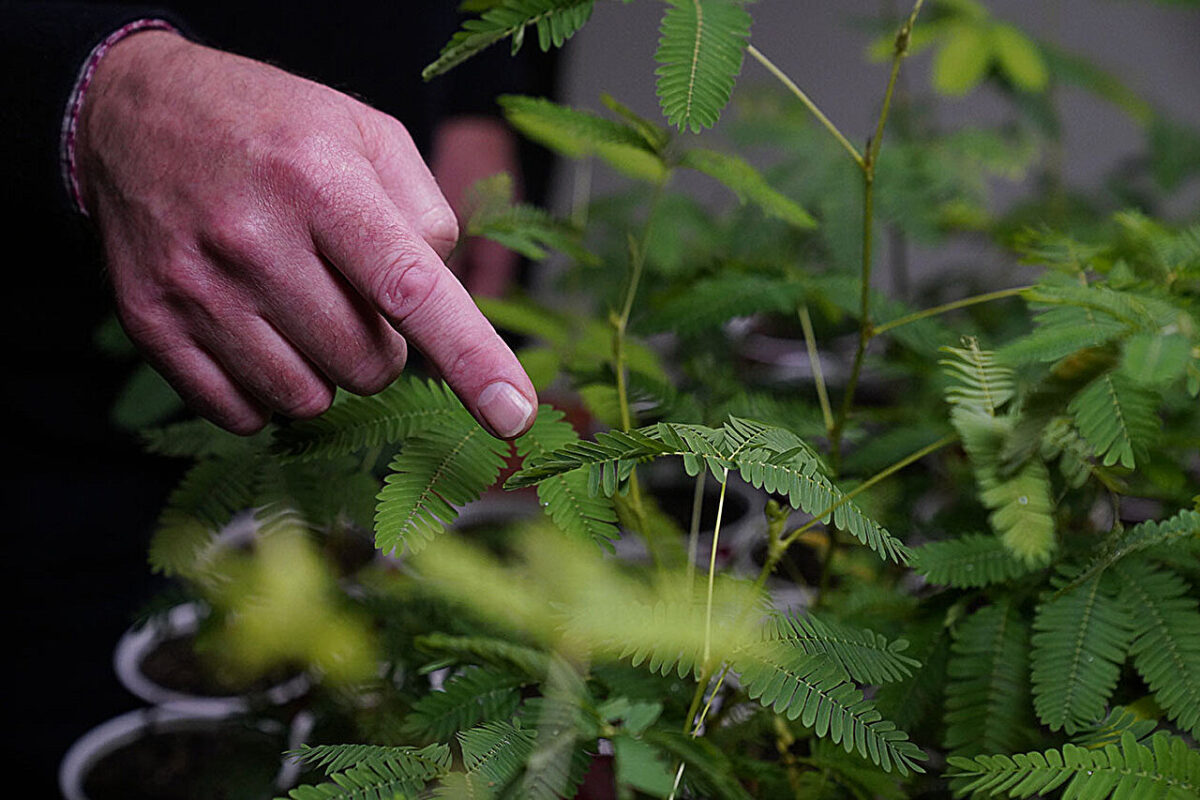
The Study was done on Mimosa Pudica Plants (Image Credits: Stephen Salpukas)
For centuries, intelligence in living organisms has been closely associated with the presence of a brain. Animals with complex nervous systems have traditionally been seen as the primary examples of learning, memory, and decision-making. Plants, by contrast, were often considered passive life forms responding automatically to environmental stimuli.
A new study is challenging that long-standing assumption. Researchers examining the behavior of the sensitive plant have found evidence suggesting that plants may be able to track and respond to repeated events in their environment—something that resembles a primitive form of counting. The discovery opens a surprising window into plant behavior and suggests that botanical life may possess more sophisticated capabilities than previously believed.
A Plant Famous for Its Sensitive Movements
The research focused on Mimosa pudica, often called the “shy plant” or “touch-me-not.” This species is well known for its dramatic leaf movements—its delicate fronds fold inward almost instantly when touched or shaken, a defense mechanism believed to deter herbivores.
Beyond responding to touch, the plant also displays rhythmic movements tied to the day-night cycle. Its leaves close during the night and reopen in the morning, a phenomenon known as nyctinasty. These predictable movements made the species an ideal candidate for studying how plants respond to patterns in their surroundings.
Researchers suspected that these rhythmic behaviors might reveal deeper insights into how plants interpret environmental signals.
The Experiment That Tested Plant “Counting”
The study was led by Peter Vishton from William & Mary, working with student researcher Paige Bartosh. Inside a controlled research tent at the university’s Integrated Science Center, the team exposed Mimosa plants to carefully timed cycles of light and darkness.
For the first two days, the plants experienced a regular schedule of 12 hours of light followed by 12 hours of darkness. On the third day, however, the lights were kept off entirely. The researchers then observed how the plants adjusted their movements in response to these changes.
The results suggested the plants were not simply reacting to the immediate presence or absence of light. Instead, their movements appeared to anticipate when light should return.
Evidence That Plants Track Repeated Events
After several repetitions of the experiment’s light-dark cycle, the plants began to alter their leaf movements before the expected return of light. In other words, they behaved as though they were anticipating dawn based on previous patterns.
However, when the third day of continuous darkness arrived, the anticipated movement did not occur in the same way. This difference suggested that the plants had been keeping track of the number of cycles they experienced rather than simply responding to internal timing alone.
To scientists, this behavior resembles the ability to enumerate—or distinguish between and track discrete events—a capability commonly associated with animals.
A Pattern Seen in Animal Learning
When researchers analyzed the plant movements mathematically, they found that the changes followed a logarithmic learning curve. Early responses shifted rapidly, but over time the plant’s behavior stabilized into a consistent pattern.
Interestingly, this type of curve is commonly seen in animal learning experiments. For example, animals learning sequences or patterns often show rapid improvement initially before reaching a steady performance level.
The similarity suggests that plants may rely on biological mechanisms that function in ways comparable to simple learning systems found in animals—even without a nervous system.
Rethinking Intelligence Without a Brain
The findings challenge the traditional view that cognition requires neurons or a central nervous system. Plants lack both, yet they possess complex biochemical networks that allow them to detect environmental signals and adjust their behavior.
This growing field of research—sometimes referred to as plant cognition or plant behavior—suggests that plants may process information through signaling pathways involving hormones, electrical impulses, and chemical feedback loops.
If plants can indeed track repeated events, it could imply that learning-like processes evolved in multiple forms across life, not only in organisms with brains.
What the Discovery Could Mean for Plant Science
Understanding how plants respond to environmental patterns could have wide-ranging implications. For agriculture, insights into plant learning or adaptation mechanisms might help scientists develop crops that respond more efficiently to changing climates.
The research also contributes to broader scientific discussions about the nature of intelligence in living systems. Rather than being limited to animals, the ability to process information and adjust behavior might exist across many branches of the tree of life.
In this sense, the humble sensitive plant could become a model organism for studying how life interprets patterns in its environment.
Conclusion: A Quiet Revolution in How We View Plants
Discoveries like this highlight how science constantly reshapes our understanding of life. For generations, plants were seen as passive organisms reacting mechanically to their surroundings. Yet study after study continues to reveal that they possess far richer behaviors than previously imagined.
If plants can track events—or even “count” in a biological sense—it forces us to reconsider what intelligence truly means. Intelligence may not be defined solely by neurons, brains, or consciousness. Instead, it may simply emerge wherever life develops systems capable of learning from patterns.
In the end, the sensitive plant reminds us of a profound scientific lesson: the natural world often hides its most fascinating abilities in the quietest places. What looks like stillness in a garden may, in reality, be a subtle form of perception unfolding leaf by leaf.

- Urban Coyotes Show Remarkable Adaptability, Learning to Thrive in City Environments - July 22, 2026
- Beavers Are Nature’s Engineers, Creating Vital Habitats for Other Wildlife Species - July 21, 2026
- The Recovery of the California Condor Offers Hope for Other Critically Endangered Birds - July 21, 2026