

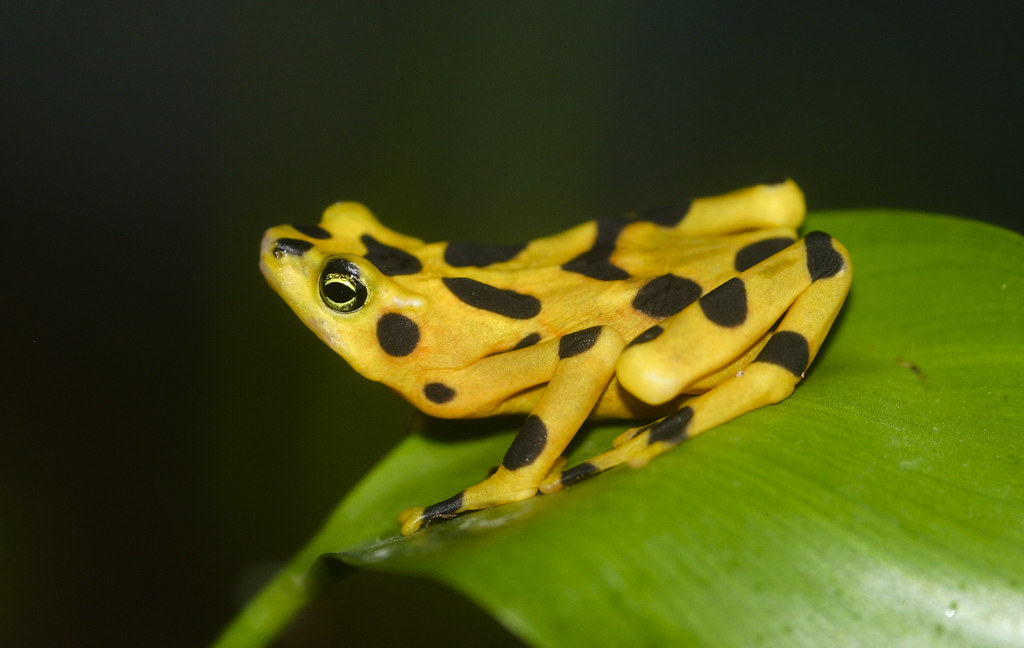
A Vibrant Icon Wiped from the Wild (Image Credits: Flickr)
El Valle de Antón, Panama – Conservationists released captive-bred Panamanian golden frogs into protected enclosures in the wild last year, marking the first such effort since the species vanished from nature in 2009.[1][2] These bright yellow amphibians, a cherished national symbol, succumbed to a devastating fungal disease that swept through their mountain stream habitats. Researchers now track the survivors to unlock the secrets of rewilding in a chytrid-dominated world.
A Vibrant Icon Wiped from the Wild
The Panamanian golden frog, known scientifically as Atelopus zeteki, once thrived along fast-flowing streams in central Panama’s rugged mountains. Endemic to the region, the species captivated locals and visitors with its striking black-spotted yellow skin and diurnal habits.[3] It held deep cultural significance as Panama’s national symbol, featured in folklore and even on lottery tickets.
Chytridiomycosis changed everything. Caused by the fungus Batrachochytrium dendrobatidis, the disease arrived in Central America during the late 1980s, spreading via water, wildlife, and human activity. By 2004, it reached El Valle de Antón, the frogs’ last stronghold, triggering rapid declines. No confirmed sightings occurred after 2009, rendering the species effectively extinct in the wild.[1][2]
Building a Safety Net Through Captive Breeding
In response to the crisis, experts formed the Panama Amphibian Rescue and Conservation Project in 2009. This coalition included the Smithsonian Tropical Research Institute, Smithsonian’s National Zoo and Conservation Biology Institute, Cheyenne Mountain Zoo, and Zoo New England. Their goal focused on establishing assurance colonies for at-risk amphibians, starting with the golden frog.[4]
Over 17 years, these institutions bred hundreds of frogs in controlled environments. Facilities housed the animals safely away from the fungus, allowing populations to grow. Maryland Zoo and Kansas City Zoo also contributed to these efforts, pioneering ex-situ breeding techniques. The work preserved genetic diversity and tested health protocols essential for any future returns to nature.[2]
Launching the Rewilding Experiment
Researchers initiated the first golden frog reintroduction trial in late 2025. They placed 100 captive-bred individuals into mesh-enclosed mesocosms – outdoor pens mimicking natural forest conditions while shielding from predators. Funded partly by Panama’s National Secretary for Science, Technology and Innovation, the setup allowed close monitoring over 12 weeks.[3]
Roberto Ibañez, director of the rescue project and scientist at the Smithsonian Tropical Research Institute, led the team. Assisted by program manager Jorge Guerrel, research technician Orlando Garcés, and fellow Oliver Granucci, they carefully introduced the frogs to their ancestral habitat. “We provide care for some of the most endangered amphibians in Panama, and now we are entering a new phase of our work to study the science of rewilding,” Ibañez stated.[2]
Facing Harsh Realities and Gleaning Insights
The trial revealed stark challenges. Approximately 70 percent of the frogs perished from chytridiomycosis during the enclosure period. The fungus, still prevalent in Panama’s streams, overwhelmed many individuals whose skin defenses had weakened in captivity.[1] Yet, scientists viewed the outcome as a critical data point rather than failure.
Brian Gratwicke, a conservation biologist with the Smithsonian’s National Zoo and Conservation Biology Institute, emphasized the value of the findings. “This project was designed to see what would happen if we put these golden frogs back into a wild situation, just to kind of understand what are the disease dynamics, and how do these frogs regain their skin toxins,” he explained.[1] Necropsies on deceased frogs provided clues about infection progression and toxin regeneration from wild diets. The surviving frogs received full release into the forest, with tracking underway.
- High initial mortality highlighted ongoing chytrid threat.
- Captive frogs lost protective skin toxins, regained slowly on wild prey.
- Mesocosms proved effective for acclimation and study.
- Climatic modeling identified potential “refuge” sites too warm for the fungus.
Pioneering Broader Amphibian Recovery
Golden frog trials built on successes with other species. In 2025, under the Smithsonian’s Tropical Amphibian Research Initiative, teams released crowned tree frogs, Pratt’s rocket frogs, and lemur leaf frogs. Acoustic monitoring detected strong survivorship, especially among lemur leaf frogs.[5] These efforts expanded through partnerships with groups like the Amphibian Survival Alliance.
Gratwicke noted optimism for refinement. “These crucial data will inform our conservation strategy moving forward. Our earlier modeling suggested there may be release sites we can select that will be climatic refuges – places that are suitable for the frogs but too hot for the fungus,” he said.[3] Future releases target such areas, aiming to restore ecosystems where amphibians play key roles in controlling insects.
Key Takeaways
- Panamanian golden frogs vanished from the wild in 2009 due to chytridiomycosis but persist in captive colonies.
- A coalition released 100 frogs into mesocosms; 30 percent survived the 12-week trial for full freedom.
- Data on disease and toxins will guide safer reintroductions in fungus-resistant sites.
This rewilding push offers hope not just for Panama’s golden frogs but for countless species battling chytrid worldwide. While risks remain high, each trial refines the path to recovery. What steps can we take to support amphibian conservation in your region? Share your thoughts in the comments.

- Urban Coyotes Show Remarkable Adaptability, Learning to Thrive in City Environments - July 22, 2026
- Beavers Are Nature’s Engineers, Creating Vital Habitats for Other Wildlife Species - July 21, 2026
- The Recovery of the California Condor Offers Hope for Other Critically Endangered Birds - July 21, 2026