

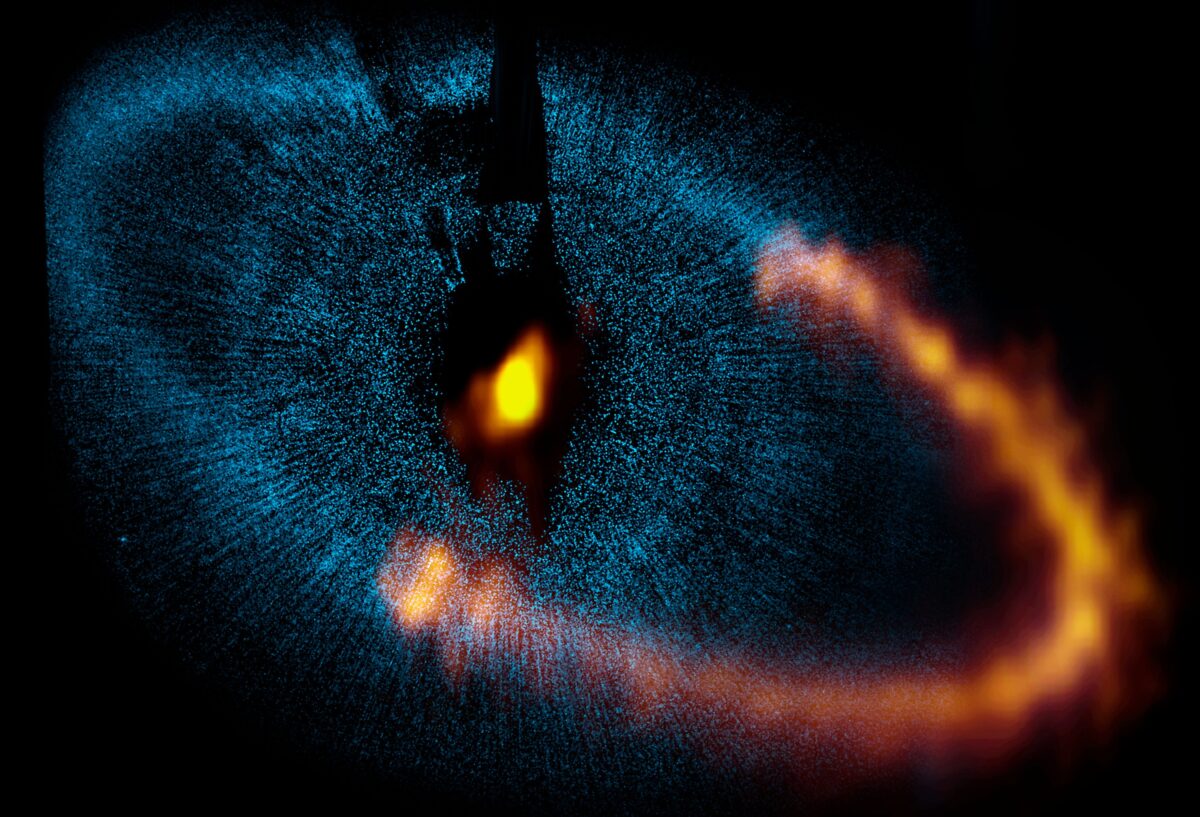
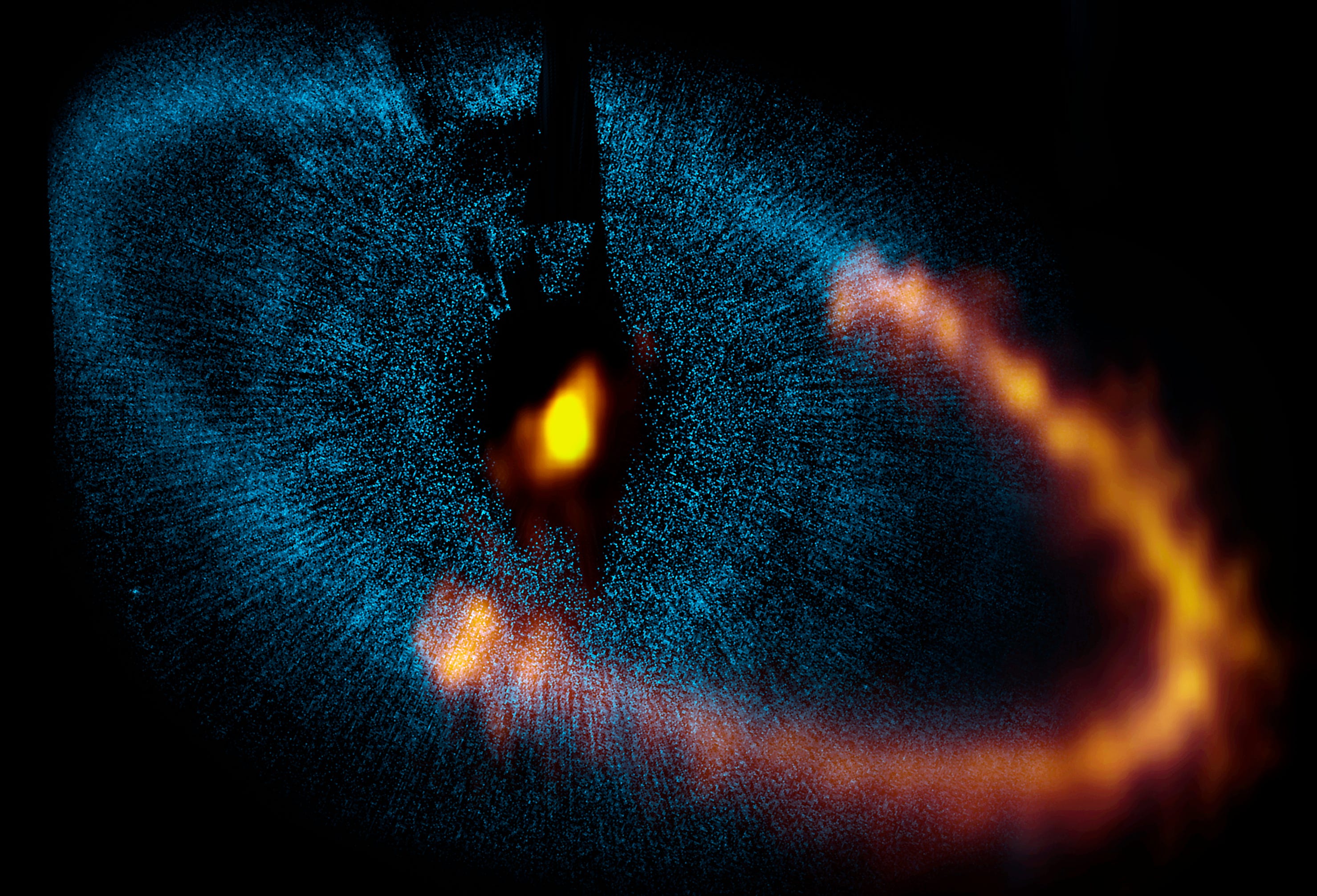
A Surprise in the Debris Disk (Image Credits: Substackcdn.com)
NASA’s Hubble Space Telescope has provided astronomers with a front-row seat to violent collisions between massive asteroids in the Fomalhaut system, located 25 light-years away in the constellation Piscis Austrinus.
A Surprise in the Debris Disk
Astronomers first spotted a bright point of light near Fomalhaut in 2004. They initially hailed it as one of the earliest direct images of an exoplanet, dubbing it Fomalhaut b. The object appeared compact and reflected the star’s light effectively.
Over the next decade, Hubble revisited the system multiple times. The object expanded, faded in brightness, and disappeared entirely by 2014. Its behavior pointed away from a stable planet and toward a transient dust cloud.[1][2]
In 2023, a new luminous speck emerged nearby in Hubble images. Researchers labeled the original sighting cs1 and the newcomer cs2. Both occupied the inner edge of Fomalhaut’s vast outer debris disk, a region teeming with rocky remnants.
Evidence of Catastrophic Impacts
Analysis revealed that cs1 and cs2 stemmed from separate smash-ups between planetesimals roughly 60 kilometers across – objects larger than most known asteroids in our solar system. These high-speed crashes pulverized the bodies into clouds of dust and fragments.
Starlight then exerted radiation pressure on the fine debris, causing the clouds to expand outward rapidly. This explained cs1’s dispersal and the potential fate awaiting cs2. The events unfolded within just two decades of Hubble monitoring, far more frequently than models predicted – one collision every 100,000 years or more.[3]
Principal investigator Paul Kalas of the University of California, Berkeley, described the discovery vividly. “This is certainly the first time I’ve ever seen a point of light appear out of nowhere in an exoplanetary system,” he said. The proximity of the two clouds puzzled scientists, as random impacts should scatter them farther apart.
Timeline of Key Observations
- 2004: Hubble detects initial bright object (cs1, later Fomalhaut b).
- 2008: Confirmed as candidate exoplanet in visible light.
- Early 2010s: Object expands and fades under radiation pressure.
- 2014: cs1 vanishes completely.
- 2023: New object cs2 appears near the same region.
- December 2025: Findings published in Science.
These milestones underscored Hubble’s long-term vigilance. The star Fomalhaut, about 500 million years old and more massive than the Sun, hosts multiple debris belts akin to our Kuiper Belt.
Implications for Planetary Evolution
Such collisions represent a chaotic phase in system development, where planetesimals merge or shatter to build planets. Co-author Mark Wyatt of the University of Cambridge noted that the observations allow estimates of the destroyed bodies’ sizes and the disk’s population – around 300 million similar objects orbit Fomalhaut.
The findings serve as a caution for exoplanet hunters. Dust clouds like cs2 mimic planets in reflected light, potentially fooling future telescopes. “What we learned from studying cs1 is that a large dust cloud can masquerade as a planet for many years,” Kalas explained.[4]
Fomalhaut’s system offers a live laboratory for these processes, absent in our stabilized solar system today. Unseen planets or companion stars might herd debris into collision zones, sparking the recent flares.
Looking Ahead to More Revelations
Astronomers secured additional Hubble time to track cs2’s evolution over three years. They anticipate changes in its shape, brightness, or orbit as it interacts with surrounding material.
The James Webb Space Telescope will join with infrared observations via its NIRCam instrument. These could reveal dust grain sizes, compositions, and even traces of water ice, deepening insights into planetesimal makeup.
Key Takeaways
- Two debris clouds from asteroid-scale collisions observed in 20 years around Fomalhaut.
- Impacts involve 60-km objects, producing expanding dust pushed by stellar radiation.
- Discovery challenges exoplanet detection and illuminates ongoing planet formation.
These cosmic wrecks highlight the dynamic youth of planetary systems. As Fomalhaut sparkles with destruction, it reminds us of our own solar system’s violent past. What surprises might the next Hubble images bring? Share your thoughts in the comments.

As a little kid, I fell in love with nature, wildlife, and animals. Living in the USA, South Africa, Italy, China and Germany gave me the opportunity to discover the world's Wildlife. My favorite animals are Mountain Gorillas, Siberian Tigers, and Great White Sharks.
I'm a certified PADI Open Water Diver, went to Everest Base Camp and Trekked Gorillas in Uganda. I hold a Master of Science in Economics and Finance.
Please send any feedback to feedback@animalsaroundtheglobe.com
- 13 Animals Only Found on One Island - July 22, 2026
- 10 Common Gardening Mistakes You’re Probably Making (And How to Avoid Them) - July 22, 2026
- 14 Most Iconic National Parks Protecting U.S. Wildlife - July 22, 2026