

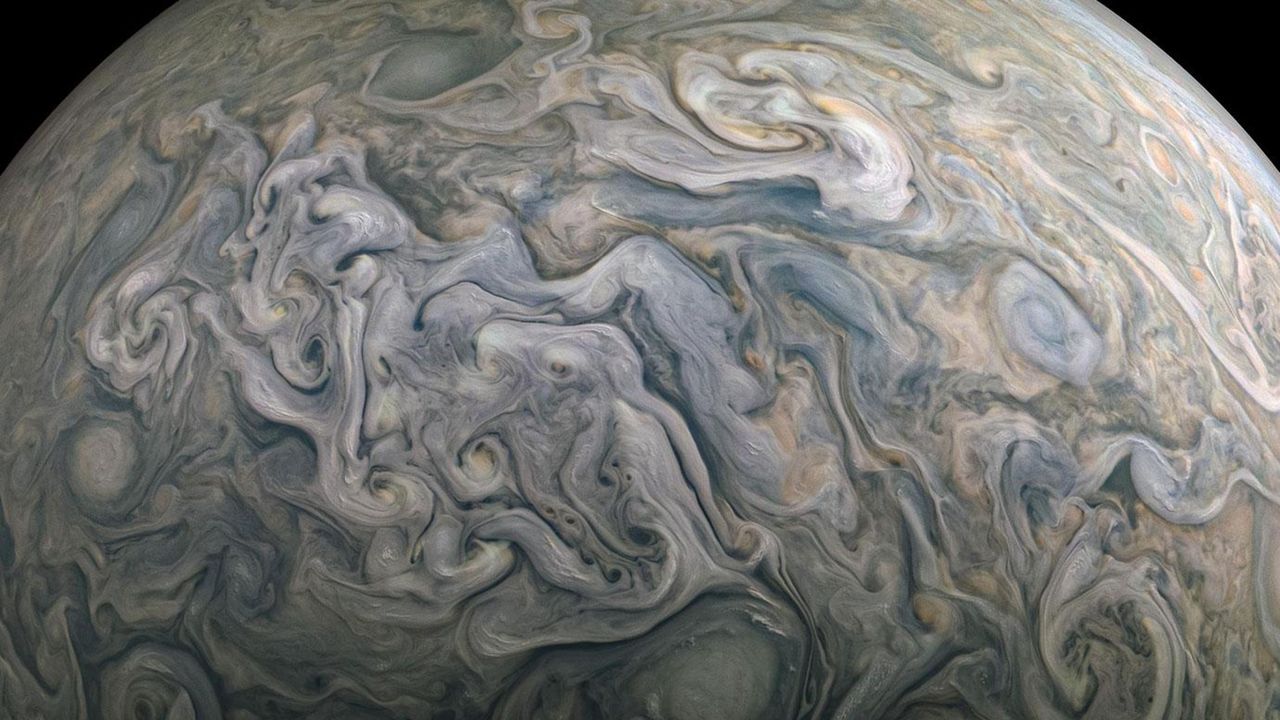
A Startling Find Beneath the Clouds (Image Credits: Cdn.mos.cms.futurecdn.net)
Astronomers have long puzzled over the composition of Jupiter’s vast atmosphere, but new computer models now indicate the gas giant possesses about 1.5 times more oxygen than the sun.
A Startling Find Beneath the Clouds
Jupiter’s swirling storms and colorful bands have captivated scientists since ancient times, yet the planet’s deeper layers remained elusive. Recent simulations, detailed in a study published this month, revealed an oxygen abundance that surpasses solar levels by 50 percent. This discovery challenges previous assumptions about the building blocks of our solar system’s largest planet.
Researchers combined chemical kinetics with fluid dynamics to model Jupiter’s interior. The results suggest oxygen, locked in water and other compounds, plays a larger role than expected. No spacecraft has penetrated far enough to confirm this directly, but the models align with data from past missions like Juno.
Decoding the Simulation Techniques
The team developed a coupled one-dimensional chemical transport model with two-dimensional hydrodynamics to simulate atmospheric mixing. These tools accounted for slower circulation rates than previously thought, allowing oxygen-rich materials to accumulate. Jupiter’s clouds, denser than Earth’s, obscure direct measurements, so such simulations provide the clearest view yet.
By integrating observations from NASA’s Juno spacecraft, the models predicted oxygen levels at depths beyond the observable surface. The process highlighted how water ice from the early solar system could have been incorporated during Jupiter’s formation. This approach not only refined estimates but also exposed gaps in earlier theories.
Clues to Planetary Formation
This oxygen excess points to Jupiter forming in a region abundant with water ice beyond the sun’s primary composition. Early in the solar system’s history, planetesimals carried oxygen-bearing ices that the young Jupiter accreted. The sun, by contrast, retained a more uniform mix from the primordial nebula.
Such findings refine models of how gas giants assemble. Jupiter likely migrated inward after formation, gathering diverse materials. This migration theory gains support from the oxygen data, suggesting dynamic processes shaped the outer planets.
Implications for Distant Worlds
Beyond our solar system, these insights could explain atmospheres of exoplanets detected by telescopes like James Webb. Many gas giants show varied compositions, and understanding Jupiter’s oxygen story offers a template. Astronomers now anticipate similar enrichments in worlds orbiting young stars.
Future missions, such as proposed probes to Uranus and Neptune, may test these ideas further. For now, the simulations underscore Jupiter’s role as a preserved snapshot of solar system youth. They also highlight the need for advanced modeling to unlock other planetary secrets.
Key Takeaways
- Jupiter’s oxygen level reaches 1.5 times that of the sun, based on recent simulations.
- Slower atmospheric mixing allows oxygen accumulation from water-rich ices.
- The discovery supports theories of planetary migration and formation in icy zones.
As these simulations illuminate Jupiter’s hidden chemistry, they remind us how much our cosmic neighborhood still holds in store. This oxygen revelation not only redefines the king of planets but also invites deeper exploration of formation processes across the universe. What aspects of Jupiter’s atmosphere intrigue you most? Share your thoughts in the comments.

- 10 Cat Breeds That Get Along With Dogs – and 10 That Absolutely Don’t - July 29, 2026
- These 10 US Villages Are So Beautiful They Feel Like a Step Back in Time - July 29, 2026
- The Best Dogs for Apartment Life in New York City - July 29, 2026