

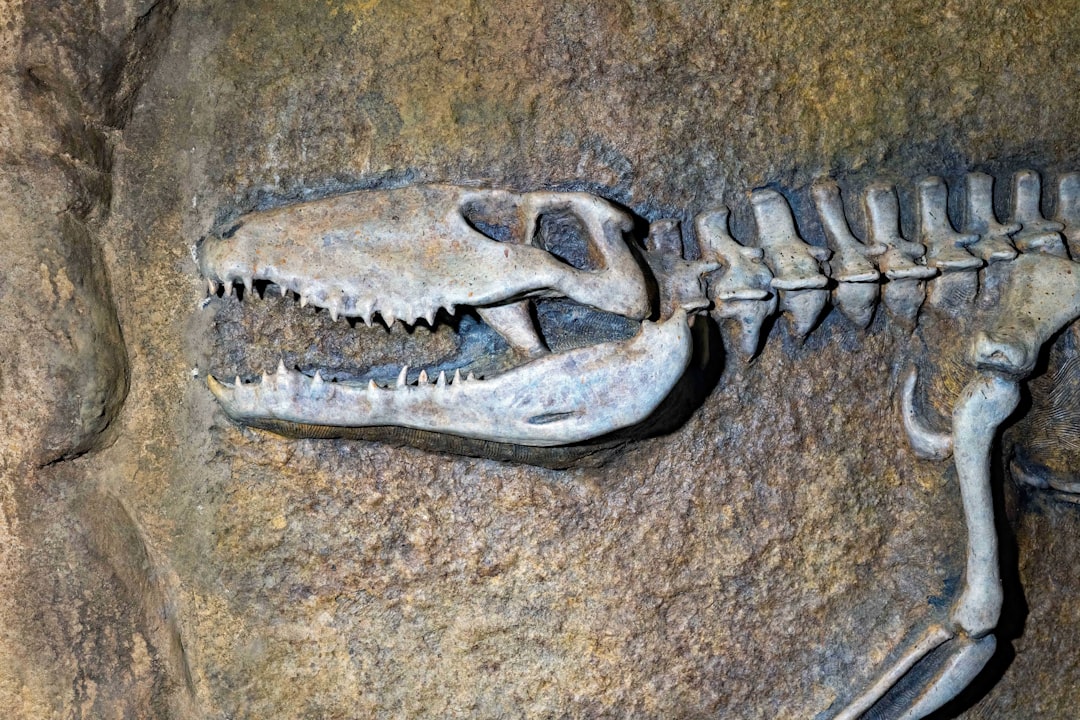
Ghost Ranch, New Mexico – Scientists have identified a long-ignored fossil from 1948 as a distinct prehistoric reptile, Eosphorosuchus lacrimosa, dating back 200 million years to the Late Triassic period. This early crocodylomorph, named after the dawn-bringing morning star, featured adaptations for a notably strong bite that set it apart from its kin. Modern imaging technology has brought its hidden anatomy to light, offering fresh insights into the evolutionary paths of crocodile relatives.
From Quarry to Drawer: A 75-Year Wait
Workers unearthed the specimen amid the rich fossil beds of Ghost Ranch, a site renowned for Triassic treasures. Initial examinations labeled it Hesperosuchus agilis, a slender early crocodile relative, but no full description followed. The bones then languished in a museum collection, overlooked as research priorities shifted.
Recent studies highlighted complexities within the sphenosuchian family, prompting a closer look. Lead researcher Miranda Margulis-Ohnuma and her team revisited the fossil, confirming it represented an entirely new genus. This rediscovery underscores how museum holdings continue to yield surprises decades later.
Unlocking Secrets with Cutting-Edge Scans
The fossil’s partial embedding in rock concealed crucial details, but microCT scanning provided a noninvasive solution. The technique generated thousands of X-ray slices, allowing researchers to peer inside without risk. They digitally isolated crushed elements and reconstructed a precise 3D model of the skull.
These models also simulated biomechanical stresses on the snout. Results demonstrated exceptional resistance to bending forces, far surpassing those of similar species. Such methods have revolutionized paleontology, turning incomplete remains into comprehensive anatomical portraits. The findings appeared in a recent paper in Proceedings of the Royal Society B.
Anatomy Built for Crushing Power
Eosphorosuchus stood out with its compact, fortified snout, diverging from the elongated profiles common among early crocodylomorphs. A prominent ridge along the lower jaw and a robust skull arch pointed to enhanced muscle attachments. These traits hinted at a bite optimized for tackling tough prey.
Another distinctive element emerged in the antorbital fenestra, a narrow slit in front of the eyes much smaller than in relatives. The research team noted, “These autapomorphies suggest specialization for a powerful bite.” Digital tests validated this, showing the snout endured greater loads without deformation.
- Short, reinforced snout for durability
- Strong lower jaw ridge supporting massive muscles
- Heavy skull arch enhancing bite force
- Slit-like antorbital fenestra, uniquely compact
- Overall structure resisting high bending stresses
Signs of Early Evolutionary Splits
This discovery challenges prior views of uniform hunting strategies among early crocodylomorphs. Instead, Eosphorosuchus displayed specialized features for distinct prey types, marking an early branch in ecological roles. Its adaptations foreshadowed the varied niches later crocodilians would occupy.
The team explained, “The specializations of E. lacrimosa therefore represent the beginnings of ecological diversification within Crocodylomorpha.” Such variety likely fueled the group’s success through the Mesozoic. Ghost Ranch’s yields, including this specimen, continue to refine our picture of Triassic diversity.
| Feature | Eosphorosuchus lacrimosa | Typical Early Relatives (e.g., Hesperosuchus) |
|---|---|---|
| Snout Shape | Short and reinforced | Long and slender |
| Jaw Ridge | Prominent and strong | Less developed |
| Antorbital Fenestra | Small, slit-like | Larger and rounded |
| Bite Strength | High resistance to forces | Lower comparative durability |
Key Takeaways
- Eosphorosuchus lacrimosa expands known diversity of 200-million-year-old crocodylomorphs.
- Advanced scans revealed a bite specialized for powerful predation.
- The find signals early ecological splits, reshaping Triassic reptile evolution.
The tale of Eosphorosuchus lacrimosa reminds us that history’s pages remain partly unturned in museum archives. This dawn predator’s robust jaws highlight nature’s inventive pressures on ancient lineages. What other forgotten fossils might rewrite our understanding next? Share your thoughts in the comments.

- Urban Coyotes Show Remarkable Adaptability, Learning to Thrive in City Environments - July 22, 2026
- Beavers Are Nature’s Engineers, Creating Vital Habitats for Other Wildlife Species - July 21, 2026
- The Recovery of the California Condor Offers Hope for Other Critically Endangered Birds - July 21, 2026