

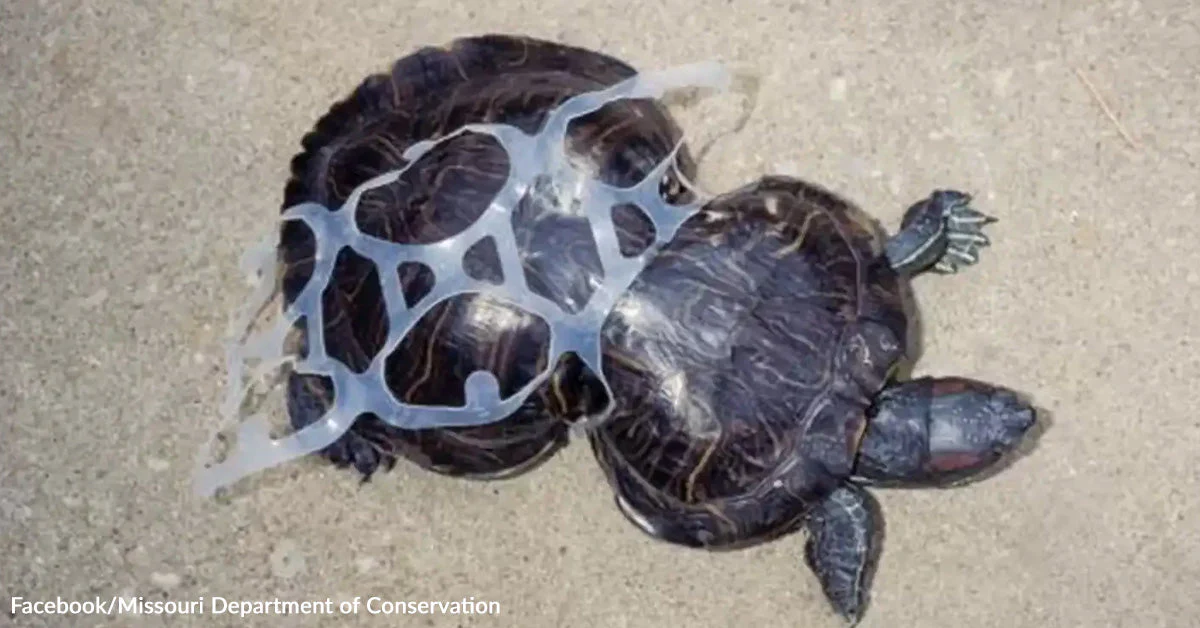
Rescue and Recovery in 1993 (Image Credits: Facebook)
Missouri – In the early 1980s, a red-eared slider turtle hatched amid the state’s natural waterways, poised for a typical wild existence.[1][2] That path shifted dramatically when a discarded plastic six-pack ring ensnared her young shell. As she grew, the unyielding plastic compressed her midsection, forging a distinctive hourglass shape that complicated movement and survival. Rescued three decades ago, Peanut now serves as a living testament to the perils of litter, outlasting expectations under dedicated care.
The Hidden Dangers of Everyday Litter
A small plastic ring from a beverage six-pack seemed harmless when tossed aside. For Peanut, however, it became a vise around her developing shell. Hatched in the wilds of Missouri, she encountered the litter during her vulnerable juvenile phase.[1] The ring failed to stretch or snap, instead cinching tighter relative to her expanding body.
Predators posed constant threats, and basic tasks like foraging exhausted her deformed frame. Conservation experts later noted that such entanglements often prove fatal for wildlife. Peanut’s case stood out because she persisted long enough for intervention. Her story underscores how seemingly minor waste inflicts lasting harm on ecosystems.
Rescue and Recovery in 1993
Discovery came in 1993 when a concerned individual spotted the struggling turtle, likely in the St. Louis region, and carefully cut away the plastic ring.[3] The Missouri Department of Conservation assumed custody immediately afterward. Return to the wild proved impossible due to her permanent deformity.
Examinations revealed a misshapen shell and altered internal structure. Caretakers monitored her closely, uncertain about her longevity. Yet Peanut adapted, gaining strength in a controlled environment. This pivotal rescue marked the start of her transformation from victim to advocate.
Thriving as an Educational Ambassador
Today, Peanut resides under the Missouri Department of Conservation’s care, approaching her mid-40s.[1] Celebrations marked her 41st birthday in 2025, complete with public fanfare. Her hourglass shell remains a stark visual reminder, visible whether she swims or rests.
Handler Amy Wilkinson observed that visitors react with shock and empathy upon learning her story. “They get it,” she said, capturing the immediate connection people form.[1] Caretakers affectionately call her a “litter-fighting superhero,” highlighting her robust health despite the odds. Red-eared sliders rarely reach such ages in the wild, making her endurance remarkable.
Global Impact on Conservation Efforts
Peanut’s image has circulated worldwide through campaigns by the Missouri Department of Conservation. Her plight anchors discussions on plastic pollution, prompting behavioral shifts in litter disposal.[4] Schools, events, and media features amplify her message, linking personal actions to wildlife welfare.
Here are key ways her story influences change:
- Illustrates long-term effects of six-pack rings on growing animals.
- Encourages cutting rings before disposal to prevent entanglements.
- Boosts participation in cleanup drives and anti-litter initiatives.
- Humanizes conservation, fostering empathy for affected species.
- Inspires policy discussions on reducing single-use plastics.
From local Missouri outreach to international posts, Peanut’s legacy endures.
Key Takeaways
- Discarded plastics like six-pack rings cause irreversible deformities in wildlife.
- Proper disposal and cutting rings save lives – simple steps with profound impact.
- One rescued animal can drive widespread environmental awareness.
Peanut’s journey from near-death to icon proves that survival stories can ignite action. Her deformed yet defiant shell challenges passersby to reconsider their waste habits. What steps will you take to protect wildlife like her? Share your thoughts in the comments.

- Urban Coyotes Show Remarkable Adaptability, Learning to Thrive in City Environments - July 22, 2026
- Beavers Are Nature’s Engineers, Creating Vital Habitats for Other Wildlife Species - July 21, 2026
- The Recovery of the California Condor Offers Hope for Other Critically Endangered Birds - July 21, 2026