

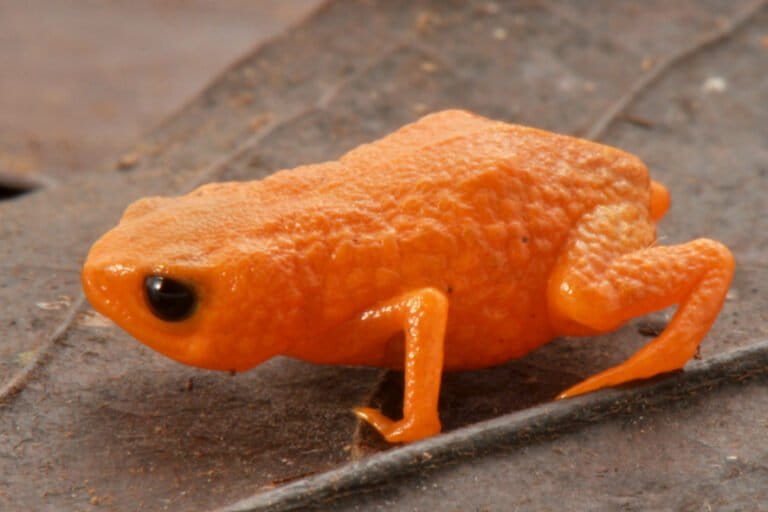

Brachycephalus luladinis (Image Credits: Imgs.mongabay.com)
Southern Brazil – Researchers have unveiled a diminutive amphibian that adds a vibrant splash to the region’s biodiversity.
A Serendipitous Find in the Clouds
The discovery began with the faint echoes of an unusual call amid the misty heights of the Serra do Quiriri mountain range. Scientists, drawn by these distinctive vocalizations, ventured into the damp understory of the Atlantic Forest. What they found was a frog no larger than a pencil tip, its brilliant orange hue standing out against the lush green backdrop. This tiny creature, measuring just over a centimeter in length, represents a species previously unknown to science.
Teams from Brazilian institutions led the expedition, meticulously documenting the frog’s behavior and habitat. The amphibian’s mating calls, consisting of short, pulsed notes, proved key to pinpointing its location. Unlike larger relatives, this toadlet relies on such sounds to navigate its foggy, forested home. The find underscores how even well-explored areas can harbor secrets, especially in cloud-shrouded elevations where visibility remains low.
Distinctive Traits of the Miniature Toadlet
Belonging to the Brachycephalus genus, commonly known as pumpkin toadlets, this new species boasts a vivid orange coloration that serves as both camouflage and warning. Its body, compact and rounded, lacks the long legs typical of many frogs, adapted instead for hopping across leaf litter. At less than half an inch long, it rivals the size of an average fingernail, making it one of the smallest vertebrates in the region.
Physical examinations revealed unique skeletal features, including reduced digits that aid in its terrestrial lifestyle. The toadlet’s skin, smooth and glossy, helps retain moisture in the humid environment. Observations showed it active during the day, foraging for small insects among decaying vegetation. These adaptations highlight its specialized role within the ecosystem, contributing to insect control in its microhabitat.
Honoring a Leader: The Naming Ceremony
The research team chose to name the species Brachycephalus luladinis, paying tribute to Brazil’s President Luiz Inácio Lula da Silva. This decision reflects the leader’s environmental advocacy and commitment to preserving the Atlantic Forest. The naming occurred as part of a peer-reviewed study published in late 2025, detailing the frog’s morphology and genetics.
Such honors in taxonomy often recognize contributions to conservation, and this case emphasizes the intersection of politics and ecology. The species’ description included genetic analysis confirming its distinction from close relatives. Researchers noted subtle differences in call patterns and color intensity that set it apart. This formal christening marks a milestone, integrating cultural significance into scientific nomenclature.
Habitat Challenges and Conservation Outlook
The Atlantic Forest, where the toadlet resides, spans a biodiversity hotspot now reduced to fragments due to historical deforestation. Cloud forests like those in Serra do Quiriri face threats from climate change and habitat loss, yet this area remains relatively intact. The new species thrives in elevations above 1,000 meters, where frequent mists support its moisture needs.
Conservation assessments classify Brachycephalus luladinis as of least concern, thanks to its occurrence within protected reserves. However, ongoing monitoring is essential to track population trends. Efforts include expanding protected zones and studying climate impacts on amphibian reproduction. Local initiatives promote reforestation, aiming to safeguard similar microhabitats.
Key features of the toadlet include:
- Vivid orange skin for aposematic signaling.
- Compact size under 1.2 cm, ideal for leaf litter navigation.
- Unique four-pulsed mating call for species recognition.
- Terrestrial habits with minimal climbing ability.
- Dependence on humid, misty environments.
Key Takeaways
- The discovery highlights untapped biodiversity in Brazil’s cloud forests.
- Naming after Lula ties science to environmental policy.
- Protected status offers hope, but vigilance against habitat threats is crucial.
This bright-orange toadlet serves as a reminder of nature’s resilience and the discoveries awaiting in overlooked corners of the world. As Brazil continues to champion forest preservation, species like Brachycephalus luladinis symbolize progress. What do you think about this tiny ambassador for conservation? Tell us in the comments.

- 23 Dog Breeds Trainers Say First-Time Owners Regret - July 29, 2026
- 18 Horse Breeds Farriers Say Are Hard on Hooves - July 29, 2026
- 21 Horse Breeds Equine Vets Wish Auction Buyers Would Research First - July 29, 2026