

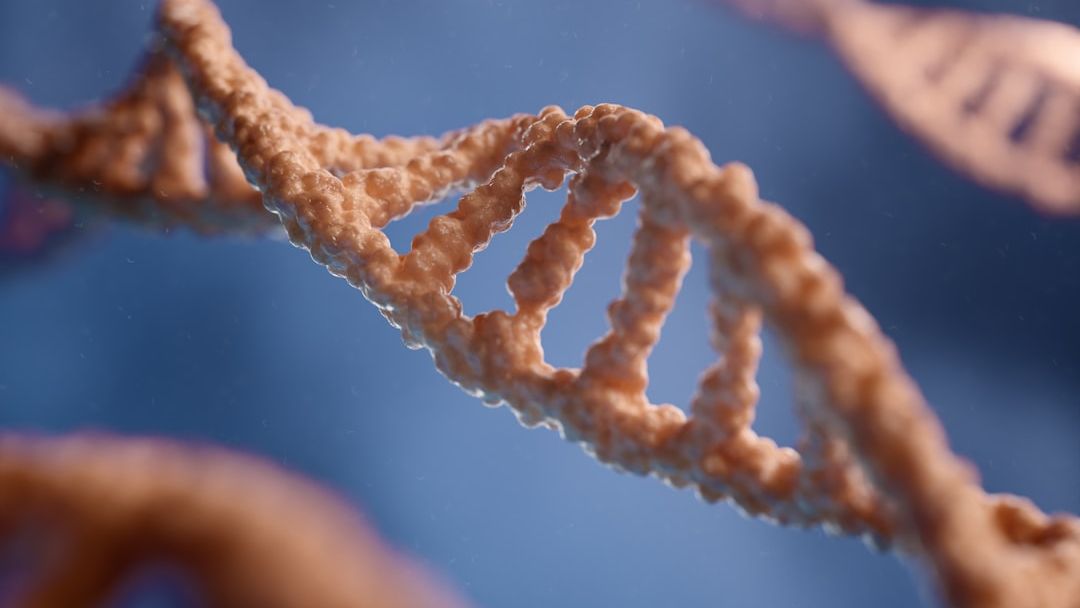
Modern humans carry genetic traces from encounters that took place deep in prehistory, long before written records or even spoken language existed. A fresh examination of proteins extracted from fossilized teeth now points to one of the earliest of those encounters, showing that Denisovans served as genetic intermediaries between Homo erectus and later populations. The discovery adds a concrete layer to the story of how our species assembled its genome through repeated mixing with other human groups across Eurasia.
The Challenge of Reaching Farther Back in Time
DNA breaks down over tens of thousands of years, leaving scientists with a practical cutoff for direct sequencing. Cooler and drier burial conditions can slow the decay, yet even under ideal circumstances the double helix fragments beyond recovery after roughly 100,000 years in most environments. Homo erectus, which left Africa more than a million years ago and spread across much of Eurasia, falls well outside that window. Researchers have therefore turned to proteins, which survive longer because their amino-acid sequences are more stable than the nucleotide chains of DNA.
Teeth, in particular, offer a protected environment for these molecules. Enamel and dentin shield proteins from water, microbes, and temperature swings that destroy DNA elsewhere in the skeleton. By analyzing the proteins that remain, scientists can reconstruct aspects of an individual’s biology even when no usable genetic material survives.
Proteins Point to an Unexpected Genetic Source
The new work focused on dental remains associated with Denisovan populations in Asia. The protein sequences recovered matched patterns previously known only from Homo erectus fossils found in Java and elsewhere. Because Denisovans themselves lived much later than the earliest Homo erectus groups, the only plausible explanation is that Denisovans inherited those protein variants through earlier interbreeding. Modern humans, in turn, received some of the same variants when they mixed with Denisovans after leaving Africa.
This chain of inheritance explains why certain protein signatures appear in present-day human genomes yet cannot be traced to Neanderthals or to the main African lineage. The proteins therefore serve as indirect but durable markers of a relationship that DNA alone could no longer document.
Revising the Map of Human Interbreeding
Until now, the Denisovan genome had already hinted at an unknown archaic contribution, but the source remained unidentified. The tooth-protein data supply a candidate that fits both the geographic range and the deep timeline required. Homo erectus occupied large parts of Asia for hundreds of thousands of years, creating ample opportunity for contact with later groups such as Denisovans.
The finding also underscores that interbreeding was not a single event but a recurring process. Each wave of migrants from Africa encountered resident populations that had already absorbed genes from still earlier groups. The result is a layered genome in which segments from multiple species coexist in living people today.
What the Discovery Changes for Understanding Our Origins
Genetic studies of living populations can now be interpreted with greater precision. Segments previously labeled simply as “archaic” can be assigned more confidently to specific source species. This matters for medical research, because some of those segments influence traits such as immune response and metabolism that still affect health outcomes.
At the same time, the work highlights the value of combining multiple lines of evidence. Proteins, isotopes, and stone tools together paint a richer picture than any single method can provide. Future excavations in under-sampled regions of Asia may yield additional protein data that further clarify the sequence of contacts.
The broader lesson is that human evolution was never a straight line from one species to the next. Instead, it resembles a braided stream in which separate channels repeatedly merged and diverged. The proteins locked inside a few ancient teeth now make one of those long-hidden merges visible, reminding us that our species is the product of many such encounters across deep time.

As a little kid, I fell in love with nature, wildlife, and animals. Living in the USA, South Africa, Italy, China and Germany gave me the opportunity to discover the world's Wildlife. My favorite animals are Mountain Gorillas, Siberian Tigers, and Great White Sharks.
I'm a certified PADI Open Water Diver, went to Everest Base Camp and Trekked Gorillas in Uganda. I hold a Master of Science in Economics and Finance.
Please send any feedback to feedback@animalsaroundtheglobe.com
- 12 Rare Creatures Spotted in the Amazon - July 14, 2026
- The Largest Snake Ever Found in a US Swamp And It Is Still Growing - July 14, 2026
- 11 Predators Smaller Than Their Prey - July 14, 2026