

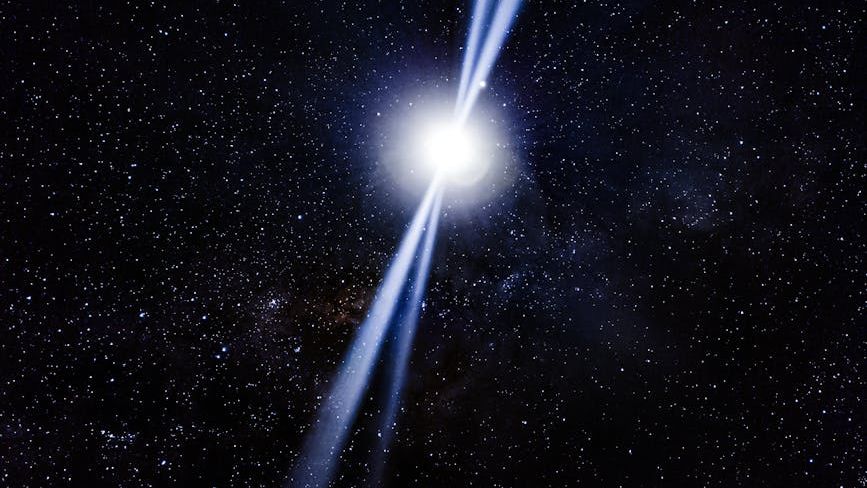
How Super-Quasars Shaped Early Galaxies and Confounded the JWST – Image for illustrative purposes only (Image credits: Pexels)
Astronomers have long puzzled over the James Webb Space Telescope’s images of the early universe, which revealed galaxies that appeared more mature and structured than models had predicted. New analysis points to a specific group of extremely powerful quasars as the missing piece. These objects, active when the cosmos was still young, expelled vast amounts of star-forming gas from their host galaxies and thereby altered the pace of cosmic evolution.
Early Quasars and Their Dramatic Reach
Quasars rank among the brightest objects in the universe, powered by supermassive black holes that consume surrounding material at enormous rates. In the first few hundred million years after the Big Bang, a subset of these quasars operated at exceptional strength. Their intense radiation and outflows pushed star-forming gas outward, stripping galaxies of the raw material needed for new stars. The result was a rapid change in how those galaxies grew and evolved. This process did not occur in isolation. The expelled gas influenced neighboring regions, limiting star formation across wider areas. Models now show that such feedback loops can account for the unexpectedly compact and evolved appearance of some early galaxies captured by JWST. Without this clearing mechanism, the observed structures would have required far more time to assemble.
Resolving the Telescope’s Surprising Findings
JWST data have repeatedly shown galaxies with well-defined shapes and substantial stellar masses at redshifts that correspond to less than 500 million years after the Big Bang. Standard simulations struggled to produce such features so quickly. The super-quasar outflows provide a direct explanation: by removing gas early, they prevented excessive star formation that would otherwise have created larger, more diffuse systems. The same outflows also heated and dispersed material on larger scales, reducing the overall gas reservoir available for later generations of stars. This matches the lower-than-expected star-formation rates inferred from several JWST fields. Researchers note that the timing and intensity of these events align closely with the redshift range where the telescope’s anomalies are most pronounced.
Implications for Galaxy Formation Models
Incorporating super-quasar feedback into simulations brings theoretical predictions into better agreement with observations. Galaxies that experienced strong early outflows end up smaller and more centrally concentrated, precisely the traits highlighted in recent JWST releases. The mechanism also helps explain why some regions of the early universe appear relatively quiet in star formation despite abundant dark matter halos. Future observations with both JWST and ground-based facilities will test these revised models by mapping gas kinematics around known high-redshift quasars. If the outflows prove as widespread as current indications suggest, astronomers will gain a clearer timeline for when and how the first galaxies transitioned from gas-rich nurseries to the more settled systems seen later in cosmic history.
What matters now is that super-quasar activity offers a concrete physical process capable of reconciling JWST data with established cosmology, shifting focus from unexpected anomalies to measurable feedback effects.
The discovery underscores how energetic events in the first galaxies helped set the stage for the universe we observe today. Continued study of these distant quasars will refine our understanding of the delicate balance between black-hole growth and galaxy assembly across cosmic time.

As a little kid, I fell in love with nature, wildlife, and animals. Living in the USA, South Africa, Italy, China and Germany gave me the opportunity to discover the world's Wildlife. My favorite animals are Mountain Gorillas, Siberian Tigers, and Great White Sharks.
I'm a certified PADI Open Water Diver, went to Everest Base Camp and Trekked Gorillas in Uganda. I hold a Master of Science in Economics and Finance.
Please send any feedback to feedback@animalsaroundtheglobe.com
- 13 Cat Breeds That Get Along with Dogs - July 20, 2026
- The 12 Largest Dog Breeds That Still Love to Cuddle - July 20, 2026
- 12 Pet Habits That Secretly Mean They Love You - July 20, 2026