

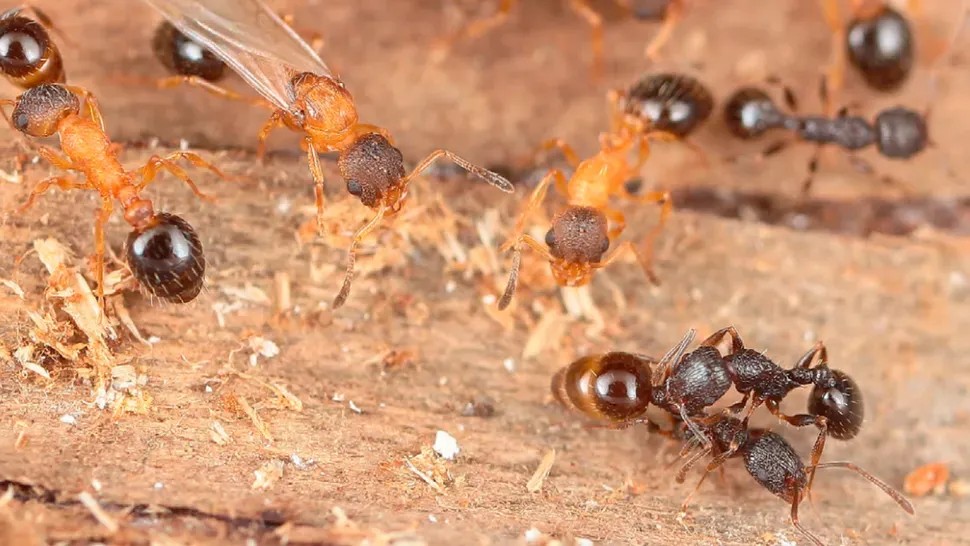
Nature has a way of making you rethink everything you thought you knew. Just when you settle into some comfortable understanding of how the animal world works, something comes along and flips the script entirely.
There is an ant species out there where the concept of a “worker” simply doesn’t exist. No queens ruling over a colony of dutiful laborers. No rigid social hierarchy. Every single individual is a queen, capable of reproducing, and they do it by cloning themselves. Oh, and they also take over the colonies of other ant species to survive. Honestly, this is the kind of biology that sounds like science fiction. Let’s dive in.
Meet the Ant That Rewrites the Rules of Colony Life
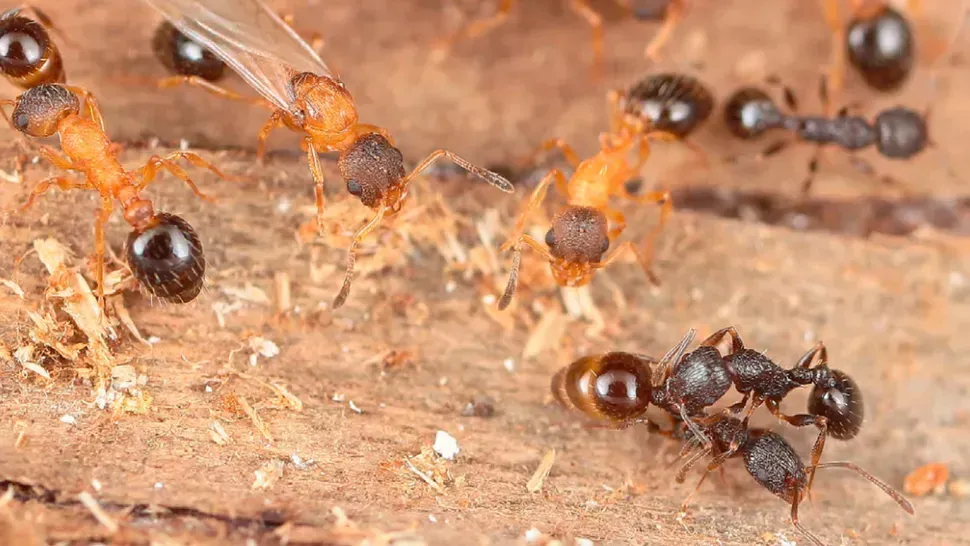
Most people picture an ant colony as a well-oiled machine with one queen at the top and thousands of workers doing the heavy lifting. That image simply does not apply to Mycocepurus castrator, a parasitic fungus-farming ant species found in Central and South America. Every female in this species is reproductively capable, meaning the colony has no worker caste at all.
This is extraordinarily rare in the ant world. Think of it like a company where every single employee is also the CEO. It sounds chaotic, yet it somehow works. Researchers have confirmed that all females in this species share identical genetic material, making them essentially clones of one another. That alone is enough to raise eyebrows, but the story gets even stranger from there.
The Science of All-Queen Colonies and Clonal Reproduction
Clonal reproduction in ants is not completely unheard of, but it is vanishingly rare. In Mycocepurus castrator, females reproduce through a process called thelytokous parthenogenesis. In plain terms, they produce offspring without mating, and those offspring are genetically identical to the mother.
Here’s the thing about clonal reproduction though: it removes genetic diversity almost entirely from the equation. That is a double-edged situation in evolutionary biology. On one hand, it allows every individual to pass on her full genetic code rather than just half. On the other hand, a single disease or environmental shift could theoretically devastate an entire population. It’s hard to say for sure how this species manages that risk long term, but clearly it has been working well enough to persist.
How This Species Hijacks the Colonies of Others
Here is where things get genuinely unsettling. Mycocepurus castrator does not build its own colony infrastructure. Instead, it infiltrates and parasitizes the colonies of a closely related ant species called Mycocepurus goeldii. The parasitic ants essentially move in, and the host colony ends up doing much of the labor.
This type of relationship is called social parasitism, and it is a fascinating and honestly ruthless survival strategy. The host workers raise the parasitic offspring as if they were their own. Over time, the parasitic species reproduces and spreads within the host colony while contributing nothing in return. It is a bit like a cuckoo bird laying eggs in another bird’s nest, except in this case the “cuckoo” takes over the whole household and never leaves.
What Makes the Fungus-Farming Connection So Intriguing
Both Mycocepurus castrator and its host species are fungus-farming ants, meaning they cultivate fungal gardens as their primary food source. This shared lifestyle is actually what makes the parasitic relationship possible. The parasite can exploit the host colony’s existing fungal garden without needing to establish or maintain one of its own.
I find this detail particularly clever from an evolutionary standpoint. The parasite essentially freeloads off a food-production system that took countless generations for the host species to develop and refine. It is almost impressively lazy, in the most scientifically interesting way possible. The fungal gardens serve as the foundation of the entire dynamic, making this not just a story about ants but also about the complex ecosystems that form within colonies themselves.
Genetic Evidence That Confirmed the Cloning Discovery
Researchers used genetic analysis to confirm what would have been nearly impossible to observe directly in the field. By examining the DNA of individuals from multiple colonies, scientists found that the females of Mycocepurus castrator showed almost no genetic variation between them. This strongly supported the conclusion that clonal reproduction is the norm rather than the exception for this species.
What makes this finding particularly significant is how it challenges assumptions about why social insects evolved worker castes in the first place. Traditional evolutionary theory suggests that workers give up their own reproduction to support a queen because they are closely related to her. In this species, that whole framework collapses. Every individual is already maximally related to every other individual because they are genetically identical. It is a biological puzzle that researchers are still unpacking.
Why This Species Offers a Window Into Evolutionary Biology
Let’s be real: species like Mycocepurus castrator are not just curiosities. They serve as natural experiments that help scientists test and refine theories about social evolution, reproduction, and parasitism all at once. Finding a species that breaks so many established rules simultaneously is genuinely valuable for research.
The absence of a worker caste raises deep questions about the evolution of eusociality, which is the complex cooperative behavior that defines most ant and bee societies. If a species can thrive without workers, what does that tell us about why most species evolved them? It suggests that the worker caste may be one solution to an ecological problem, but not the only one. This kind of discovery nudges evolutionary biology forward in ways that years of theoretical modeling sometimes cannot.
A Species That Challenges Everything We Think We Know About Ants
There is something genuinely humbling about a discovery like this. Ants have been studied intensively for well over a century, and yet a species like Mycocepurus castrator can still emerge from the research literature and make experts do a double take. The natural world remains full of exceptions, outliers, and rule-breakers that force science to stay curious.
The combination of clonal reproduction, all-queen colonies, social parasitism, and fungal farming wrapped up in one small ant species is almost too much to process at once. Each of those traits alone would be remarkable. Together, they make this one of the more extraordinary insect discoveries in recent memory. Nature, it turns out, does not read the textbooks.
What do you think about a species where every individual is a queen and a clone? Drop your thoughts in the comments. The world of ants, it seems, still has plenty of surprises left to offer.

- Urban Coyotes Show Remarkable Adaptability, Learning to Thrive in City Environments - July 22, 2026
- Beavers Are Nature’s Engineers, Creating Vital Habitats for Other Wildlife Species - July 21, 2026
- The Recovery of the California Condor Offers Hope for Other Critically Endangered Birds - July 21, 2026