


As seasons change, the skies become highways for some of nature’s most remarkable travelers. Migratory birds, driven by instinct and the eternal rhythm of the seasons, embark on journeys that can span continents and oceans. These feathered nomads offer bird enthusiasts and casual observers alike an opportunity to witness one of nature’s most spectacular phenomena. From vibrant warblers to majestic raptors, migratory birds bring color, song, and wonder to our local ecosystems during their annual pilgrimages. This article highlights ten stunning migratory birds to watch for this season, their remarkable journeys, and tips on when and where to spot these avian travelers as they pass through on their awe-inspiring migrations.
The Marvel of Bird Migration
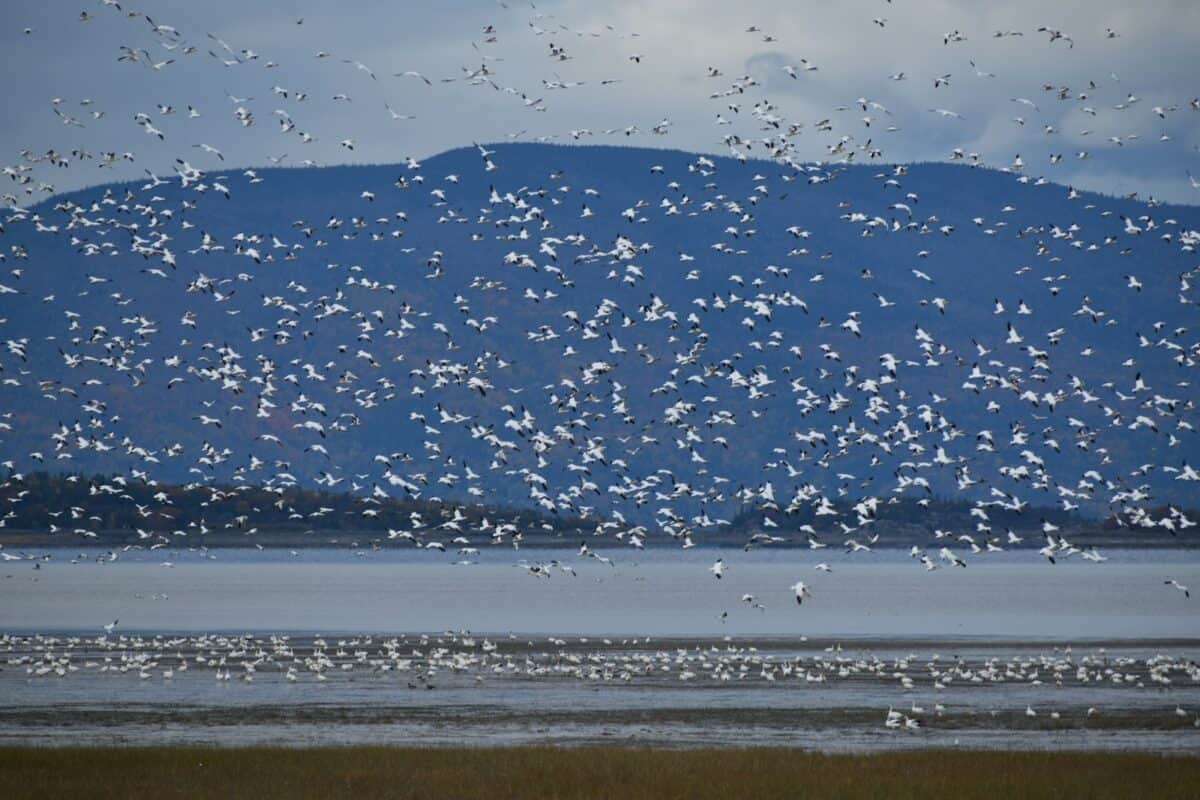
Bird migration represents one of the most astonishing phenomena in the natural world. Driven by changes in food availability, habitat conditions, and breeding requirements, birds travel incredible distances between their breeding and non-breeding grounds. Some species navigate across entire continents or oceans, using a combination of celestial cues, Earth’s magnetic field, landmark recognition, and even scent to guide their journey. The Arctic Tern holds the record for the longest migration, traveling approximately 44,000 miles annually between the Arctic and Antarctic. These seasonal movements are precisely timed and often follow specific flyways—established routes that birds have used for countless generations. Understanding this remarkable behavior not only inspires awe but also highlights the importance of protecting habitats along these critical pathways.
10. Ruby-throated Hummingbird
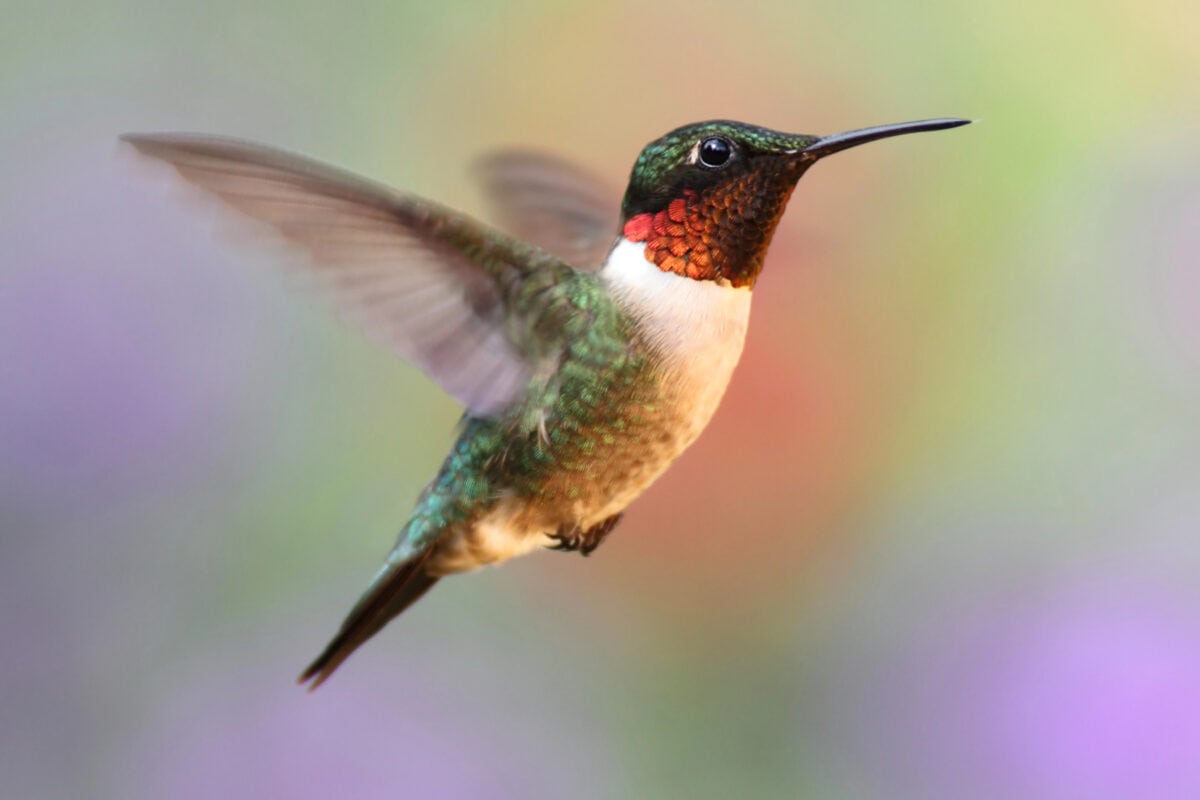
The Ruby-throated Hummingbird (Archilochus colubris) may be tiny, weighing less than a penny, but its migration is nothing short of extraordinary. As North America’s most common hummingbird species, these jewel-like birds embark on an incredible journey each spring from Central America to the eastern United States and Canada. What makes their migration particularly remarkable is that many individuals cross the Gulf of Mexico in a single non-stop flight, covering about 500 miles over water in 18-22 hours—an astounding feat for a creature so small. Before this journey, they double their body weight by consuming nectar and insects. Males, distinguished by their iridescent ruby-red throats, typically arrive at breeding grounds a week before females. Look for them from April through May as they visit flowering gardens, particularly those with tubular red flowers. Their high-pitched buzzing wings and ability to hover make them relatively easy to spot despite their diminutive size.
9. Scarlet Tanager
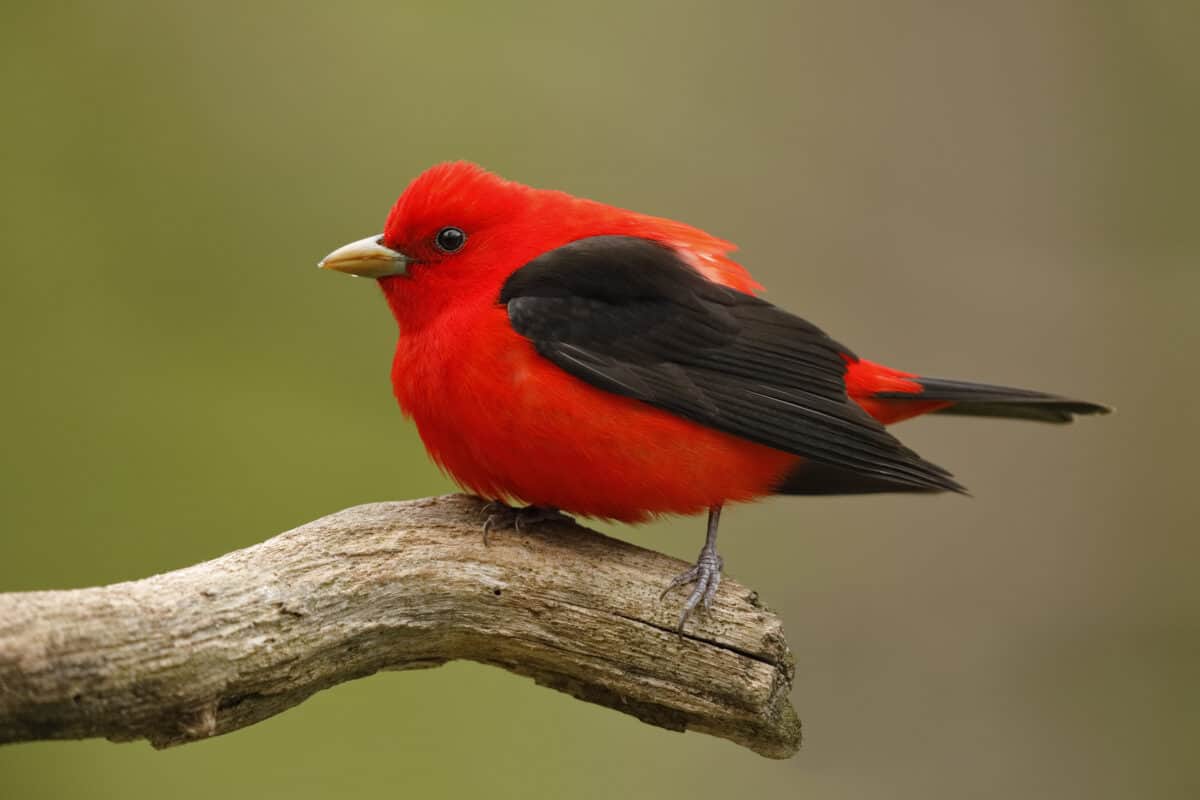
The Scarlet Tanager (Piranga olivacea) offers one of spring’s most dramatic color displays. The male’s brilliant scarlet body with contrasting jet-black wings and tail makes it look like a tropical visitor rather than a migrant that breeds throughout the eastern United States. These stunning birds spend their winters in northwestern South America before making the long journey north, often arriving in late April or early May. Despite their vibrant appearance, Scarlet Tanagers can be surprisingly difficult to spot as they prefer to forage in the upper canopy of mature deciduous forests. Their distinctive chick-burr call or robin-like song often reveals their presence before visual confirmation. Female tanagers are a more subdued yellowish-green, providing excellent camouflage among the forest leaves. During fall migration in September, look for males in their transitional plumage—a patchwork of scarlet and yellowish-green—as they head back to South America. The preservation of large forest tracts is vital for the continued success of this spectacular migrant.
8. Sandhill Crane
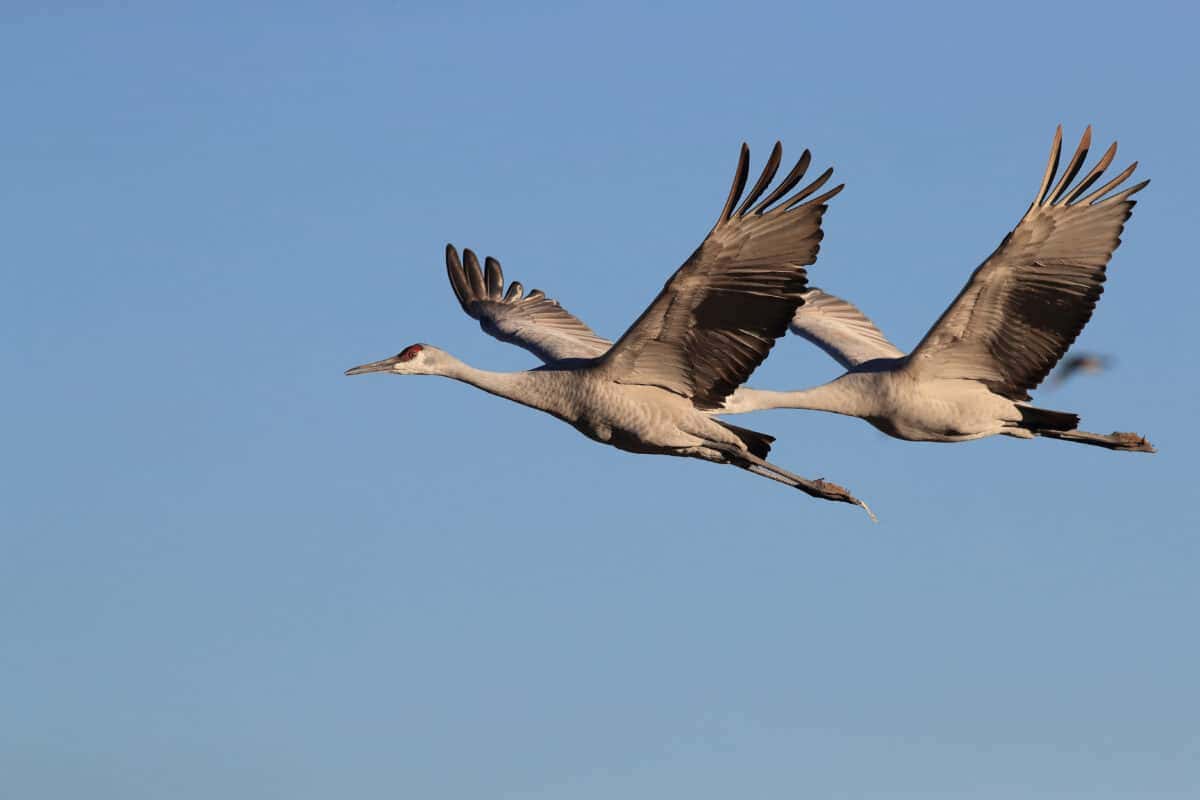
Few migratory spectacles rival the sight and sound of Sandhill Cranes (Antigone canadensis) in flight. Standing nearly four feet tall with a wingspan of up to seven feet, these elegant gray birds create one of nature’s most impressive displays when they gather by the thousands during migration. Their distinctive rolling bugle call can be heard from over a mile away, announcing their presence as they travel in V-formations or circular patterns high overhead. Each spring, approximately 80% of all Sandhill Cranes—over 500,000 birds—converge on Nebraska’s Platte River during their journey from wintering grounds in the southern United States and Mexico to breeding territories in Canada, Alaska, and even Siberia. The Platte River Valley in March represents one of the greatest wildlife concentrations on the continent. During fall migration in October and November, key stopover sites include Jasper-Pulaski Fish and Wildlife Area in Indiana, Bosque del Apache National Wildlife Refuge in New Mexico, and Hiwassee Wildlife Refuge in Tennessee. These ancient birds, with fossil records dating back 2.5 million years, represent one of conservation’s greatest success stories after recovering from near-extinction in the early 20th century.
7. Baltimore Oriole

The Baltimore Oriole (Icterus galbula) brings a flash of tropical brilliance to eastern North America each spring. Males sport a striking combination of bright orange and black plumage that once inspired the colors of the Baltimore baseball team, while females display a more subtle yellowish-orange and brownish-gray pattern. These melodious songbirds winter in Central America and northern South America before beginning their northward journey in late March, typically arriving at their breeding grounds throughout the eastern United States and southern Canada by early May. Baltimore Orioles have adapted well to human-altered landscapes, frequently nesting in parks, orchards, and suburban areas with mature deciduous trees. They construct distinctive pendulous nests woven from plant fibers, grasses, and string, often hanging them from the outer branches of tall trees like elms, maples, and cottonwoods. During migration and the breeding season, orioles are attracted to sugar water feeders (similar to those used for hummingbirds) and offerings of orange halves and grape jelly. Their flute-like whistling song and preference for treetop feeding make them a delightful spring arrival to watch for from mid-April through May.
6. Painted Bunting

Often described as “flying rainbows,” male Painted Buntings (Passerina ciris) are arguably North America’s most colorful songbirds. Their extraordinary plumage features a bright blue head, red underparts, and green back—a combination so vivid it almost appears artificial. These stunning birds maintain two distinct breeding populations: one along the Atlantic coast from North Carolina to Florida, and a larger group spanning from Louisiana and Texas into Mexico. They winter in southern Florida, Cuba, and throughout Central America. Despite their brilliant coloration, Painted Buntings can be surprisingly secretive, preferring shrubby habitats and woodland edges. The coastal population typically arrives at breeding grounds in late April, while the interior population reaches its northern range by early May. Female buntings, clothed entirely in bright green, are equally beautiful though less conspicuous. Both sexes are seed specialists, visiting feeders that offer white millet and other small seeds. Unfortunately, Painted Bunting populations have declined by approximately 40% over the last 50 years due to habitat loss and illegal trapping for the pet trade. Conservation efforts focus on protecting shrubby breeding habitats and wintering grounds for these avian jewels.
5. Whooping Crane
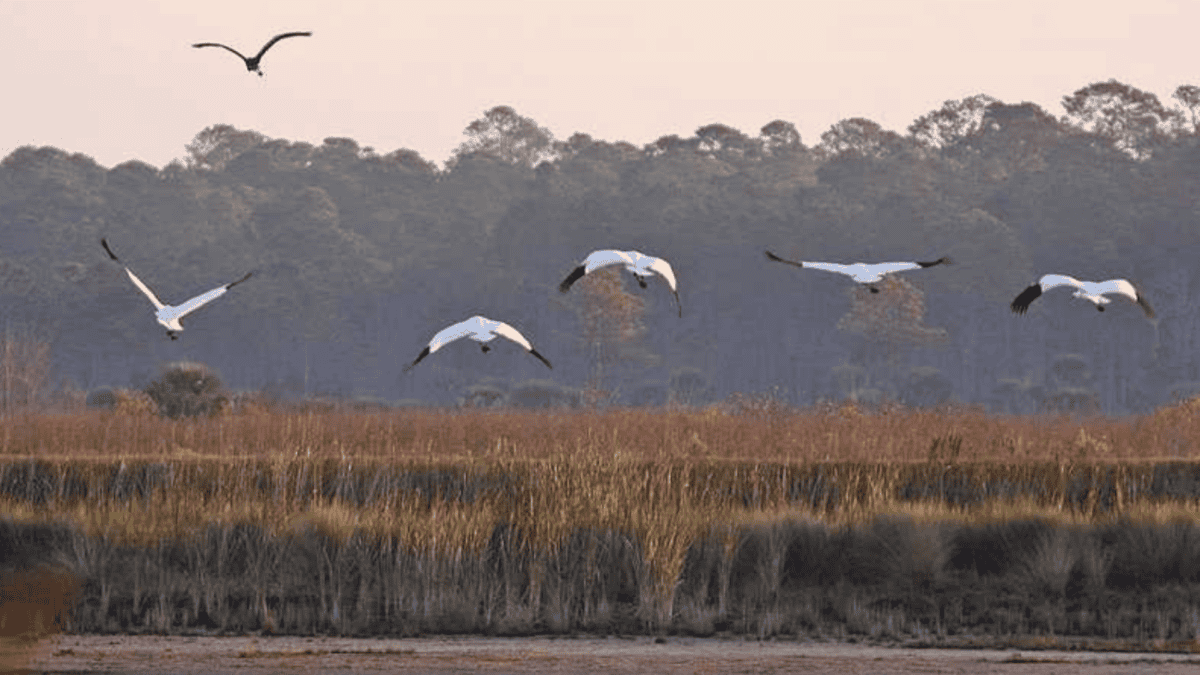
The Whooping Crane (Grus americana) represents one of North America’s most remarkable conservation stories—and one of its most magnificent migratory birds. Standing five feet tall with a seven-foot wingspan, these stately white birds with black wingtips and crimson crowns nearly vanished in the 1940s when their population plummeted to just 15 individuals. Today, after decades of intensive conservation efforts, approximately 500 Whooping Cranes exist in the wild. The only self-sustaining wild population migrates 2,500 miles between Wood Buffalo National Park in Canada and Aransas National Wildlife Refuge on the Texas Gulf Coast each year. Their journey takes them through the central United States from mid-October through early November (southward) and March through April (northward). Another reintroduced population, taught their migration route by following ultralight aircraft, travels between Wisconsin and Florida. Whooping Cranes mate for life and perform elaborate courtship dances involving leaping, wing-flapping, and loud unison calls. Their distinctive whooping vocalization can carry for several miles across marshes and wetlands. Viewing these endangered birds represents a rare privilege—the Aransas National Wildlife Refuge offers boat tours during winter months when the majority of the population gathers along the Texas coast.
4. Broad-winged Hawk

The Broad-winged Hawk (Buteo platypterus) creates one of the most spectacular migration phenomena in North America—kettle formations that can contain thousands of birds spiraling upward on thermal air currents. These compact woodland hawks, with their distinctive black-and-white banded tails, breed throughout eastern North America’s deciduous forests before undertaking an extraordinary journey to South America each fall. Unlike many raptors that migrate individually, Broad-winged Hawks travel in large groups, creating what birders call “kettles” as they ride rising warm air to gain altitude before gliding to the next thermal, conserving energy during their 4,000+ mile journey. Prime viewing locations for this phenomenon include Hawk Mountain Sanctuary in Pennsylvania, Cape May Point in New Jersey, and Corpus Christi, Texas. The most spectacular concentrations occur at funneling points in Central America, particularly in Veracruz, Mexico, where over a million Broad-winged Hawks may pass through during September and early October. Spring migration in April and early May is typically more dispersed. These medium-sized raptors have one of the most synchronized migrations among North American birds, with the majority of the population moving within a two-week window each fall—making correct timing essential for witnessing this breathtaking spectacle.
3. Arctic Tern

The Arctic Tern (Sterna paradisaea) holds the title for the longest migration of any animal on Earth, traveling an astonishing round-trip journey of nearly 44,000 miles annually between the Arctic and Antarctic. These elegant seabirds, with their slender build, deeply forked tails, and blood-red bills, essentially follow an endless summer, breeding in the Arctic Circle during the northern hemisphere’s summer and then flying to the Antarctic Circle to enjoy the southern hemisphere’s summer. This remarkable journey allows Arctic Terns to experience more daylight than any other creature—approximately 24 hours of daylight for eight months of the year. Recent tracking studies have revealed that these birds don’t simply fly directly north and south but follow complex routes across the Atlantic and Pacific Oceans, taking advantage of global wind patterns. Arctic Terns can live up to 30 years, meaning some individuals may fly more than 1.5 million miles in their lifetime—equivalent to three trips to the moon and back. While they spend most of their time at sea, coastal locations in New England, the Pacific Northwest, and Alaska offer viewing opportunities during their May arrival and August departure. Their graceful flight, acrobatic plunge-diving for fish, and fierce defense of nesting colonies make them particularly memorable to observe.
2. American Golden-Plover

The American Golden-Plover (Pluvialis dominica) undertakes one of the most remarkable migrations in the avian world, following an elliptical route that spans the hemisphere. These medium-sized shorebirds, speckled with gold and black during breeding season, nest in the Arctic tundra of Alaska and Canada before embarking on an extraordinary transoceanic journey. Each fall, they fly non-stop over the western Atlantic Ocean—a distance of up to 2,500 miles—from the Canadian Maritimes to South America, eventually reaching their wintering grounds in southern Brazil and Argentina. In spring, they take a different route, traveling through central North America along the Mississippi River Valley and Great Plains. This elliptical migration pattern allows them to take advantage of prevailing winds in both directions. American Golden-Plovers are known for their incredible endurance and fat-storing capacity, with individuals nearly doubling their body weight before their ocean crossing. They can fly at speeds of 60 mph and altitudes exceeding 10,000 feet. During migration, look for them in April and May (spring) or August through October (fall) in open habitats including recently plowed fields, short-grass prairies, mudflats, and sod farms, where they feed primarily on insects and other invertebrates. Their plaintive, whistled calls often reveal their presence before they’re spotted.
1. Blackpoll Warbler
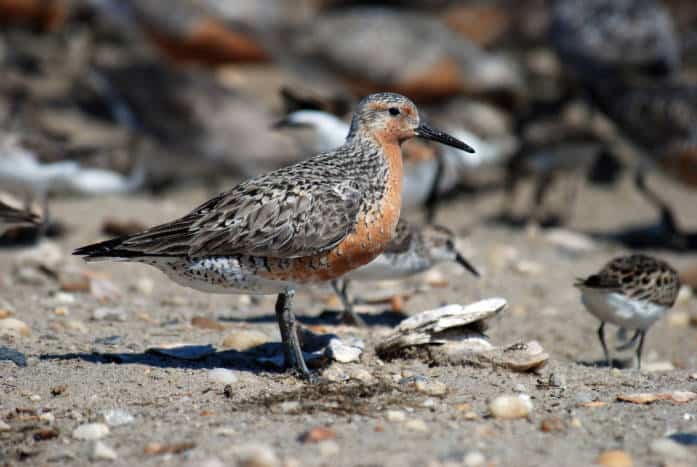
The Blackpoll Warbler (Setophaga striata) may appear unassuming with its black-and-white breeding plumage, but this small songbird accomplishes one of the most impressive migratory feats of any land bird. After nesting in the boreal forests of Canada and Alaska, autumn-migrating Blackpolls gather along the northeastern coast of North America before launching on a non-stop transoceanic flight to South America. This extraordinary journey spans 1,500 to 2,000 miles over open ocean, taking 72 to 90 hours of continuous flight without food or water. To fuel this marathon, Blackpolls double their body weight before departure, converting from 12 grams to a plump 21 grams or more. Using specialized adaptations, they can metabolize their fat reserves with extreme efficiency while in flight. Radar studies have confirmed these tiny birds maintain altitudes of 5,000 to 15,000 feet during their oceanic crossing. After wintering in northern South America, they take a different route northward through Central America and the Mississippi Valley in spring. Look for Blackpolls during fall migration along the Atlantic Coast from late September through October, when they appear in a much less distinctive yellowish-green non-breeding plumage. Spring migrants in their distinctive black-capped breeding attire pass through the central and eastern United States from late April through May, often singing their high-pitched, insect-like songs from the tops of conifers.
Tips for Spotting Migratory Birds

Successful bird migration watching begins with timing and location. Research migration calendars for your region, as peak movements often occur within specific weeks. Early morning offers prime viewing opportunities when birds are most active after overnight flights. Weather plays a crucial role—birds often migrate in waves following cold fronts with northerly winds in fall and warm fronts with southerly winds in spring. Coastal areas, ridgelines, river valleys, and wetlands act as natural funnels for migrating birds. Invest in quality binoculars (8×42 magnification is ideal for beginners) and a field guide specific to your region. Mobile apps like Merlin Bird ID, eBird, and BirdsEye provide real-time information on recent sightings and identification assistance. Join local Audubon Society chapter outings or bird festivals timed to coincide with migration peaks. When observing birds, maintain a respectful distance to avoid causing stress, particularly at stopover sites where birds are replenishing energy reserves. Keeping a field journal of your sightings not only enhances your own experience but can contribute valuable citizen science data to migration monitoring efforts.
Conservation Challenges for Migratory Birds

Migratory birds face mounting challenges across their extensive ranges. Habitat loss represents the most significant threat, with development destroying both breeding grounds and crucial stopover sites where birds refuel during journeys. Climate change disrupts the delicate timing of migrations, potentially creating mismatches between birds’ arrivals and peak food availability. Light pollution from cities confuses nocturnal migrants, causing collisions with buildings that kill an estimated 600 million birds annually in North America alone. Additional threats include pesticide use, invasive species, illegal hunting, and energy infrastructure such as wind turbines and power lines. Conservation efforts require international cooperation since migratory birds cross multiple national boundaries. The Migratory Bird Treaty Act of 1918 provides legal protection in the United States, while international agreements like the Convention on Migratory Species coordinate global conservation efforts. Citizen science projects such as eBird and the Breeding Bird Survey provide critical data for monitoring population trends. Supporting habitat conservation, creating bird-friendly spaces, advocating for bird-safe building designs, and participating in community science initiatives represent meaningful ways individuals can contribute to protecting these remarkable travelers for future generations.
The seasonal journeys of migratory birds represent one of nature’s most extraordinary spectacles, connecting distant ecosystems and cultures through the beating wings of these remarkable travelers. From the continent-spanning flights of the Arctic Tern to the Gulf-crossing feats of the tiny Ruby-throate

- Why Deer Are Showing Up in U.S. Neighborhoods More Often - August 18, 2026
- Why Smart Dogs Might Struggle With Obedience Training - August 18, 2026
- How Rabbits Are Being Used in School Classrooms for Therapy - August 17, 2026