


Long before the United States existed as a nation, the land that would become America was home to an astonishing array of prehistoric creatures. From massive marine reptiles that patrolled ancient seas to dinosaurs that roamed verdant landscapes and mammals that survived the last ice age, America’s fossil record tells a fascinating story of evolution and extinction spanning hundreds of millions of years. The continental United States has some of the richest and most diverse fossil deposits in the world, giving paleontologists remarkable insights into creatures that once called this land home. Let’s explore twelve prehistoric animals whose remains have been discovered across what would eventually become the United States, revealing an ancient America filled with life forms both familiar and fantastically alien to modern eyes.
Tyrannosaurus Rex The Tyrant King of the American West

Perhaps no prehistoric creature captures the imagination quite like Tyrannosaurus rex, the 40-foot-long, 7-ton apex predator that stalked the western United States during the late Cretaceous period, about 68-66 million years ago. Montana, Wyoming, and the Dakotas have yielded some of the most complete T. rex fossils ever found, including the famous specimen nicknamed “Sue” discovered in South Dakota in 1990. Standing 12 feet tall at the hip with a massive skull measuring up to 5 feet in length, T. rex possessed the strongest bite force of any land animal that ever lived—capable of exerting more than 12,000 pounds of pressure, enough to crush bone.
Recent research has challenged the old view of T. rex as merely a scavenger, suggesting it was an active and formidable predator. Its tiny forelimbs, long a source of scientific puzzlement, may have been used to hold struggling prey. Fossil evidence from the Hell Creek Formation spanning Montana, Wyoming, and the Dakotas shows that T. rex shared its ecosystem with triceratops, ankylosaurs, and various other dinosaurs. This iconic predator represents the pinnacle of theropod evolution and ruled the American landscape until the mass extinction event that ended the dinosaurs’ reign 66 million years ago.
Triceratops The Three-Horned Face of the Great Plains
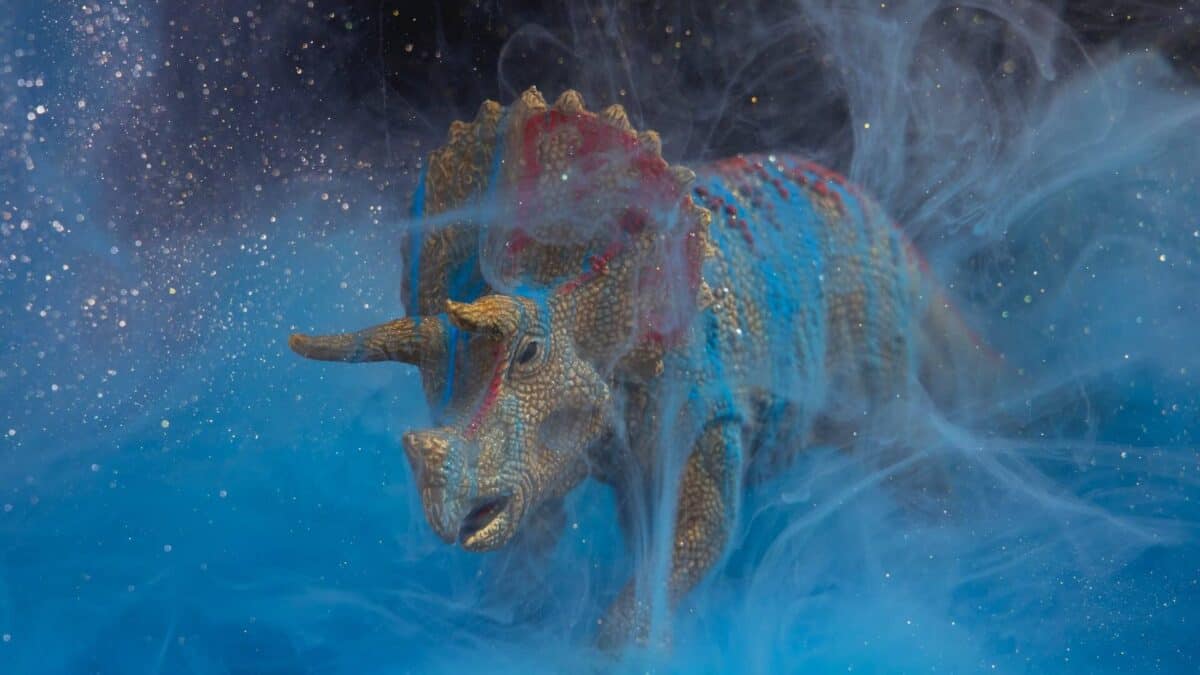
Triceratops, with its distinctive three-horned face and bony neck frill, was one of the last dinosaurs to exist before the mass extinction event. Thriving between 68 and 66 million years ago in what is now the American West, particularly Colorado, Montana, Wyoming, and the Dakotas, this plant-eater grew up to 30 feet long and weighed as much as 12 tons. Its skull, which could reach over 8 feet in length, was one of the largest of any land animal. The two large brow horns could grow over 3 feet long, while a smaller horn adorned the nose, creating the iconic three-horned profile that gives Triceratops its name.
Fossil evidence suggests Triceratops lived in herds and used its impressive horns and frill not just for defense against predators like T. rex, but also for species recognition and competition for mates. The Hell Creek Formation has yielded hundreds of Triceratops specimens, making it one of the most common dinosaur fossils found in North America. Interestingly, paleontologists have identified at least two species: Triceratops horridus and Triceratops prorsus, with subtle differences in horn angles and frill shapes. These magnificent herbivores represent the final chapter of ceratopsian evolution, a diverse group of frilled, horned dinosaurs that thrived across North America.
Allosaurus The Jurassic Predator of the Rocky Mountains

Allosaurus was the dominant predator of the late Jurassic period, stalking what is now the western United States approximately 155 to 145 million years ago. At up to 35 feet long and weighing around 2 tons, this theropod dinosaur was the largest meat-eater of its time. The Cleveland-Lloyd Dinosaur Quarry in Utah has yielded remains of at least 46 Allosaurus individuals, suggesting these predators may have been drawn to trap-like conditions where prey animals had become stuck. Wyoming’s famous fossil site, Como Bluff, has also produced numerous Allosaurus specimens, cementing this dinosaur’s status as a quintessential American prehistoric predator.
Unlike its later relative T. rex, Allosaurus had relatively long, powerful arms with three-fingered hands tipped with sharp claws, which it likely used to grasp struggling prey. Its skull featured distinctive crests above the eyes, and its jaws were lined with dozens of serrated, blade-like teeth designed for slicing through flesh. Biomechanical studies suggest Allosaurus hunted using its upper jaw like a hatchet, swinging its head downward to inflict devastating wounds on prey such as Stegosaurus and Diplodocus. The abundance of Allosaurus fossils across the Morrison Formation makes it one of the best-understood large predatory dinosaurs and a true icon of America’s prehistoric past.
Diplodocus The Lengthy Giant of the American West
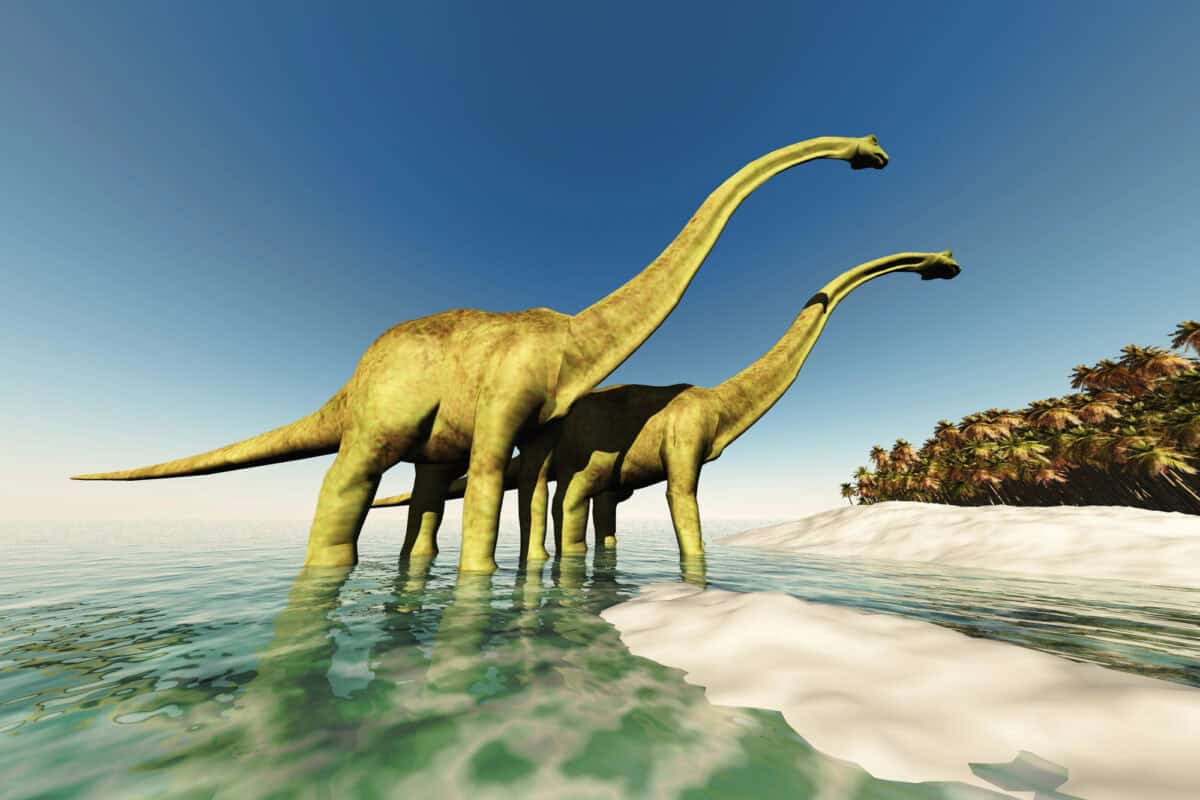
Diplodocus stands as one of the most iconic sauropod dinosaurs ever to walk the North American continent. Living during the Late Jurassic period approximately 154-152 million years ago, this massive herbivore could reach astonishing lengths of up to 90 feet, making it one of the longest dinosaurs known to science. Despite its incredible length, Diplodocus was relatively lightweight for its size, estimated at 10-15 tons, due to its vertebrae containing large air spaces that reduced weight while maintaining strength. The first Diplodocus fossils were discovered in the Morrison Formation of Colorado in 1877 by Benjamin Mudge and Samuel Wendell Williston, initiating America’s fascination with these enormous creatures.
What made Diplodocus particularly distinctive was its incredibly long, whip-like tail comprising up to 80 vertebrae, which scientists believe may have been used for defense or possibly to create sonic booms for communication. Its long neck allowed it to feed on vegetation both high and low, though unlike some other sauropods, its neck was held more horizontally than vertically. Numerous well-preserved specimens have been found across Wyoming, Colorado, Utah, and Montana, including the famous “Dippy” skeleton that became one of the most widely displayed dinosaur fossils in the world through casts sent to museums across multiple continents. Diplodocus represents the golden age of sauropod evolution in North America, when these tremendous creatures dominated the landscape of what would become the western United States.
Elasmosaurus The Long-Necked Sea Monster of the Inland Sea
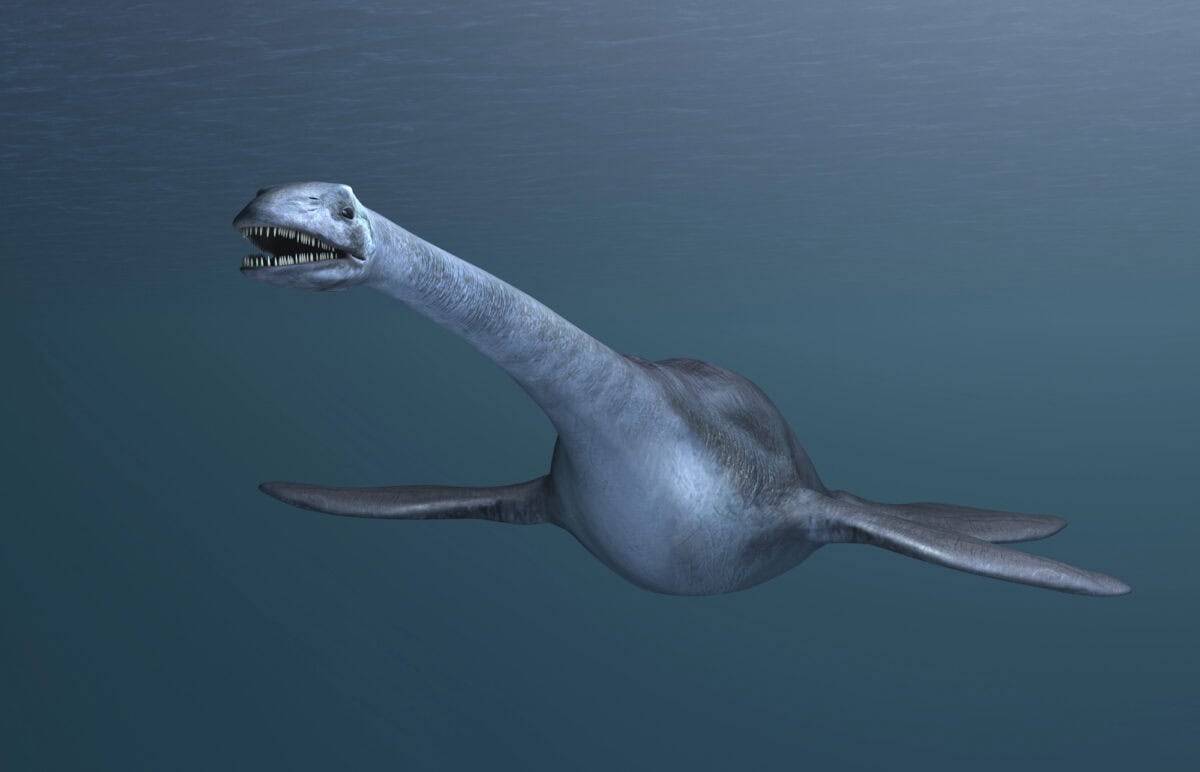
During the Late Cretaceous period, approximately 80 million years ago, much of central North America was covered by the Western Interior Seaway, a vast inland sea that split the continent in two. This ancient ocean was home to Elasmosaurus, one of the most extreme plesiosaurs ever to swim Earth’s oceans. First discovered in Kansas in 1868, this marine reptile possessed an extraordinarily elongated neck containing 71 vertebrae—the most of any known vertebrate—stretching to lengths of up to 23 feet, attached to a relatively small head and body. The entire animal could reach lengths of 46 feet, making it one of the longest plesiosaurs ever discovered.
Elasmosaurus propelled itself through Cretaceous waters using four powerful flipper-like limbs, hunting fish and squid with its needle-like teeth. Contrary to early illustrations, it could not raise its neck high above the water like a sea serpent due to the neck’s limited flexibility. Fossil remains have been found across what is now Kansas, South Dakota, Colorado, and Wyoming—all areas once covered by the ancient seaway. The discovery of Elasmosaurus sparked the infamous “Bone Wars” between rival paleontologists Edward Drinker Cope and Othniel Charles Marsh, a scientific feud that ultimately advanced American paleontology despite its bitter personal rivalry. Elasmosaurus represents just one of many spectacular marine reptiles that once swam through the heart of what would eventually become the United States.
Deinonychus The Inspiration Behind “Velociraptor” in Fiction

Discovered in Montana in the 1960s by paleontologist John Ostrom, Deinonychus antirrhopus revolutionized our understanding of dinosaurs and directly inspired the “raptors” featured in Jurassic Park (though the film used the name of its smaller cousin, Velociraptor). Living approximately 115-108 million years ago during the Early Cretaceous period, this mid-sized predator measured about 11 feet long and stood around 5 feet tall. What made Deinonychus truly remarkable was its sickle-shaped retractable claw on each hind foot, measuring up to 5 inches long and likely used to slash and disembowel prey animals much larger than itself.
Ostrom’s detailed study of Deinonychus fossils found in Montana and Wyoming provided crucial evidence for the theory that some dinosaurs were active, agile, and possibly warm-blooded—a dramatic departure from the then-prevailing view of dinosaurs as slow, cold-blooded reptiles. Multiple specimens found together suggested that Deinonychus may have hunted in coordinated packs, taking down prey like the plant-eating Tenontosaurus, which was much larger than individual Deinonychus. The discovery of Deinonychus helped launch the “Dinosaur Renaissance,” a complete scientific reassessment of dinosaur biology and behavior that continues to this day. Its legacy extends beyond paleontology into popular culture, where it forever changed how we imagine dinosaurs in art, literature, and film.
Mammoth The Ice Age Giant of North America

Far more recently than the dinosaurs, the vast grasslands and tundra of North America were home to several species of mammoths during the Pleistocene epoch, which lasted from 2.6 million to 11,700 years ago. The most iconic, the Columbian mammoth (Mammuthus columbi), stood nearly 14 feet tall at the shoulder and weighed up to 10 tons, making it even larger than modern African elephants. Its enormous curved tusks could reach lengths of 16 feet. Unlike its relative the woolly mammoth, which inhabited more northern regions, the Columbian mammoth ranged widely across the continental United States, from the Pacific to the Atlantic and from Canada to Mexico. Particularly rich fossil sites include the La Brea Tar Pits in Los Angeles, where dozens of mammoth skeletons have been recovered.
Perhaps most fascinating is that mammoths survived long enough to encounter humans, who hunted these impressive beasts using spears tipped with distinctive fluted points. Archaeological sites across the United States, including the famous Clovis site in New Mexico, have yielded mammoth bones with clear evidence of human butchery alongside stone tools dating to approximately 13,000 years ago. The cause of mammoth extinction around 10,000 years ago remains debated, with climate change at the end of the last ice age and human hunting both likely playing roles. Unlike dinosaurs, which are known only through fossils, some mammoth specimens have been found frozen with soft tissue, hair, and even stomach contents preserved, giving us unprecedented insights into these magnificent animals that once roamed across what would become the United States.
Smilodon America’s Saber-Toothed Predator

Smilodon fatalis, commonly known as the saber-toothed cat, was one of North America’s most fearsome predators during the Pleistocene epoch. Living from approximately 1.6 million to 10,000 years ago, this powerful felid was characterized by its iconic pair of elongated upper canine teeth, which could reach up to 11 inches in length. Unlike modern big cats, Smilodon had a relatively short tail and powerful, bear-like build with exceptionally strong forelimbs. Standing about 3 feet tall at the shoulder and weighing up to 600 pounds, Smilodon was built for power rather than the sustained speed of modern cheetahs or lions.
The most spectacular Smilodon fossils come from the La Brea Tar Pits in Los Angeles, California, where over 2,000 individuals have been recovered—more than any other predator. This remarkable fossil abundance suggests Smilodon was drawn to struggling herbivores trapped in the sticky asphalt, only to become trapped themselves. Studies of these fossils reveal Smilodon was a social predator that likely lived and hunted in groups, similar to modern lions. Many specimens show evidence of healed injuries that would have been fatal to solitary hunters, suggesting pack members cared for injured individuals. Smilodon likely preyed on large herbivores like bison, camels, horses, and juvenile mammoths across what is now the United States, using its powerful build to ambush and wrestle prey to the ground before delivering a precise killing bite with its famous sabers.
Megalodon The Enormous Prehistoric Shark of American Coastlines

Otodus megalodon, commonly known simply as megalodon, was the largest shark ever to swim Earth’s oceans, patrolling the coastal waters of what would become the United States from about 20 million to 3.6 million years ago during the Miocene and Pliocene epochs. This enormous predator could reach lengths of up to 60 feet—three times longer than the largest modern great white sharks. With jaws large enough for a human to stand upright inside and teeth measuring up to 7 inches long, megalodon had the most powerful bite force of any known animal, estimated at up to 40,000 pounds of pressure. Fossil megalodon teeth are commonly found along the Atlantic coastal plains of North and South Carolina, Florida, and Maryland, as well as parts of California’s coast.
Unlike dinosaurs, sharks have skeletons made of cartilage rather than bone, which rarely fossilizes. As a result, much of what we know about megalodon comes from its abundant teeth, which are among the most commonly collected fossils in the United States. By studying tooth size, shape, and arrangement, scientists have reconstructed megalodon as a stockier, more robust version of the great white shark, though the two species are not as closely related as once thought. Megalodon likely preyed on large marine mammals including early whales, seals, and sea lions along America’s prehistoric coastlines. Its extinction around 3.6 million years ago may have been caused by cooling oceans during the onset of ice ages, competition from newly evolved killer whales, or the disappearance of its large whale prey. Today, beachcombers along American coasts can still find the distinctive triangular teeth of this impressive predator washed up on shore.
Pteranodon The Soaring Giant of American Skies
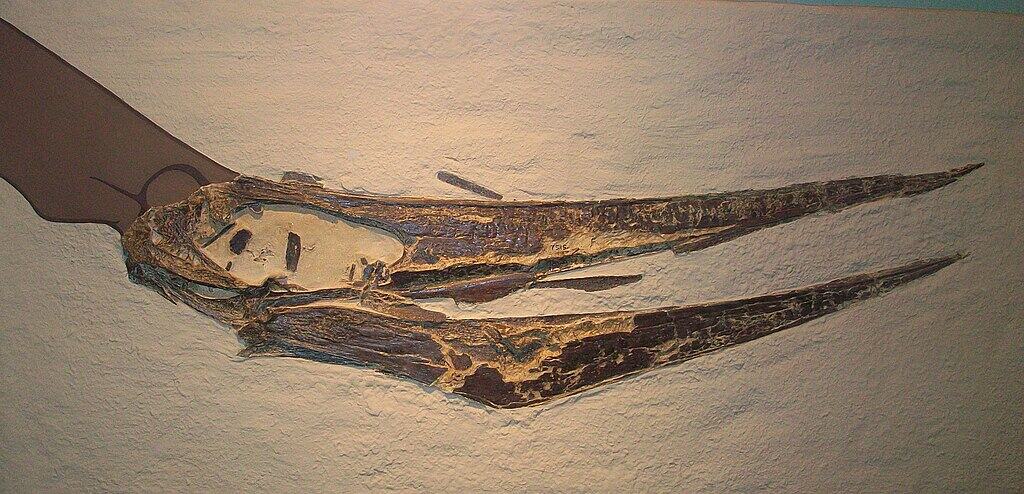
Pteranodon was not a dinosaur but a pterosaur—a flying reptile that soared over the shallow sea that covered much of central North America during the Late Cretaceous period, approximately 86-84 million years ago. With a wingspan reaching up to 23 feet, Pteranodon was one of the largest flying animals ever to exist. Despite its impressive size, this remarkable creature likely weighed only about 55 pounds due to hollow bones and other adaptations for flight. The most distinctive feature of Pteranodon was its elongated skull crest, which could be longer than its entire body in males and likely served for display rather than aerodynamic purposes.
Most Pteranodon fossils have been discovered in the Niobrara Formation of western Kansas, which was once covered by the Western Interior Seaway. Over 1,000 specimens have been collected from this region, making Pteranodon one of the best-understood pterosaurs. These fossils suggest Pteranodon fed primarily on fish, catching them by dipping its long beak into the water while flying low over the surface, similar to modern skimmers. Unlike birds, Pteranodon launched itself into the air using all four limbs, pushing off from the ground with its powerful wing fingers. Its flight style likely involved soaring on thermal currents and updrafts over the ancient seaway, much as albatrosses do today over oceans. Pteranodon represents just one of many amazing flying reptiles that once dominated American skies millions of years before the first birds evolved.
Conclusion:

Long before cities, highways, and modern landscapes, the land we now call the United States was home to a stunning array of prehistoric creatures. From towering mammoths and saber-toothed cats to massive marine reptiles and armored dinosaurs, these animals once roamed, swam, and soared across ancient ecosystems that spanned deserts, swamps, and inland seas. Their fossils offer fascinating glimpses into a time when North America was a very different place—shaped by shifting continents, changing climates, and evolutionary marvels.
Exploring these prehistoric animals isn’t just about the distant past; it also helps us understand the deep natural history of the land beneath our feet. Many of these species’ remains have been uncovered in U.S. national parks, riverbeds, and quarries, offering clues about extinction, adaptation, and survival. By studying them, we connect with Earth’s dynamic story and gain insight into how today’s wildlife—and our own future—continues to be shaped by the forces of nature.

As a little kid, I fell in love with nature, wildlife, and animals. Living in the USA, South Africa, Italy, China and Germany gave me the opportunity to discover the world's Wildlife. My favorite animals are Mountain Gorillas, Siberian Tigers, and Great White Sharks.
I'm a certified PADI Open Water Diver, went to Everest Base Camp and Trekked Gorillas in Uganda. I hold a Master of Science in Economics and Finance.
Please send any feedback to feedback@animalsaroundtheglobe.com
- 12 Reasons Your Dog Tilts Its Head Its Not What You Think - July 26, 2026
- 12 Prehistoric Animals That Lived in What Now the U.S. - July 26, 2026
- The Sneakiest Invaders Taking Over Americas Backyards - July 26, 2026
Leave a comment
You must be logged in to post a comment.