


The bald eagle, America’s national bird, soars through our collective imagination as a symbol of freedom and strength. Yet despite its iconic status, misconceptions about this magnificent raptor abound. From beliefs about its baldness to assumptions about its diet and behavior, many myths have taken flight alongside accurate information. As one of North America’s most recognizable birds, the bald eagle deserves to be understood based on facts rather than fiction. This article separates myth from reality, exploring seventeen common beliefs about bald eagles and revealing the fascinating truths behind this majestic symbol of American heritage.
Myth #18 Bald Eagles Are Actually Bald

Despite their name, bald eagles are not actually bald. The name “bald” comes from an older meaning of the word that referred to being white-headed rather than hairless. Adult bald eagles have distinctive white feathers covering their head and neck, which stand out dramatically against their dark brown body, creating the appearance that inspired their name. This white plumage doesn’t develop until the birds reach maturity at around four to five years of age. Before that, young bald eagles have mostly brown heads, often causing them to be misidentified as golden eagles by casual observers.
Truth #17 Bald Eagles Have Incredible Vision

Bald eagles possess some of the sharpest vision in the animal kingdom. Their eyesight is estimated to be four to eight times stronger than that of humans, allowing them to spot prey from remarkable distances. A bald eagle flying at an altitude of 1,000 feet can scan an area of nearly three square miles and detect fish swimming beneath the water’s surface. This exceptional visual acuity comes from having more light-sensitive cells in their retinas and a higher density of nerves connecting these cells to the brain. Additionally, eagles can see ultraviolet light, giving them access to a visual spectrum beyond human perception. This extraordinary vision is essential for their hunting success and survival in the wild.
Myth #16 Bald Eagles Only Eat Fish

While fish constitute a significant portion of the bald eagle’s diet, the belief that they feed exclusively on fish is inaccurate. Bald eagles are opportunistic feeders with diverse diets. In addition to fish, they regularly consume waterfowl, small mammals such as rabbits and squirrels, and even reptiles. They’re also known to scavenge carrion (dead animals) when available, and some eagles have been observed stealing food from other predators like ospreys—a behavior known as kleptoparasitism. During winter months when bodies of water freeze over, bald eagles rely more heavily on non-fish prey and carrion, demonstrating their adaptability to changing food availability.
Truth #15 Bald Eagles Mate for Life

Bald eagles typically form long-term monogamous bonds, often mating with the same partner for life. These pairs work together to build impressively large nests, raise their young, and defend their territory. However, this “till death do us part” arrangement does have exceptions. If one mate dies or disappears, the surviving eagle will seek another partner. Similarly, if a pair consistently fails to successfully reproduce, they may separate and find new mates. Despite these exceptions, their tendency toward lifelong bonding is remarkable in the animal kingdom. Some bald eagle pairs have been documented remaining together for over 20 years, building on their massive nests year after year until these structures can weigh up to a ton.
Myth #14 Bald Eagles Can Pick Up and Carry Children

A persistent myth suggests that bald eagles are capable of carrying off small children. This misconception likely stems from exaggerated stories and the impressive appearance of these birds. In reality, while bald eagles are powerful predators, their lifting capacity is limited. The average bald eagle weighs between 8 and 14 pounds and can typically carry about 4 to 5 pounds—roughly a third of its body weight. This means they can carry small prey like fish, rabbits, and other small mammals, but nothing approaching the weight of even a small child. Their talons, while incredibly strong for gripping prey, aren’t designed to lift extremely heavy objects. This myth may persist due to the eagle’s role in folklore and its symbolic association with power.
Truth #13 Bald Eagles Build the Largest Nests of Any North American Bird

Bald eagles are master architects, constructing the largest nests of any bird in North America. These remarkable structures, called aeries, are typically built high in tall trees near water and are continuously expanded year after year. The average bald eagle nest measures about 5 feet in diameter and 2-4 feet deep. However, since eagles often return to the same nest annually, adding new materials each season, these nests can grow to extraordinary dimensions over time. The largest documented bald eagle nest was found in St. Petersburg, Florida, measuring 9.5 feet in diameter, 20 feet deep, and weighing over two tons. The construction and maintenance of these enormous nests represent significant investments of time and energy, highlighting the importance of stable nesting sites for eagle conservation.
Myth #12 Bald Eagles Are Endangered

Many people still believe that bald eagles are endangered, but this is outdated information. While bald eagles were indeed once on the brink of extinction in the continental United States, their population has made a remarkable recovery. The species was listed as endangered under the Endangered Species Preservation Act in 1967 after their numbers plummeted primarily due to DDT pesticide poisoning, hunting, and habitat destruction. Through conservation efforts, including the banning of DDT in 1972 and protections under the Endangered Species Act, bald eagle populations rebounded significantly. By 2007, they were removed from the federal list of threatened and endangered species. Today, with an estimated 316,700 individuals in the United States, the bald eagle serves as one of America’s greatest conservation success stories, though they remain protected under the Bald and Golden Eagle Protection Act.
Truth #11 Bald Eagles Make Distinctive Vocalizations

Despite their fierce appearance and powerful symbolism, bald eagles don’t produce the impressive, piercing cry often associated with them in movies and television. The strong, high-pitched screech commonly attributed to bald eagles in media is actually the call of a red-tailed hawk, dubbed over eagle footage to create a more dramatic effect. In reality, bald eagles typically make a series of high-pitched whistling or chirping sounds that might seem surprisingly weak for such a majestic bird. Their most common call is a rapid series of short notes that sounds something like “kee-kee-kee.” During nesting season, pairs also communicate with a lower-pitched “chatter.” These vocalizations, though less dramatic than their Hollywood counterparts, serve important functions in territorial defense and communication between mates and their young.
Myth #10 Bald Eagles Only Live in America

While the bald eagle is famously the national bird and symbol of the United States, the belief that these raptors live exclusively within U.S. borders is incorrect. Bald eagles have a range that extends well beyond the United States. They are native to most of North America, including Canada and northern Mexico. In fact, Canada hosts a significant portion of the world’s bald eagle population, particularly in coastal British Columbia where thousands gather annually for salmon runs. The largest concentration of bald eagles in the contiguous United States occurs during winter along the Skagit River in Washington State. While they are indeed a symbol of American heritage and pride, these magnificent birds recognize no political boundaries in their natural habitat.
Truth #9 Bald Eagles Can Live for Decades
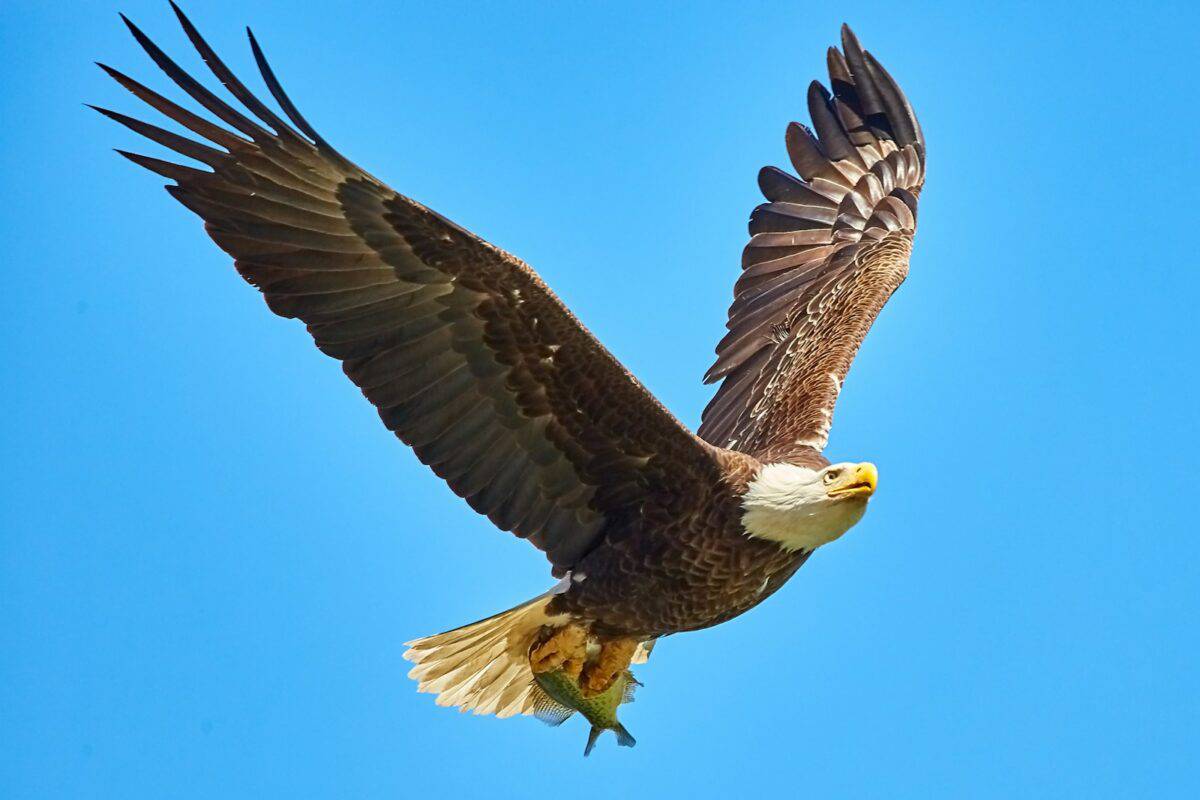
Bald eagles are remarkably long-lived birds, especially considering the challenges of life in the wild. In their natural habitat, bald eagles typically live between 20-30 years, though some individuals have been documented reaching 38 years of age. In captivity, where they’re protected from predators, hunting, and environmental hazards, they can live even longer—up to 50 years in some cases. This impressive lifespan is one of the longest among birds of prey and contributes to their ability to produce many offspring over their lifetime. Their longevity also means that some eagles alive today were born when the species was still endangered, making them living witnesses to one of America’s most successful conservation efforts. This extended lifespan is particularly notable given the numerous threats eagles face, including habitat loss, collisions with vehicles and structures, and poisoning from lead ammunition in scavenged prey.
Myth #8 Bald Eagles Have Excellent Sense of Smell

Contrary to what some might assume given their predatory prowess, bald eagles do not have a particularly developed sense of smell. Like most birds, their olfactory abilities are limited compared to many mammals. Bald eagles rely primarily on their exceptional vision to locate prey, spot carrion, and navigate their environment. While some birds, particularly certain seabirds like albatrosses and petrels, have evolved keen senses of smell to detect food over vast oceanic areas, raptors like eagles have invested their evolutionary capital in visual acuity instead. This misconception might stem from observations of eagles finding carrion, which they locate through sight rather than smell, often by noticing the gathering of other scavengers like vultures (which do have an excellent sense of smell).
Truth #7 Bald Eagles Were Once Nearly Extinct

The bald eagle’s journey from the brink of extinction represents one of the most dramatic wildlife recoveries in history. By the late 1960s, the population in the lower 48 states had declined to just 417 nesting pairs, primarily due to widespread use of the pesticide DDT. This chemical accumulated in fish, which eagles consumed, causing them to lay eggs with shells too thin to support the weight of incubating parents. Combined with habitat destruction and hunting, this pushed the species perilously close to disappearing from most of the United States. The banning of DDT in 1972, protection under the Endangered Species Act, and intensive conservation efforts led to a remarkable turnaround. Today, with more than 71,400 nesting pairs and a total population exceeding 300,000 individuals across North America, the bald eagle stands as powerful testimony to what dedicated conservation work can achieve when supported by effective legislation.
Myth #6 Bald Eagles Cannot Swim

A common misconception holds that bald eagles cannot swim and will drown if they end up in water. In reality, bald eagles are actually capable swimmers, though they don’t typically choose to swim. When an eagle catches a fish too heavy to lift into the air, it may perform a swimming motion called “rowing,” using its wings to paddle to shore with its catch. There are numerous documented cases of eagles swimming this way, sometimes for considerable distances. Their hollow bones provide buoyancy, and their powerful wings serve as effective paddles. However, getting waterlogged can be dangerous for eagles, as wet feathers can lead to hypothermia and difficulty flying, so they generally avoid extended time in water unless necessary. This swimming ability is yet another example of the bald eagle’s remarkable adaptability.
Truth #5 Bald Eagles Change Colors as They Age

Bald eagles undergo dramatic color changes as they mature, which often leads to misidentification of younger birds. When first hatched, eaglets are covered in light gray down which is replaced by dark brown feathers within a few weeks. For their first four to five years, juvenile bald eagles look markedly different from adults, with mostly dark brown plumage and irregular patches of white under their wings and tail. Their eyes and beak also transform with age—young eagles have dark brown eyes and a black beak, which gradually lighten to the characteristic bright yellow eyes and beak of adults. The distinctive white head and tail feathers that make bald eagles so recognizable develop gradually as the birds approach sexual maturity around five years of age. This dramatic transformation from dark juvenile to the classic white-headed adult is so striking that early naturalists mistakenly classified young bald eagles as a separate species.
Myth #4 Bald Eagles Have Bald Spots in Old Age
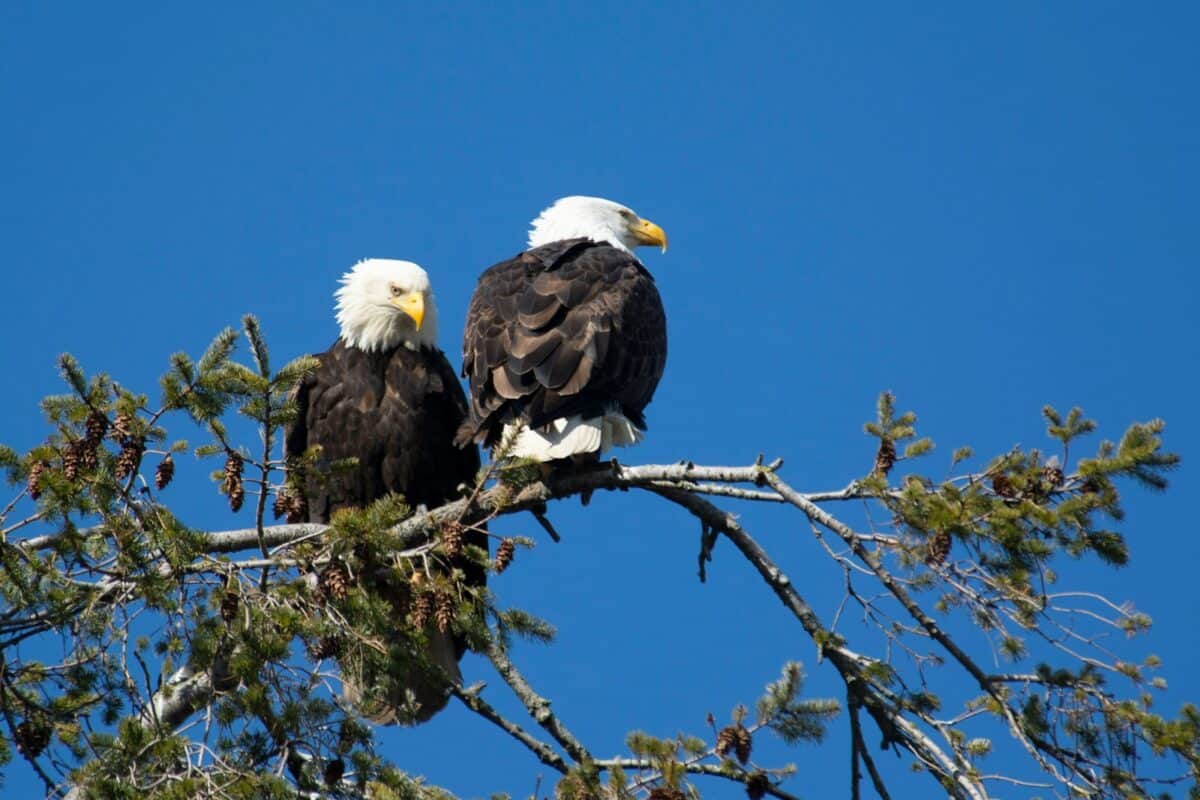
Some people believe that elderly bald eagles develop actual bald spots on their heads, relating this to the bird’s common name. This is entirely fictional and stems from a misunderstanding of the term “bald” in the eagle’s name. As explained earlier, “bald” in this context refers to the white coloration of the head, not a lack of feathers. Bald eagles maintain their full plumage throughout their lives, including their distinctive white head feathers in adulthood. While individual eagles might occasionally lose feathers due to injury, disease, or malnutrition, this is not a normal part of aging. Healthy older eagles maintain their characteristic appearance until death, with no special “balding” pattern emerging in their senior years. This myth likely persists due to the natural association people make between the word “bald” and hair loss in humans.
Truth #3 Bald Eagles Have No Natural Predators as Adults

Adult bald eagles sit at the top of their food chain and have essentially no natural predators. Their large size (with wingspans reaching up to 7.5 feet), powerful talons, and formidable beaks make them dangerous opponents for potential predators. While eagle eggs and nestlings may be vulnerable to raccoons, bears, wolves, and other large birds like great horned owls, once bald eagles reach adulthood, they have few enemies in the natural world. Their greatest threats come from human activities: habitat destruction, environmental contaminants, collisions with vehicles and structures, electrocution from power lines, and lead poisoning from consuming prey containing lead ammunition fragments. Despite legal protections, illegal shooting still occurs occasionally. Their position at the apex of the food chain makes bald eagles important indicator species—their population health often reflects the overall condition of the ecosystems they inhabit.
Myth #2 Bald Eagles Can Close Their Talons at Will

A widespread myth suggests that bald eagles cannot voluntarily release their grip once they’ve clutched prey with their talons. According to this belief, eagles occasionally drown after grabbing fish too large to lift because they’re unable to let go. This is false—bald eagles have complete control over their talons and can release their grip at will. Their feet contain tendons that allow both grasping and releasing actions. The misconception likely stems from observations of eagles struggling with oversized prey. In these cases, the eagle isn’t physically unable to release its catch; rather, it’s making a persistent effort to secure a valuable food source despite the challenge. Eagles can and do release prey that proves too heavy or dangerous. Their talon control is actually quite sophisticated, allowing them to manipulate objects with remarkable dexterity for hunting, nest-building, and feeding their young.
Truth #1 Bald Eagles Have Incredible Hunting Success Rates

Bald eagles are remarkably efficient hunters, with success rates that would impress any predator. When fishing—their preferred hunting method—adult bald eagles succeed in catching prey in approximately 90% of their attempts. This extraordinary success rate surpasses most other predators and demonstrates their mastery of hunting techniques refined over millennia. Their hunting process typically involves soaring over water, identifying prey from heights of up to 1,000 feet, then diving at speeds approaching 100 mph to snatch fish with their powerful talons. Unlike ospreys, which plunge entirely into water, bald eagles usually only submerge their legs. Their hunting prowess extends beyond fishing; they’re equally adept at capturing waterfowl and small mammals. This efficiency is crucial for their survival and successful reproduction, particularly during the demanding nesting season when adults must supply enough food for themselves and their rapidly growing eaglets.
A Conclusion: The Majestic Truth Behind America’s Bird

The bald eagle stands as a living embodiment of both America’s natural heritage and its conservation ethic, representing one of wildlife management’s greatest success stories. Understanding the truths behind this magnificent raptor enhances our appreciation for its remarkable adaptations and ecological importance. From their incredible vision and massive nests to their dramatic recovery from near-extinction, bald eagles continue to captivate our imagination while dispelling the myths that have grown around them. As we move forward, it’s vital to base our admiration not on legend but on knowledge. These birds are more than just symbols—they are resilient, intelligent, and deeply woven into the ecosystems they inhabit. By separating myth from fact, we not only gain a clearer picture of the bald eagle’s true nature but also deepen our responsibility to protect it and the wild places it calls home. Let the truth about America’s bird inspire continued respect, curiosity, and conservation for generations to come.

As a little kid, I fell in love with nature, wildlife, and animals. Living in the USA, South Africa, Italy, China and Germany gave me the opportunity to discover the world's Wildlife. My favorite animals are Mountain Gorillas, Siberian Tigers, and Great White Sharks.
I'm a certified PADI Open Water Diver, went to Everest Base Camp and Trekked Gorillas in Uganda. I hold a Master of Science in Economics and Finance.
Please send any feedback to feedback@animalsaroundtheglobe.com
- $100k+ Hunting Experiences The Most Expensive Animals to Pursue - July 30, 2026
- D.C. Region Gets Drought Relief from Midweek Showers After Warm Winds - July 30, 2026
- 10 Most Puzzling Animal Mysteries Solved in the U.S. - July 30, 2026