


The bald eagle, America’s national bird, is a magnificent creature that has captured the imagination and hearts of people worldwide. With its striking white head, powerful yellow beak, and impressive wingspan, this majestic raptor symbolizes freedom and strength. Beyond its iconic appearance lies a fascinating world of behaviors, adaptations, and remarkable abilities that have enabled it to thrive for centuries. In this article, we’ll explore 20 extraordinary facts about bald eagles that showcase why these birds deserve not only our admiration but also our continued protection.
19. National Symbol with a Misleading Name

Despite their name, bald eagles aren’t actually bald. The term “bald” derives from the old English word “balde,” meaning white, referring to their distinctive white-feathered heads that contrast sharply with their dark brown bodies. This striking feature typically develops when eagles reach sexual maturity around 4-5 years of age. Before this transformation, juvenile bald eagles have predominantly brown plumage with mottled white patterns, making them easily mistaken for golden eagles by inexperienced observers. This dramatic change in appearance marks their transition to adulthood and breeding capability, signaling their readiness to establish territories and find mates.
18. Impressive Physical Proportions

Bald eagles boast remarkable physical dimensions that contribute to their imposing presence. Females typically weigh between 10-14 pounds, while males are smaller at 8-9 pounds, exhibiting one of nature’s examples of reverse sexual dimorphism. Their wingspan ranges from an impressive 6 to 8 feet, allowing them to soar effortlessly on thermal currents for hours. Standing about 3 feet tall, these birds possess powerful legs equipped with sharp talons measuring up to 2 inches in length. Their massive beaks, specialized for tearing flesh, can exert a crushing force of approximately 400 pounds per square inch—powerful enough to break bones and manipulate large prey with remarkable precision.
17. Exceptional Vision Capabilities

Bald eagles possess some of the most acute vision in the animal kingdom, estimated to be four to eight times stronger than human eyesight. Their eyes are specially adapted with a higher concentration of light-sensitive cells and an extra transparent eyelid called a nictitating membrane that protects their eyes while maintaining visibility. Eagles can spot a rabbit from nearly two miles away and can distinguish fish swimming beneath the water’s surface while soaring at altitudes of 1,000 feet or more. This remarkable visual acuity is due to their specialized fovea—a concentration of cones in the retina—which gives them extraordinary detail perception and the ability to detect ultraviolet light invisible to humans.
16. Record-Breaking Nest Builders

Bald eagles construct the largest nests of any North American bird, creating massive structures known as eyries. These architectural marvels typically measure 5-6 feet in diameter and 2-4 feet deep, though they can grow substantially larger over time. Eagles add to their nests each breeding season, with some documented nests reaching extraordinary dimensions. The largest recorded bald eagle nest was discovered in St. Petersburg, Florida, measuring 9.5 feet in diameter, 20 feet deep, and weighing an estimated 2.9 tons—equivalent to the weight of a small car! These enormous nests serve as multi-generational homes, sometimes used continuously for over 30 years by successive pairs of eagles.
15. Remarkable Recovery from Near Extinction

The bald eagle represents one of America’s most successful conservation stories. In the 1960s, their population plummeted to just 417 nesting pairs in the contiguous United States due to habitat destruction, hunting, and the devastating effects of DDT pesticide, which caused eggshell thinning and reproductive failure. Following the ban of DDT in 1972 and protections under the Endangered Species Act of 1973, their numbers began a remarkable recovery. By 2007, bald eagles had rebounded sufficiently to be removed from the endangered species list, with populations continuing to grow. Today, there are estimated to be more than 316,700 bald eagles in the lower 48 states, representing one of the most dramatic wildlife comebacks in conservation history.
14. Impressive Diving Speeds

When hunting, bald eagles can reach astonishing speeds during their hunting dives. While they typically soar at a leisurely 30 mph during normal flight, they can accelerate to speeds between 75-100 mph when diving for prey. This remarkable velocity allows them to strike with incredible precision and force, often surprising fish near the water’s surface before they can escape. Their aerodynamic bodies, with specially designed feathers that reduce drag, enable these impressive diving speeds. The eagle’s third eyelid closes just before impact to protect its eyes while maintaining visibility, and their nostrils can be closed during dives to prevent water intrusion. These adaptations make bald eagles formidable aerial hunters capable of capturing prey with remarkable success rates.
13. Lifelong Monogamous Relationships
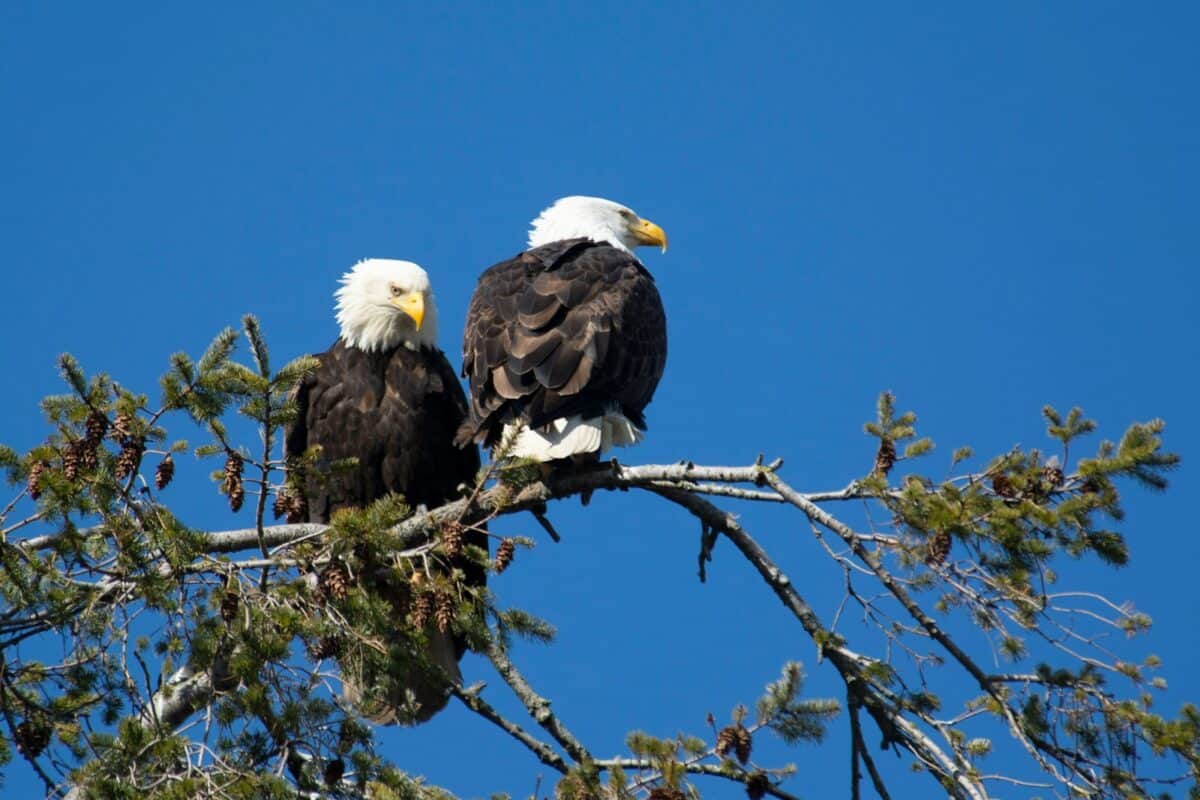
Bald eagles typically mate for life, forming bonds that can last 20-30 years until one partner dies. Their courtship rituals are spectacular, featuring elaborate aerial displays where pairs lock talons and spiral toward the ground in a dangerous “death spiral,” releasing just before impact. This dramatic behavior tests and strengthens their bond while demonstrating mutual trust. Once paired, eagles remain fiercely loyal, returning to the same territory and nest site each year. They share parenting duties equally, taking turns incubating eggs and hunting for food. Even during non-breeding seasons, mated pairs often remain together, strengthening their relationship through mutual preening and roosting side by side. This lifelong partnership contributes significantly to their reproductive success and survival.
12. Unique Vocalization Patterns

Despite their fierce appearance, bald eagles produce surprisingly delicate vocalizations that contrast with their powerful image. Their primary call is a series of high-pitched, chirping whistles or chatters that sound more reminiscent of a small bird than a powerful raptor. These calls, described as a weak-sounding “kee-kee-kee,” serve various communication purposes between mates and offspring. Interestingly, this disconnect between appearance and vocalization is why Hollywood productions typically substitute the more dramatic screech of a red-tailed hawk when depicting bald eagles in films and television. Eagles communicate through at least three distinct call types: a territorial “peal” call, an alarm call, and various contact calls between family members. Their vocalizations are most frequently heard during breeding season and territorial disputes.
11. Exceptional Longevity

Bald eagles are remarkably long-lived birds, especially considering the challenges of life in the wild. In their natural habitat, they typically survive 20-30 years, with the oldest wild bald eagle documented reaching 38 years of age. In captivity, their lifespan can extend even further, with some individuals living past 50 years. This longevity is unusual among large predatory birds and contributes to their slow reproductive strategy. Eagles typically don’t begin breeding until they’re 4-5 years old, and pairs usually produce only 1-3 eggs annually. Their extended lifespan allows for multiple breeding seasons throughout their lives, compensating for their relatively low annual reproductive output. This longevity strategy has proven successful for the species, enabling population recovery despite numerous environmental challenges.
10. Opportunistic Feeding Behaviors
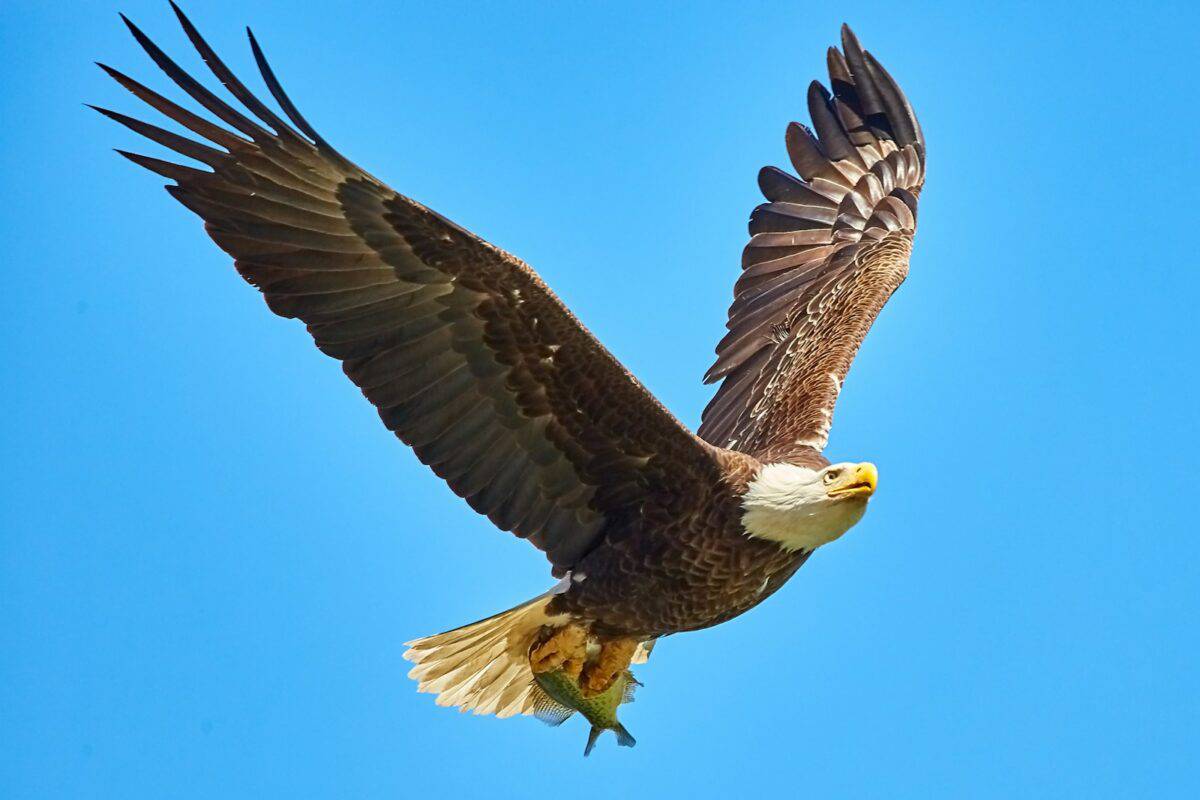
While often portrayed as noble fishers, bald eagles are actually opportunistic feeders with surprisingly diverse dining habits. Fish comprise about 60% of their diet, but they readily consume small mammals, other birds, reptiles, amphibians, and invertebrates. They are also efficient scavengers, often stealing food from other predators (a behavior called kleptoparasitism) or feeding on carrion. This adaptable feeding strategy has been documented in fascinating group behaviors, particularly during salmon runs where dozens of eagles may gather. In winter, when lakes freeze, eagles congregate around open water or move to areas with abundant carrion. Their willingness to scavenge led Benjamin Franklin to criticize their selection as a national symbol, calling them birds of “bad moral character” due to their habit of stealing food from other birds.
9. Specialized Breathing System

Bald eagles possess a remarkable respiratory system that differs significantly from mammals. Instead of having lungs that expand and contract, eagles have a complex system of air sacs connected to their hollow bones that allows for continuous, one-way airflow through their lungs. This highly efficient breathing apparatus extracts maximum oxygen with each breath, enabling them to function normally at high altitudes where oxygen levels are lower. Their specialized lungs extract nearly twice as much oxygen from each breath compared to mammalian lungs. Additionally, eagles can control their breathing rate during dives and high-speed flight, maximizing oxygen efficiency. This advanced respiratory system is one of the key adaptations that allows eagles to soar at altitudes exceeding 10,000 feet and undertake long migratory journeys with minimal energy expenditure.
8. Incredible Talon Strength

The bald eagle’s talons represent one of nature’s most perfectly designed hunting tools. Each foot has four powerfully built toes equipped with razor-sharp talons that can exert an astonishing grip pressure of approximately 400 pounds per square inch—ten times stronger than the average human hand. The rear talon (hallux) is particularly large and can reach lengths of over two inches, allowing eagles to puncture vital organs of prey instantly. Their feet contain specialized tendons that lock into place when gripping, enabling eagles to maintain their hold with minimal muscle fatigue—essential when carrying heavy prey over long distances. This powerful grip allows them to lift prey weighing up to 4 pounds, including large fish and waterfowl, and even drag prey weighing substantially more. The talons’ design combines with exceptional leg strength to create one of nature’s most effective predatory adaptations.
7. Sophisticated Bathing Rituals

Bald eagles maintain meticulous grooming habits that include elaborate bathing rituals essential for feather maintenance and parasitic control. They typically bathe several times weekly, performing dramatic plunge-diving maneuvers into water before vigorously splashing and flapping their wings. After bathing, eagles engage in extensive preening sessions where they use their beaks to distribute natural oils from their uropygial (preen) gland throughout their feathers. This waterproofing process is critical for maintaining flight efficiency and insulation. Eagles also engage in sunbathing behaviors, spreading their wings wide to expose feathers to ultraviolet rays that help kill bacteria and parasites. During winter, they’ve been observed taking “snow baths,” using similar motions in fresh powder snow when water sources are frozen. These complex grooming behaviors help maintain the peak physical condition necessary for hunting and survival.
6. Extraordinary Feather Insulation

Bald eagles possess remarkable feather insulation that allows them to thrive in harsh environments ranging from Alaska to the southern United States. Their bodies are covered with approximately 7,000 feathers that provide exceptional thermal regulation. The dense, downy underlayer traps air close to the body, creating an insulating barrier that maintains body temperature even when eagles are exposed to extreme cold or are partially submerged while catching fish. Their specialized contour feathers are arranged in an overlapping pattern similar to roof shingles, creating a waterproof outer layer that prevents moisture from reaching the skin. This advanced insulation system allows eagles to withstand temperatures as low as -40°F and permits them to remain in northern territories year-round if food sources remain accessible. Eagles continuously replace feathers through a gradual molting process that ensures flight capability is maintained throughout the year.
5. Complex Family Dynamics
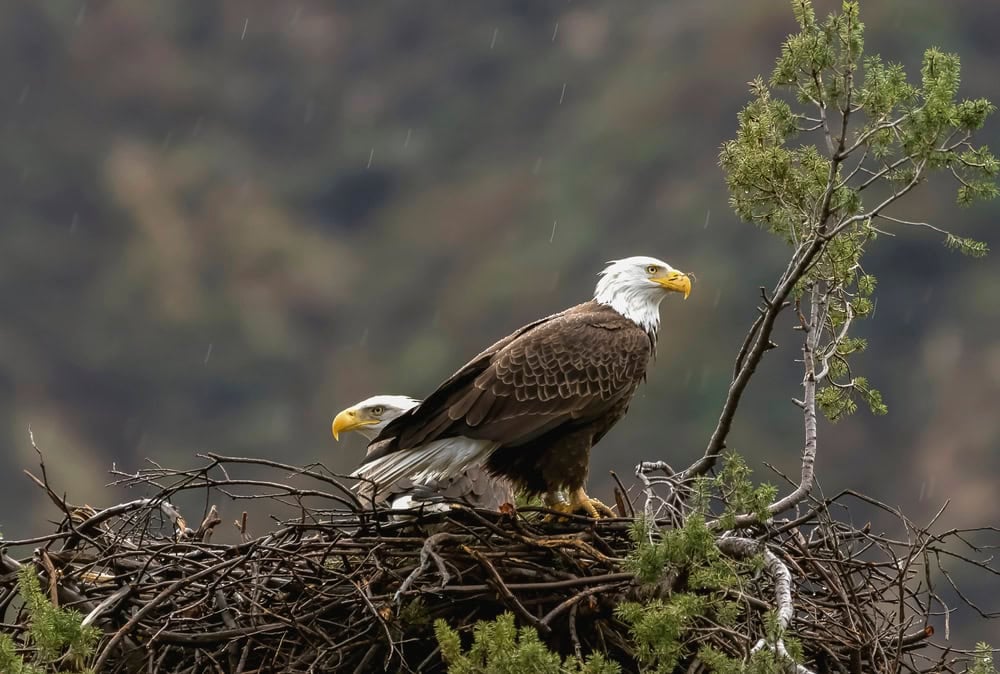
Bald eagle family life reveals fascinating social behaviors not commonly associated with predatory birds. Both parents participate equally in nest building, incubation, and chick rearing, demonstrating remarkable cooperation. Females typically lay 1-3 eggs, which hatch asynchronously after a 35-day incubation period. This staggered hatching creates a size hierarchy among siblings that can lead to a phenomenon called “siblicide” during food shortages, where larger chicks may outcompete smaller ones for resources. However, in years of abundance, all chicks often survive. Parents continue caring for fledglings for 4-12 weeks after they leave the nest, gradually teaching hunting skills before the young become independent. Research suggests that juvenile eagles maintain complex social networks, often roosting together in communal areas that serve as “information centers” where younger birds learn from experienced hunters about productive feeding locations.
4. Unique Cultural Significance

Beyond their status as America’s national symbol since 1782, bald eagles hold profound cultural significance for many indigenous North American cultures. In numerous Native American traditions, eagle feathers are considered sacred objects used in important ceremonies and religious practices. The Bald and Golden Eagle Protection Act acknowledges this cultural importance by making special provisions for federally recognized tribes to possess eagle feathers for religious purposes. Eagles feature prominently in creation stories, with many tribes viewing them as messengers between humans and the spirit world. Their perceived ability to fly higher than any other bird has led to their association with divine power across diverse cultures. This spiritual significance extends internationally, with eagles appearing as prominent symbols in the mythologies and national emblems of countries around the world, reflecting their universal appeal as powerful representations of freedom and strength.
3. Exceptional Aerial Agility

Despite their impressive size, bald eagles display remarkable aerial agility that allows them to perform complex maneuvers with precision. Their wing structure combines a large surface area with specialized primary feathers that can separate like fingers, providing exceptional control during flight. Eagles can execute tight turns by adjusting individual feathers and shifting their weight, abilities that prove crucial during territorial disputes and hunting. Their impressive wing loading ratio (weight to wing surface area) enables them to soar effortlessly on thermal currents for hours while expending minimal energy. Perhaps most remarkable is their ability to carry prey weighing up to half their body weight while maintaining flight control. Eagles have been observed performing mid-air prey transfers between mates and executing complex evasive maneuvers when harassed by smaller birds like crows and gulls that frequently mob them to protect their territories.
2. Remarkable Migratory Patterns

Bald eagles display fascinating migratory behaviors that vary significantly based on location and age. Northern populations generally migrate south when water bodies freeze, while southern populations remain relatively sedentary year-round. Using rising thermal air currents, migrating eagles can travel up to 125 miles daily with minimal energy expenditure. Tracking studies have revealed that some individuals follow astonishingly precise routes year after year, returning to the exact same winter territories. Young eagles often undertake more extensive “wandering migrations,” traveling thousands of miles during their first years before establishing territories. One tracked eagle from Maine traveled over 5,000 miles in its first year, exploring territories from Quebec to Florida. These journeys help juvenile eagles identify productive feeding areas and potential future nesting sites. Intriguingly, eagles demonstrate a phenomenon called site fidelity, with many returning to their birth regions to establish breeding territories once they reach maturity.
1. Specialized Digestive Adaptations

Bald eagles possess specialized digestive adaptations perfectly suited to their predatory lifestyle. Unlike mammals, they lack teeth for chewing, instead using their powerful beaks to tear food into manageable pieces. Their highly acidic stomach environment, with a pH as low as 1.0, allows them to digest bone, feathers, and other animal tissues that would be indigestible to many other species. Eagles efficiently process the nutritional components of their prey while forming indigestible materials (fur, feathers, bones) into compact pellets that they regurgitate approximately 24 hours after eating. This pellet-casting behavior, similar to that of owls but less frequent, enables eagles to empty their digestive system of non-nutritive material. Additionally, bald eagles can consume up to 1 pound of food in a single meal—equivalent to about 10% of their body weight—and can store food in their crop when feeding conditions are favorable, allowing them to go several days between meals during lean periods.
Conclusion:

The bald eagle is far more than a national symbol—it is a living emblem of resilience, adaptation, and natural wonder. From its unmatched vision and powerful talons to its intricate social behaviors and stunning aerial acrobatics, every aspect of the bald eagle’s life is a testament to evolutionary ingenuity. Once teetering on the brink of extinction, this iconic raptor has soared back to reclaim its place in America’s skies, reminding us of what can be achieved through dedicated conservation efforts. As we marvel at these 20 incredible facts, we’re reminded not only of the bald eagle’s grandeur but also of our responsibility to protect the wild places it calls home—for future generations to continue witnessing its awe-inspiring presence.

As a little kid, I fell in love with nature, wildlife, and animals. Living in the USA, South Africa, Italy, China and Germany gave me the opportunity to discover the world's Wildlife. My favorite animals are Mountain Gorillas, Siberian Tigers, and Great White Sharks.
I'm a certified PADI Open Water Diver, went to Everest Base Camp and Trekked Gorillas in Uganda. I hold a Master of Science in Economics and Finance.
Please send any feedback to feedback@animalsaroundtheglobe.com
- 12 Bald Eagle Comebacks That Prove Conservation Works - July 31, 2026
- 16 Pet Breeds Perfect for Apartment Living - July 31, 2026
- 13 Animal Behaviors Scientists Still Don not Understand - July 31, 2026