
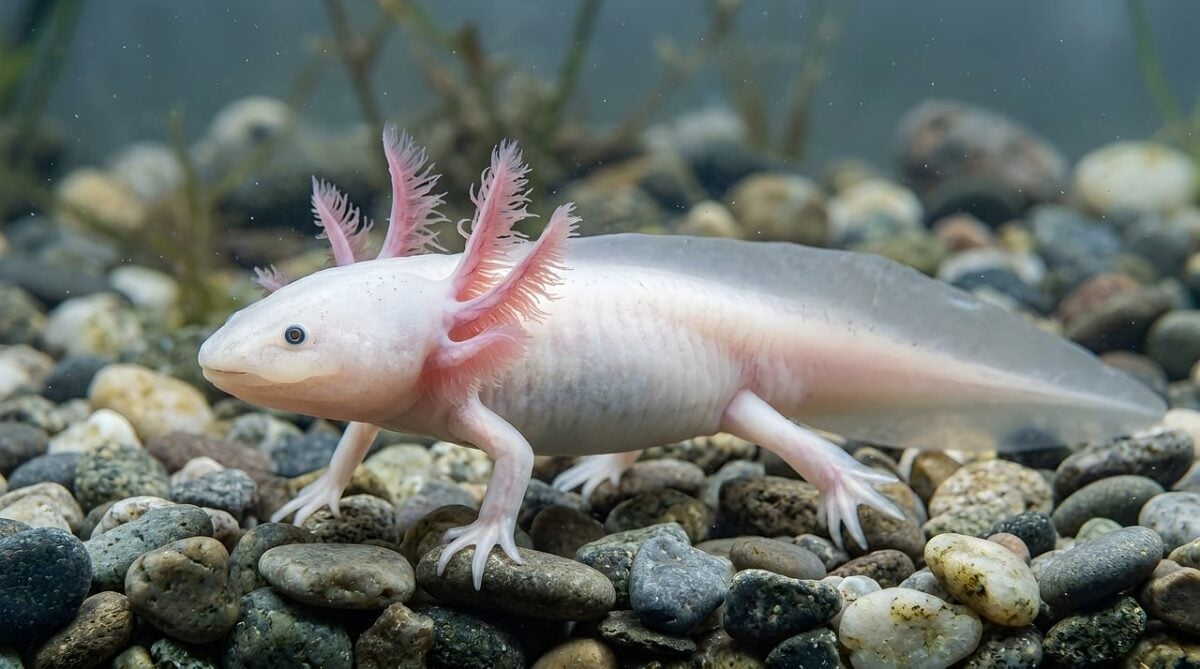
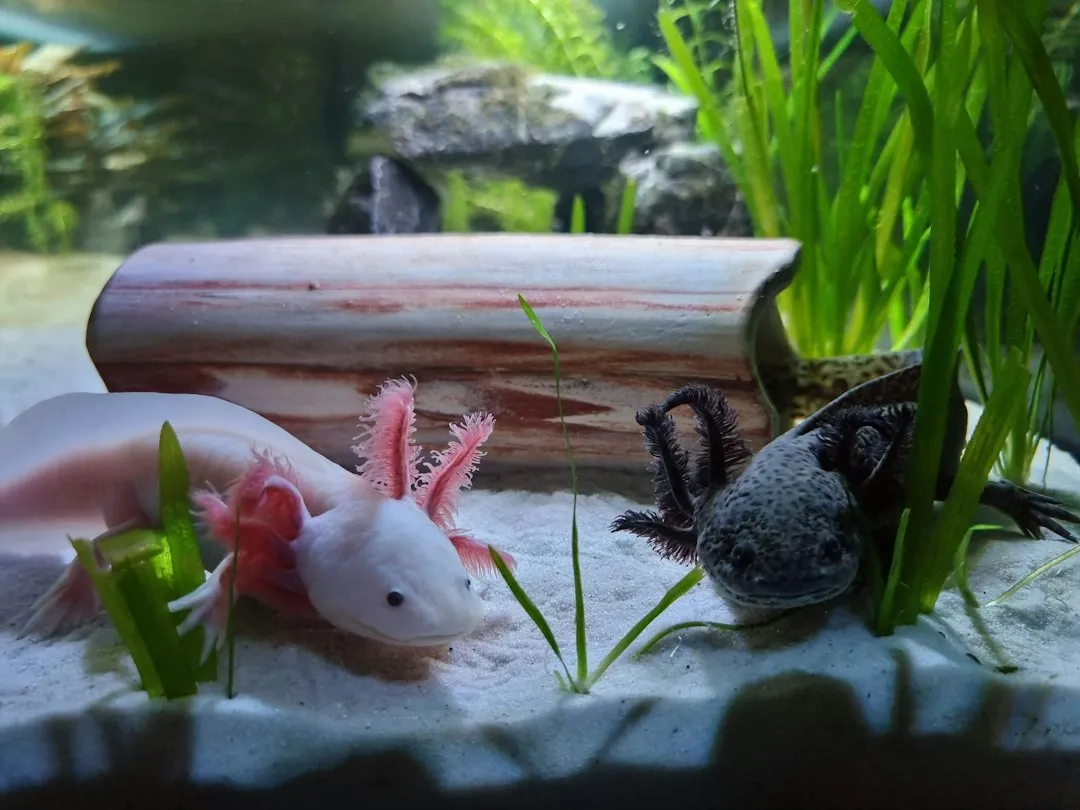
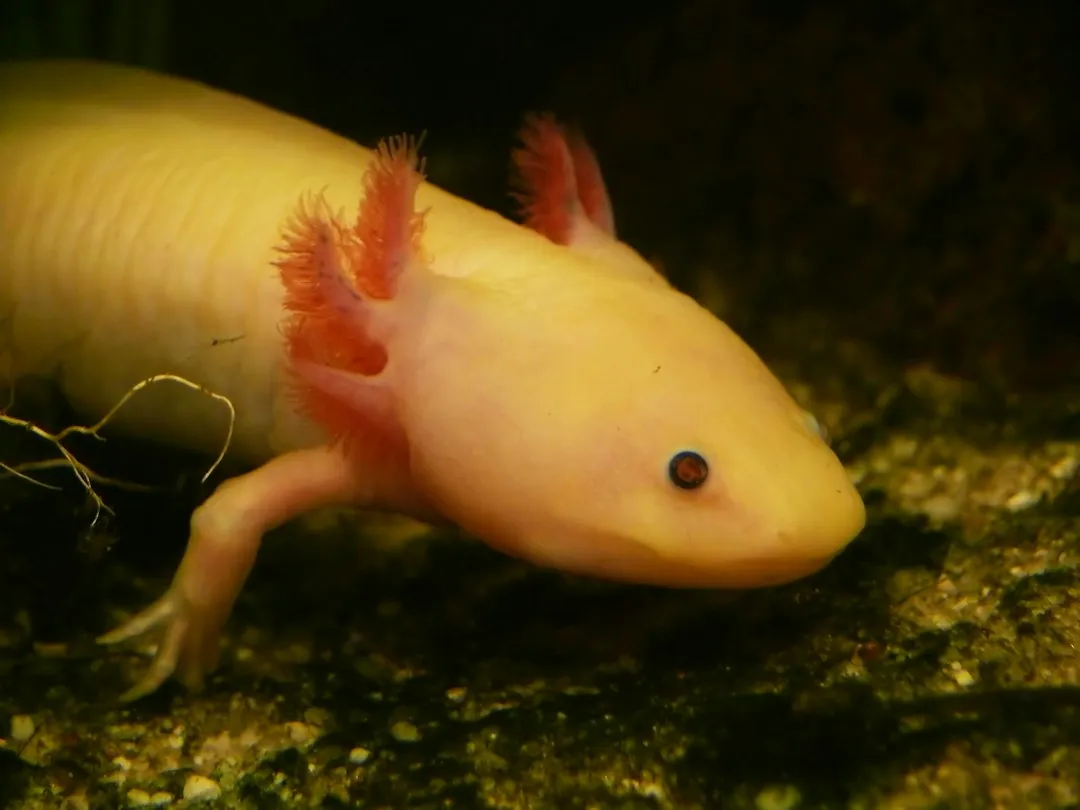
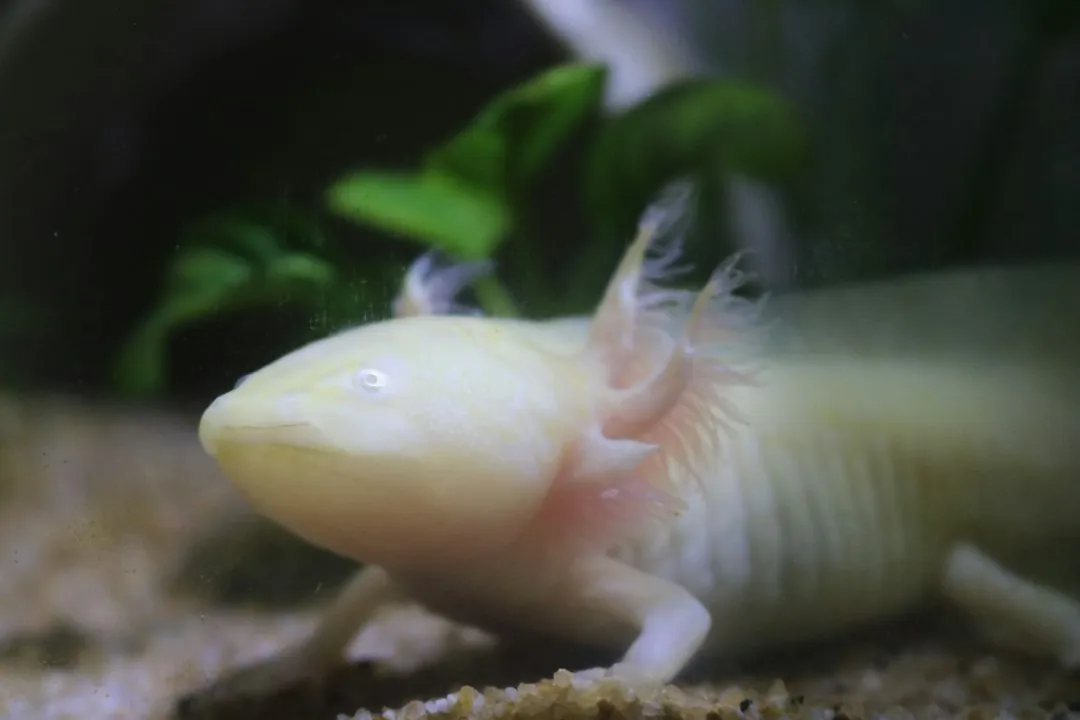
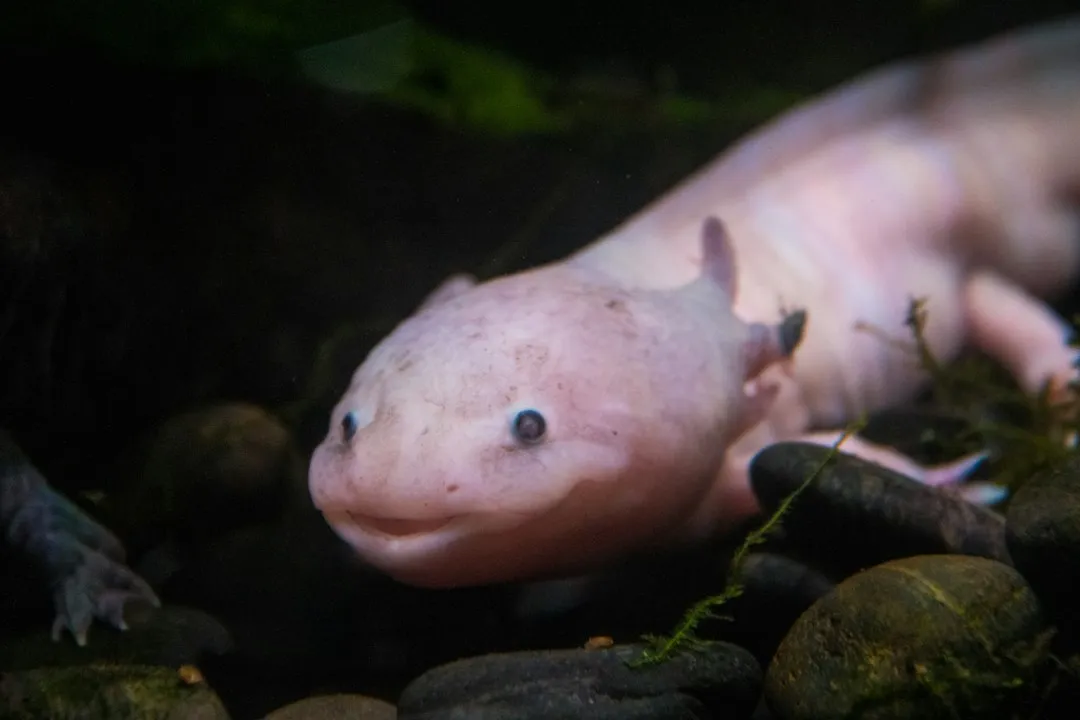
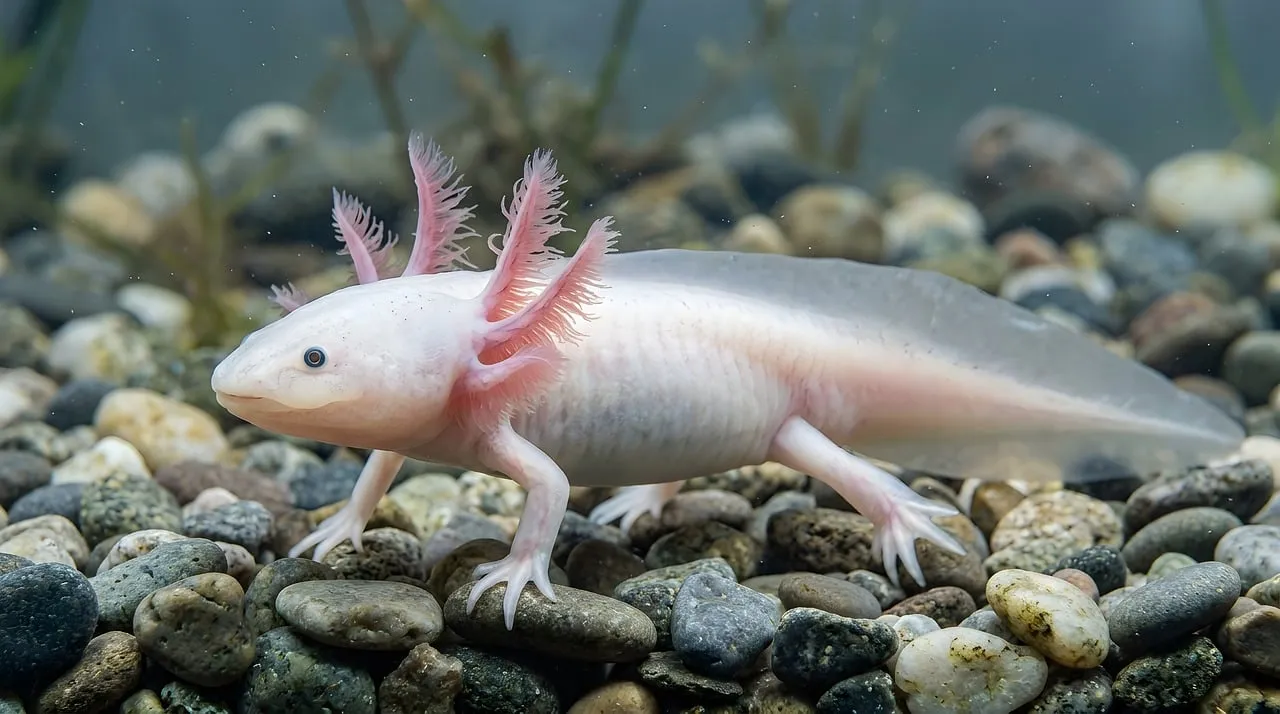
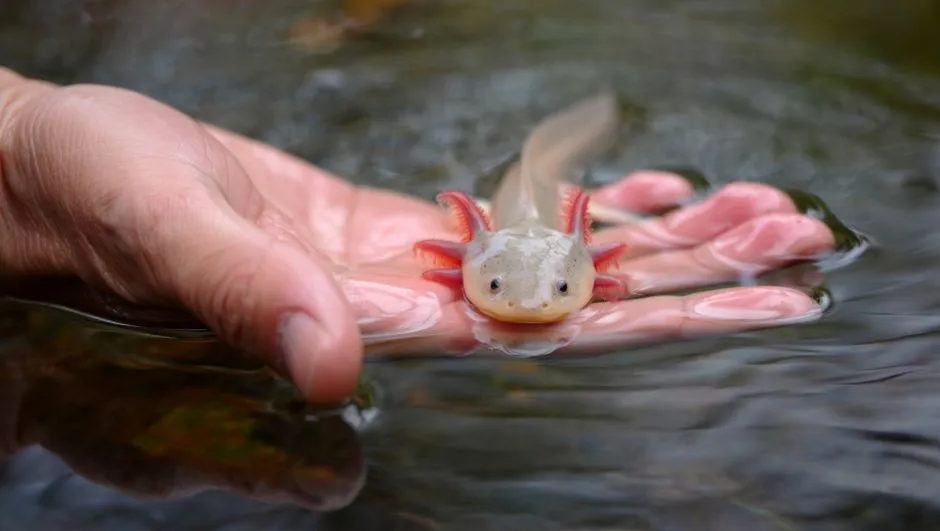
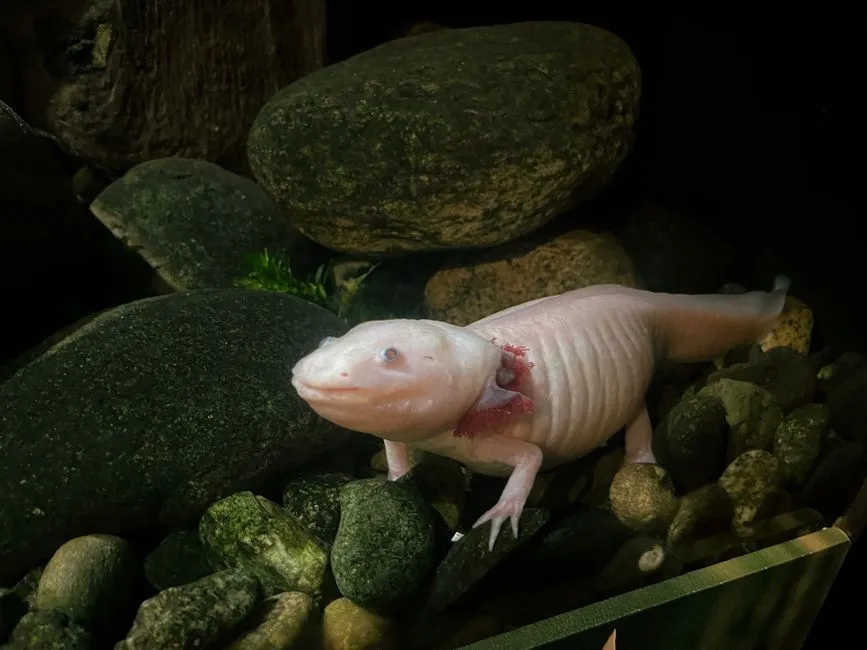
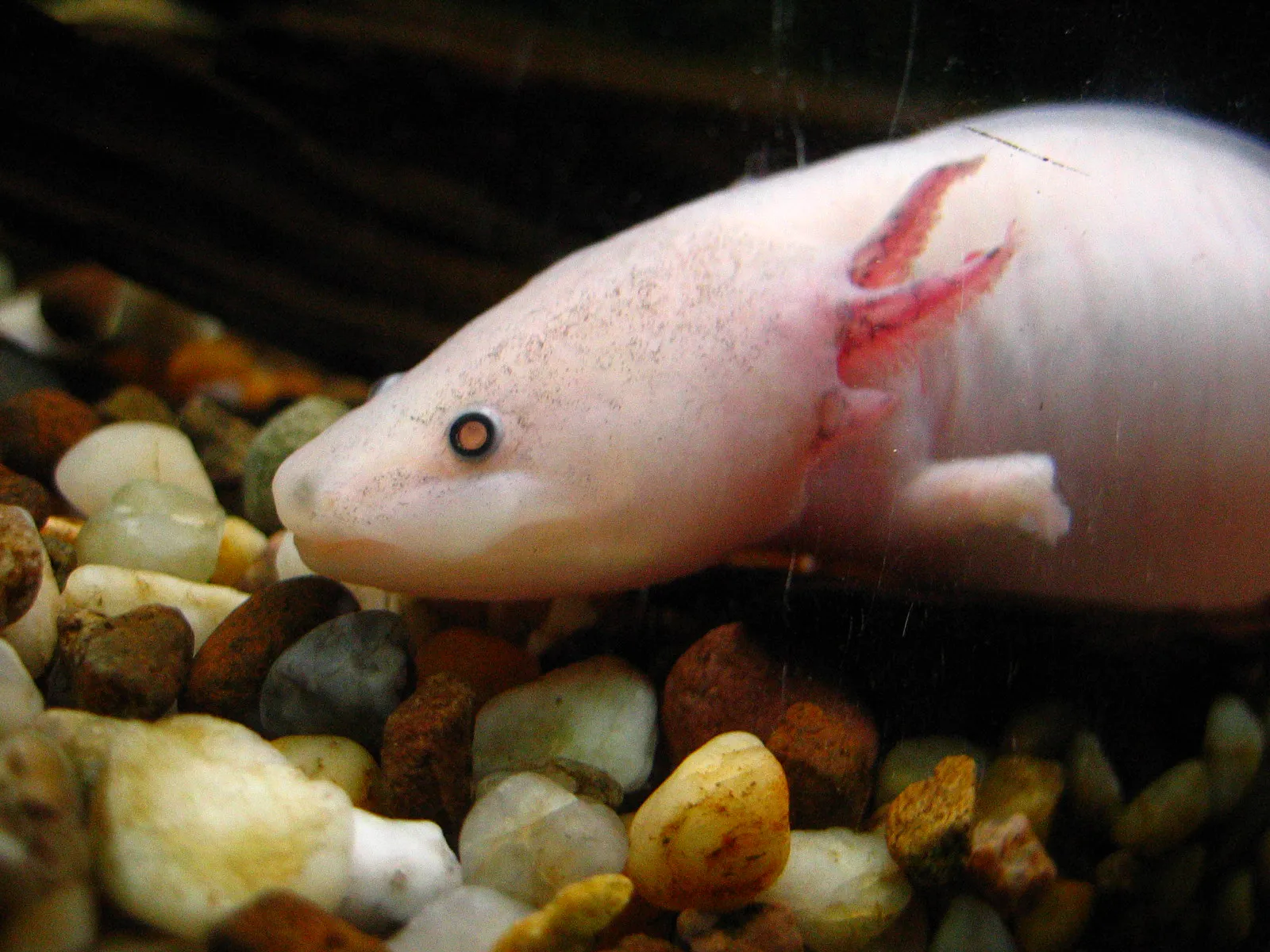
At first glance, the axolotl looks like a cartoon. It has a permanent half smile, feathery gills and a pale, rubbery body. It’s easy to see why it became an internet favorite.
Behind that face is an animal that has kept biologists busy for a very long time. Most animals, humans included, patch up an injury and live with the scar. The axolotl does something else, and researchers are still working out how.
It Regrows Only What Is Missing
🔥 Would you like to save this?
We'll email this post to you, so you can come back to it later!
When an axolotl loses a limb, the new one isn’t a rough replacement or a stump with a bump on the end. Every time an axolotl loses a limb, it grows back just the missing pieces. The body somehow knows where the cut happened and rebuilds from that exact point.
That sense of position is one of the biggest puzzles in the field. A cell near the elbow has to behave differently from a cell near the wrist. Scientists want to understand how that information is stored and read, because any future therapy would need the same kind of precision.
Limbs Are Only the Beginning
🔥 Would you like to save this?
We'll email this post to you, so you can come back to it later!
The limb gets the headlines, but the axolotl’s talent goes much deeper. Researchers describe axolotls as able to regenerate most body parts, including heart, lung, liver, kidney, spinal cord, vertebrae and brain, without scarring. That’s a long list for a small salamander.
The absence of scarring matters as much as the regrowth itself. Scar tissue in people can limit how well a damaged heart or spinal cord works. An animal that rebuilds the original structure instead of sealing the wound with scar tissue shows what a different outcome could look like.
A Clump of Cells Called the Blastema Leads the Way
🔥 Would you like to save this?
We'll email this post to you, so you can come back to it later!
After an amputation, the wound doesn’t just close. Cells gather into a mass called a blastema, which acts like a construction crew for the new limb. It’s a key stage, and much of the research focuses on how it forms.
Mathematics is now helping. A 2026 preprint built a model of blastema formation based on local softening of the wounded epithelium. Comparing simulations with real axolotl cells lets scientists test their ideas about how the tissue physically behaves, not just which genes switch on.
Tails and Limbs Don’t Follow the Same Playbook
🔥 Would you like to save this?
We'll email this post to you, so you can come back to it later!
It would be tidy if one master program handled every regrowth. Reality is messier. Scientists had assumed that tails and limbs were regrown through the same cells and strategies.
A 2026 study in Science Advances challenged that. It found muscle stem cell strategies that differed fundamentally between the main body axis and the appendages. In the tail, muscle stem cells can revert to a more flexible state and produce both muscle and connective tissue, which limb muscle stem cells don’t do in the same way.
A Gene Called SP8 Shows Up Across Species
🔥 Would you like to save this?
We'll email this post to you, so you can come back to it later!
One of the more talked about results of 2026 came from Wake Forest University. Scientists studying axolotls, zebrafish and mice found a shared set of genes that may one day help humans regrow lost limbs. Mice aren’t known for regrowing limbs, so a shared genetic thread is intriguing.
Within that group, SP8 appears especially important for limb regeneration in salamanders. When the team used CRISPR to remove it from the axolotl genome, regeneration was disrupted. That points to a specific lever, though a therapy for people is, by the researchers’ own account, still many years away.
The Nervous System Can Rebuild Itself
🔥 Would you like to save this?
We'll email this post to you, so you can come back to it later!
Regrowing a brain or spinal cord sounds like science fiction, yet it’s well documented in this animal. A 2026 paper in Nature Communications focused on cells called ependymoglial cells. When these cells were depleted, regeneration of the central nervous system failed.
The authors suggest they are the sole source of that regeneration. They also used large scale loss of cortical neurons to model damage seen in neurodegenerative disease. It’s an early research tool rather than a treatment, but it gives scientists a living example of a brain that recovers.
Even Fingers Rebuild With Surprising Detail
🔥 Would you like to save this?
We'll email this post to you, so you can come back to it later!
You might expect small structures like digits to be the easy part. They’re actually a useful test case. A recent characterization of digit regeneration revealed both conserved features and notable divergences from classical limb regeneration.
The study highlighted hedgehog signaling as a critical piece. It also noted that the success of rebuilding joints and bone segments varied from digit to digit, which is a reminder that regeneration isn’t perfect every time. Those quirks help researchers pin down what exactly the process depends on.
The Ability Switches On During Development
🔥 Would you like to save this?
We'll email this post to you, so you can come back to it later!
Axolotls weren’t necessarily born ready to regrow a tail. A 2026 preprint reported that a defined embryonic window between stages 30 and 34 is when the tail region becomes regeneration competent. Before that point, the tissue can’t do it.
The same work suggested that regeneration and normal tail development can be separated mechanistically. Embryos with severe tail defects could still regrow the tail effectively. Preprints haven’t been through full peer review, so this is best read as a promising lead.
Regeneration Research Is Pointing Toward Cancer and Aging
🔥 Would you like to save this?
We'll email this post to you, so you can come back to it later!
Rebuilding tissue and growing tumors both involve cells multiplying, which is why the two fields keep overlapping. One report described a crude extract from axolotl limb tissue halting the growth of acute myeloid leukemia cells in the lab. That’s a cell culture result, not a medicine.
Researchers also talk about what regeneration might teach us about keeping tissue working with age while limiting cancer risk. One scientist quoted in 2026 reporting cautioned that lab grown limbs aren’t coming soon. The nearer term payoff, they said, lies in learning the rules cells follow when rebuilding tissue.
Final Thoughts
🔥 Would you like to save this?
We'll email this post to you, so you can come back to it later!
I think the axolotl deserves more respect than its meme status gives it. It isn’t a magic animal. It’s a carefully studied one, and the 2026 findings show how much of its talent comes down to specific genes, cell types and timing that can be tested.
My view is that the hype about regrowing a human arm will keep running ahead of the science, and that’s fine as long as we’re honest about it. The real prize is probably less dramatic, such as less scarring, better graft healing and tissue that holds up longer. If the little salamander gets us even part of the way there, it will have earned every bit of the attention.

- 7 Everyday Habits That Can Make Your Senior Dog Happier - November 5, 2026
- 10 Enigmatic Structures That Continue to Puzzle Scientists Today - November 5, 2026
- 10 Strange Ruins in the Americas That Challenge What We Know About Early History - November 5, 2026