


The vast waters surrounding the United States’ 95,471 miles of shoreline are home to some of the ocean’s most impressive predators. While shark encounters are statistically rare, with the International Shark Attack File recording an average of just 72 unprovoked incidents annually worldwide, the presence of these massive marine creatures near popular beaches continues to captivate our attention. From the legendary great white to the gentle giant whale shark, America’s coastal waters host a remarkable diversity of large shark species that occasionally venture close to shore, creating both awe and concern among beachgoers. This article explores 13 massive shark species that have been documented near U.S. beaches, examining their characteristics, behaviors, and the reality behind our fascination with these magnificent apex predators.
Great White Shark (Carcharodon carcharias)

Perhaps the most recognizable shark species in the world, the great white shark has been spotted along both the Atlantic and Pacific coasts of the United States. These massive predators typically reach lengths of 15-16 feet, with females growing larger than males, but exceptional specimens exceeding 20 feet have been documented. Great whites are particularly common near seal colonies in Massachusetts, California, and Hawaii. In recent years, Cape Cod has seen a significant increase in great white sightings as the local seal population has recovered. These sharks are identified by their robust, torpedo-shaped bodies, distinctive triangular serrated teeth, and slate-gray upper bodies contrasting with white undersides. Despite their fearsome reputation, largely influenced by the movie “Jaws,” unprovoked attacks on humans are extremely rare. Research programs like OCEARCH have tagged and tracked numerous great whites, revealing complex migration patterns and dispelling many myths about these often misunderstood predators.
Tiger Shark (Galeocerdo cuvier)
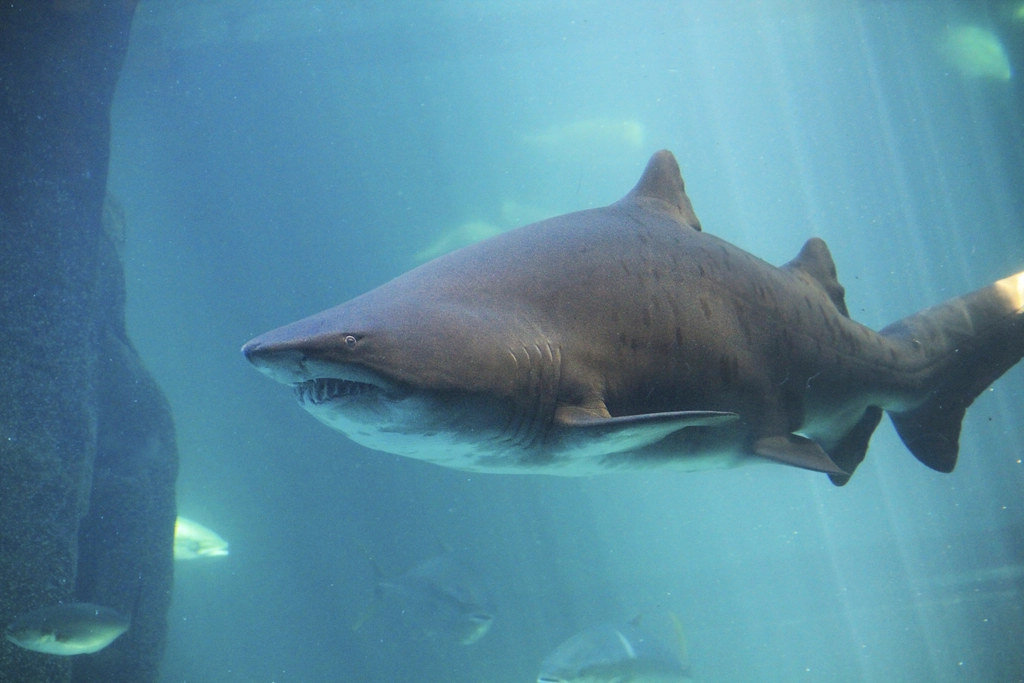
Named for the distinctive dark stripes that adorn their bodies (at least when young), tiger sharks are frequent visitors to the warm coastal waters of Florida, Hawaii, and the Gulf of Mexico. These imposing predators commonly reach lengths of 10-14 feet, though specimens approaching 18 feet have been recorded. Tiger sharks are recognized for their blunt, wide heads, serrated teeth designed for shearing, and their almost legendary status as “garbage cans of the sea” due to their indiscriminate diets. Items recovered from tiger shark stomachs include license plates, tires, and all manner of marine life. Their tendency to patrol shallow coastal waters, particularly at dawn and dusk, has earned them a reputation as one of the shark species most likely to encounter humans. Hawaii has documented regular seasonal appearances of tiger sharks, with peak sightings coinciding with the fall months when female tiger sharks travel to the islands to give birth.
Bull Shark (Carcharhinus leucas)

Perhaps the most dangerous shark species to humans, bull sharks are unique in their ability to tolerate fresh water, allowing them to venture far up rivers and into lake systems. These robust sharks, typically reaching 7-11.5 feet in length and weighing up to 500 pounds, have been spotted in the Mississippi River as far north as Illinois and in Florida’s Lake Pontchartrain. Bull sharks are identified by their stout, broad bodies, small eyes, and distinctive short, blunt snouts. Their aggressive temperament, combined with their preference for shallow coastal waters that humans often recreate, contributes to their reputation as potentially dangerous. The warm waters of the Gulf Coast, particularly Florida and Texas, see frequent bull shark activity, especially during the summer months. Their ability to survive in brackish and freshwater environments means they can appear in locations where most people wouldn’t expect to encounter a shark, including harbors, canals, and river mouths. Recent research has revealed complex breeding migrations, with pregnant females often seeking the protected waters of coastal bays and estuaries to give birth.
Whale Shark (Rhincodon typus)

As the largest fish species in the ocean, whale sharks certainly qualify as “massive,” with average adults measuring 18-33 feet and exceptional individuals reaching lengths of 40 feet or more. Despite their intimidating size, these gentle giants are filter feeders, consuming plankton and small fish rather than large prey. Whale sharks are occasional visitors to the Gulf Coast, particularly off Texas and Louisiana during summer months, where they’re drawn to seasonal plankton blooms. Their appearance is unmistakable—a broad, flat head with a wide mouth and a distinctive pattern of white spots and stripes on a dark background, creating a unique “fingerprint” for each individual. In recent years, the Georgia Aquarium has partnered with conservation organizations to study whale sharks that congregate near offshore oil platforms in the Gulf of Mexico. These encounters provide unique opportunities for researchers and eco-tourists alike, as swimming with whale sharks has become a popular (though regulated) activity when these majestic creatures appear in U.S. waters.
Basking Shark (Cetorhinus Maximus)

The basking shark holds the distinction of being the second-largest fish species, reaching lengths of 20-26 feet on average, with exceptional specimens exceeding 30 feet. Like the whale shark, this massive species is a filter feeder, swimming with its cavernous mouth agape to strain plankton from the water. Basking sharks are regular seasonal visitors to the northeastern United States, particularly off the coasts of Massachusetts, Maine, and New York. They’re most commonly spotted from spring through fall when plankton is abundant in surface waters. These sharks are identified by their enormous gill slits that nearly encircle the head, their conical snout, and their habit of “basking” at the surface while feeding—the behavior that inspired their common name. The New England coast has become an important area for basking shark research, with scientists using aerial surveys and satellite tagging to track their movements. Though once heavily hunted for their liver oil and fins, basking sharks now enjoy protected status in U.S. waters, though their global population continues to face threats from ship strikes and entanglement in fishing gear.
Hammerhead Sharks (Sphyrnidae family)

The distinctive T-shaped head of hammerhead sharks makes them among the most recognizable ocean predators. Several species of hammerheads patrol U.S. coastal waters, with the great hammerhead (Sphyrna mokarran) being the largest, reaching lengths of 13-20 feet. Scalloped hammerheads (Sphyrna lewini) and smooth hammerheads (Sphyrna zygaena) are also common sightings, particularly along the southern Atlantic coast and throughout the Gulf of Mexico. Their unique head shape, called a “cephalofoil,” provides several evolutionary advantages, including enhanced electroreception for locating prey buried in sand and improved maneuverability. Florida’s coast is a particular hotspot for hammerhead activity, with seasonal migrations bringing large numbers to shallow waters. Bimini in the nearby Bahamas hosts a famous hammerhead research station due to the reliable presence of these sharks. Despite their intimidating appearance, hammerheads rarely show aggression toward humans, though the great hammerhead is considered potentially dangerous due to its size and predatory nature. Conservation concerns have grown for several hammerhead species, with the scalloped hammerhead now listed as endangered due to fishing pressure, particularly for the shark fin trade.
Thresher Shark (Alopias species)

The thresher shark’s most distinctive feature is its extraordinarily long upper caudal (tail) fin lobe, which can be as long as the shark’s body and is used to stun prey by whipping it through schools of fish. These sharks, which typically measure 10-20 feet in total length (including the tail), are occasionally spotted off both the Atlantic and Pacific coasts of the United States. California’s Monterey Bay is a known hotspot for thresher shark activity, while on the East Coast, they range from Maine to Florida depending on the season. Three species may be encountered in U.S. waters: the common thresher (Alopias vulpinus), pelagic thresher (Alopias pelagicus), and bigeye thresher (Alopias superciliosus). Despite their size, threshers pose little threat to humans, preferring to feed on schooling fish like mackerel, bluefish, and herring. These sharks are prized by recreational anglers for their fighting ability and spectacular aerial displays when hooked. However, their relatively slow reproductive rate makes them vulnerable to fishing pressure, with concerns growing about the sustainability of thresher shark populations, particularly in the Atlantic.
Shortfin Mako Shark (Isurus oxyrinchus)

Renowned as the fastest sharks in the ocean, shortfin makos can reach burst speeds of 45 mph, making them the cheetahs of the sea. These powerful, streamlined predators typically measure 10-12 feet in length, though females can exceed 14 feet. Makos are primarily offshore species but occasionally venture closer to shore, where they may be encountered by fishermen and divers, particularly off California, New England, and the mid-Atlantic states. Their distinctive appearance includes a conical snout, large black eyes, and a striking metallic blue coloration on the dorsal surface. Perhaps their most intimidating feature is their mouth full of long, narrow teeth that visibly protrude even when their jaws are closed. Shortfin makos are among the few shark species known to leap completely out of the water, sometimes achieving heights of 20 feet or more. This behavior, called breaching, may be related to feeding or removing parasites. While makos rarely interact with humans in the water, they are a prized sport fish, known for their spectacular aerial displays and fighting ability when hooked. Unfortunately, this popularity with anglers, combined with commercial fishing pressure, has contributed to concerning population declines, with the species now listed as endangered on the IUCN Red List.
Sandbar Shark (Carcharhinus plumbeus)

The sandbar shark, though less famous than some of its cousins, is one of the largest coastal shark species in U.S. waters, with adults typically reaching 6-8 feet in length. These sharks are particularly common along the Atlantic coast from New England to Florida, including the Chesapeake Bay, which serves as a crucial nursery area for juvenile sandbar sharks. They’re identified by their large first dorsal fin, brownish-gray coloration, and relatively heavy build. Despite their size, sandbar sharks have never been implicated in an unprovoked attack on humans, feeding primarily on bottom-dwelling fish, smaller sharks, and rays. Their preference for shallow coastal waters, particularly sandy or muddy bottoms near the shore, means beachgoers frequently encounter them, though most remain unaware of their presence. Sandbar sharks undertake seasonal migrations, moving northward along the East Coast during the summer months and returning south for winter. These migrations make them particularly visible near beaches during spring and fall transition periods. Once heavily targeted by commercial fisheries, sandbar sharks now benefit from stronger management measures in U.S. waters. However, their slow reproductive rate—females don’t reach maturity until about 16 years of age—makes population recovery a slow process.
Blue Shark (Prionace glauca)
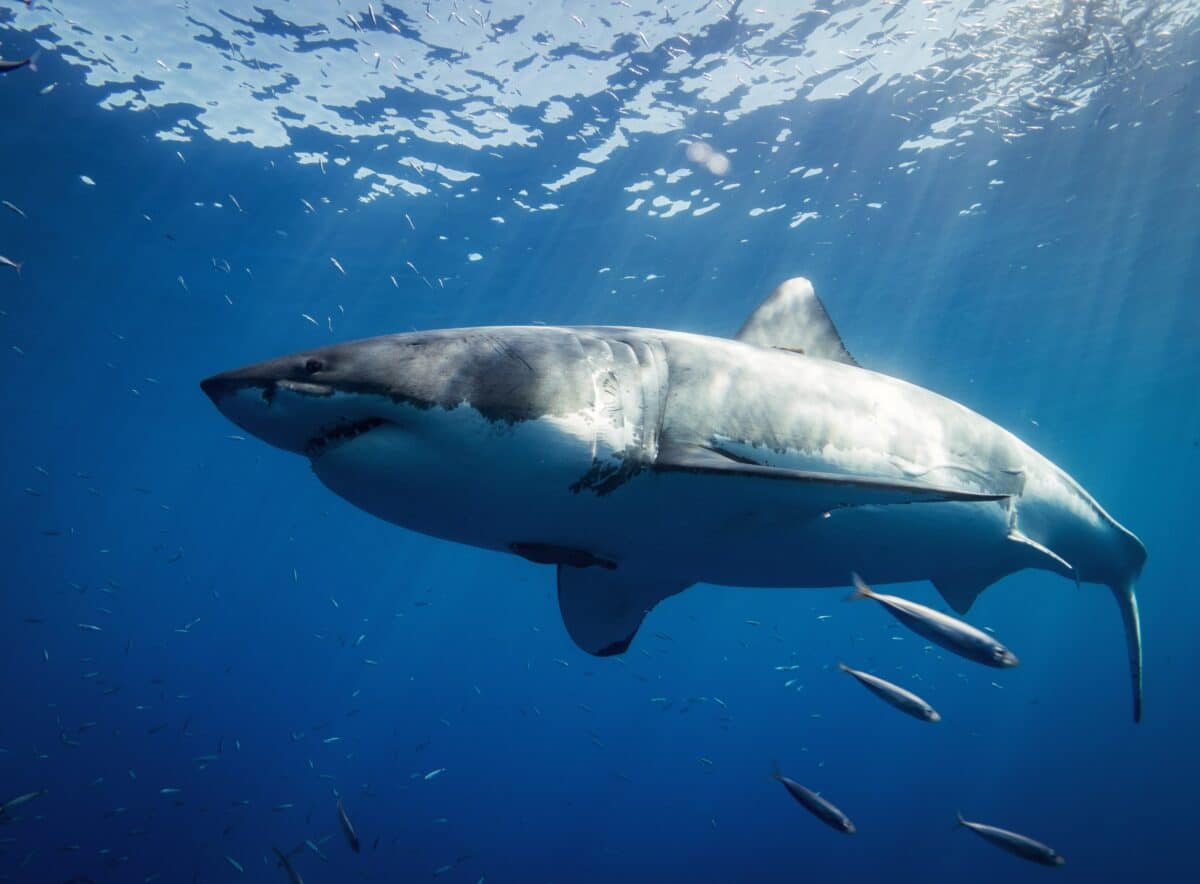
With their slender bodies and stunning indigo-blue coloration, blue sharks are among the most beautiful of the large shark species occasionally spotted near U.S. coasts. These primarily pelagic (open ocean) sharks typically reach lengths of 10-13 feet, though females can grow larger. While they generally prefer deeper offshore waters, seasonal migrations and oceanographic conditions sometimes bring blue sharks closer to shore, particularly along the California coast and New England waters during summer months. Blue sharks are easily identified by their deep blue dorsal surface (which provides perfect camouflage in the open ocean), white underside, and long, slender pectoral fins. They’re known for their remarkable migratory behavior, with some individuals tracked traveling over 5,700 miles across the Atlantic Ocean. Blue sharks are also highly social, sometimes forming same-sex groups or “schools.” Though considered potentially dangerous due to their size and dentition, blue sharks rarely interact with humans in U.S. waters. Unfortunately, they face intense fishing pressure globally, with estimates suggesting between 10-20 million blue sharks are caught annually, many as bycatch in longline fisheries targeting tuna and swordfish.
Lemon Shark (Negaprion brevirostris)

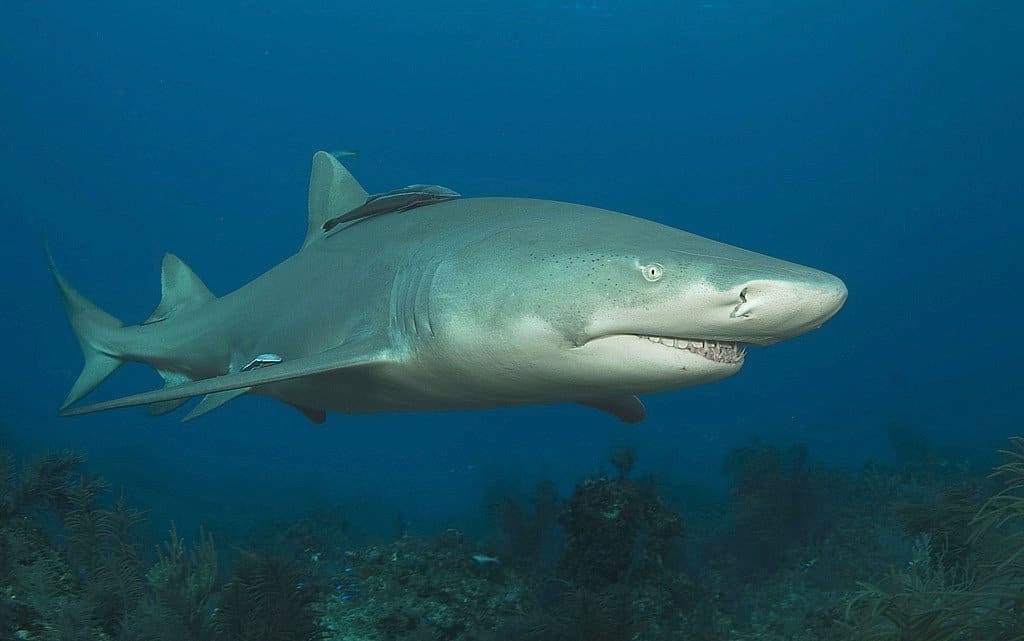
Named for their yellowish-brown coloration that provides excellent camouflage over sandy seabeds, lemon sharks are substantial predators reaching 8-10 feet in length that frequent the warm coastal waters of Florida and the Gulf of Mexico and occasionally venture as far north as New Jersey during summer months. These stocky sharks are identified by their two similarly-sized dorsal fins, broad snout, and lack a ridge between the dorsal fins that many other large sharks possess. Lemon sharks show a strong preference for shallow coastal waters, including estuaries, mangrove areas, and seagrass beds, making encounters with beachgoers relatively common in Florida and the Keys. What makes lemon sharks particularly interesting is their social behavior—they’ve been documented forming complex social groups and demonstrating preferences for associating with specific individuals, challenging the stereotype of sharks as solitary hunters. The shallow waters of Bimini in the Bahamas, just 50 miles east of Miami, host one of the best-studied lemon shark populations, with researchers documenting female sharks returning to the same nursery areas where they were born to give birth to their own young—a remarkable display of site fidelity spanning decades.
Oceanic Whitetip Shark (Carcharhinus longimanus)
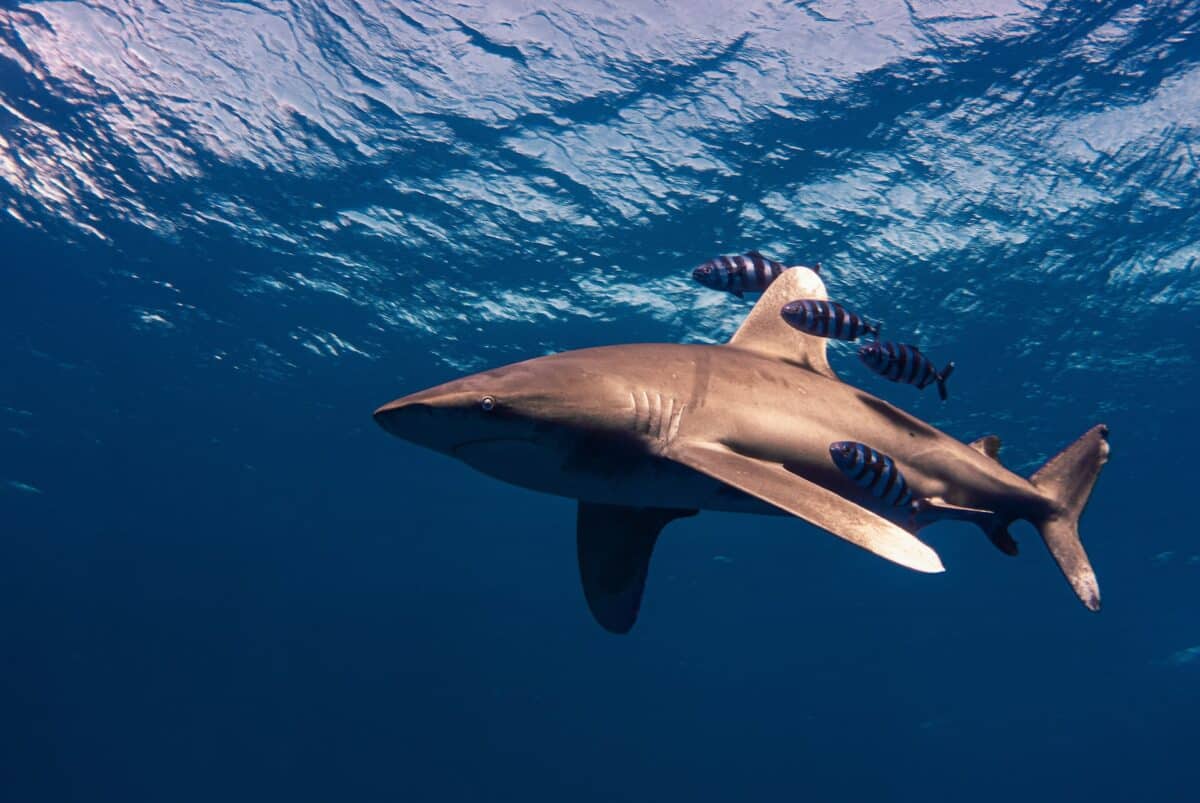
Once described by Jacques Cousteau as “the most dangerous of all sharks,” the oceanic whitetip is a large, pelagic species reaching 10-13 feet in length that occasionally appears in offshore waters around Hawaii, the Gulf of Mexico, and the southeastern U.S. coast. These sharks are instantly recognizable by their rounded, white-tipped fins—particularly the pectoral fins, which are extraordinarily long and paddle-shaped. Their reputation stems largely from historical accounts of shipwrecks and plane crashes at sea, where oceanic whitetips were often the first sharks to appear at the scene. While primarily a creature of the open ocean, typically found in the upper levels of the water column, changing ocean conditions and food availability occasionally bring these sharks closer to shore. Hawaii has documented several nearshore encounters, particularly around the Big Island. The oceanic whitetip’s bold, persistent nature makes these encounters particularly notable, as these sharks show little fear and will often approach boats and swimmers with curiosity. Once among the most abundant large animals on Earth, oceanic whitetip populations have collapsed due to fishing pressure, particularly as bycatch in tuna longline fisheries, with some regions seeing declines of over 95%. The species is now listed as threatened under the Endangered Species Act and critically endangered globally.
Sixgill Shark (Hexanchus species)
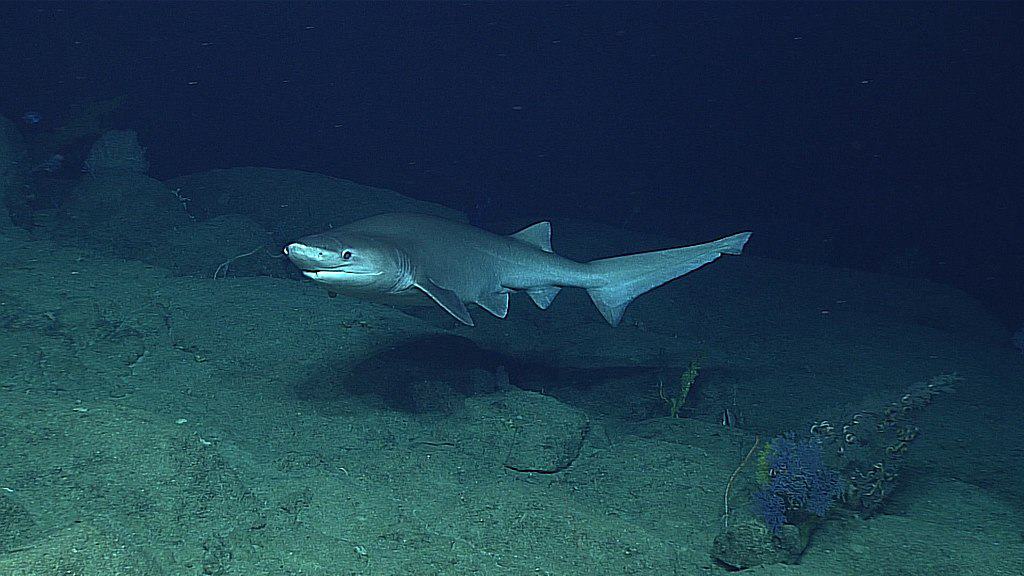
Among the most ancient shark lineages still swimming in our oceans, sixgill sharks (both the bluntnose, Hexanchus griseus, and bigeye, Hexanchus nakamurai, species) are occasionally encountered in deeper waters off both U.S. coasts. As their name suggests, these massive, primitive-looking sharks possess six-gill slits on each side, unlike the five found in most modern shark species. The bluntnose sixgill is the larger of the two, with females reaching impressive lengths of 15-16 feet and weighing up to 1,300 pounds. While typically deep-water residents, inhabiting depths from 300 to 6,000 feet, sixgills have been documented making vertical migrations that sometimes bring them into shallower waters, particularly at night. In Puget Sound, near Seattle, researchers have identified a resident population of six gills that venture into relatively shallow water, providing rare opportunities to study these normally elusive creatures. California divers occasionally report nighttime encounters with sixgills in areas where underwater canyons approach the coast. These sharks are identified by their broad, blunt heads, single dorsal fin set far back on the body, and fluorescent green eyes that reflect light dramatically in the darkness of the deep. Their appearance has changed little from their ancestors that swam the oceans 200 million years ago, predating many dinosaur species.
Conclusion
The sight of massive sharks near U.S. beaches reminds us of the incredible diversity and ancient power still thriving just beyond the shoreline. While these encounters can spark both awe and fear, it’s important to remember that sharks play a vital role in maintaining healthy marine ecosystems. Most species pose little threat to humans and are far more vulnerable to us than we are to them. As we continue to learn more about these magnificent creatures, conservation efforts become ever more critical to ensuring their survival for future generations. Respect, education, and responsible stewardship are key to preserving the balance between humans and the ocean’s greatest predators.

As a little kid, I fell in love with nature, wildlife, and animals. Living in the USA, South Africa, Italy, China and Germany gave me the opportunity to discover the world's Wildlife. My favorite animals are Mountain Gorillas, Siberian Tigers, and Great White Sharks.
I'm a certified PADI Open Water Diver, went to Everest Base Camp and Trekked Gorillas in Uganda. I hold a Master of Science in Economics and Finance.
Please send any feedback to feedback@animalsaroundtheglobe.com
- 14 Natural Phenomena That Only Animals Understand - August 6, 2026
- 15 Times Orcas Surprised Scientists - August 6, 2026
- Pollock Fish - August 6, 2026