

In the intricate world of insects, honeybees have long fascinated scientists with their complex behaviors and remarkable cognitive abilities. Recent research has unveiled an astonishing discovery: bees can perform basic mathematical operations. This revelation challenges our understanding of brain size and cognitive capacity, suggesting that complex thinking doesn’t necessarily require large brains. From the busy hives to laboratory settings, these tiny creatures demonstrate numerical competence that was once thought exclusive to vertebrates with larger brains. This article explores the fascinating world of bee mathematics, how researchers discovered this ability, and what it means for our understanding of intelligence across species.
The Surprising Discovery of Bee Mathematics

In 2019, scientists from RMIT University in Melbourne, Australia, published groundbreaking research in Science Advances demonstrating that honeybees can understand the concepts of addition and subtraction. The study revealed that despite having brains containing fewer than one million neurons (compared to the human brain’s 86 billion), bees could solve simple arithmetic problems. The researchers trained bees to recognize colors as mathematical operations—blue for addition and yellow for subtraction—and then tested whether the insects could apply these rules to new scenarios. Remarkably, the bees showed success rates significantly above chance, indicating a genuine understanding of basic arithmetic rather than mere pattern recognition.
How Bees’ Brains Process Numbers

Bees possess a brain roughly the size of a sesame seed, yet they manage to process numerical concepts within this tiny neural framework. Research suggests that bees have specialized neurons that respond to specific quantities, similar to the “number neurons” found in primates. These neurons fire when the bee encounters particular numbers of objects. Scientists believe bees use a combination of innate counting abilities and working memory to process simple calculations. Unlike humans who rely on language-based mathematical systems, bees appear to use a more direct representation of quantity, processing numbers as immediate visual patterns rather than abstract symbols.
The Experimental Design That Proved Bees Can Count

To test bees’ mathematical abilities, researchers designed an ingenious Y-shaped maze. Bees would enter the maze and see a sample number of colored shapes (between 1 and 5). If the shapes were blue, the bee had to add one to the sample number; if yellow, subtract one. At the maze’s fork, they would find two options—one with the correct answer and one with an incorrect answer. Choosing correctly led to a sugar reward, while incorrect choices resulted in a bitter quinine solution. After approximately 100 training trials, bees chose the correct mathematical outcome 60-75% of the time—significantly better than the 50% expected from random chance. This carefully controlled experiment eliminated alternative explanations like simple association learning.
Why Bees Need Math in the Wild

The ability to count and perform basic calculations serves crucial functions in bees’ natural behavior. When foraging, bees must keep track of various numerical attributes: how many flowers they’ve visited, the quantity of nectar collected, and the distance and direction back to the hive. They also need to assess the number of available nectar-producing flowers in different locations to optimize their foraging efficiency. In the complex social structure of the hive, numerical processing helps bees communicate information about food sources through their waggle dance. This mathematical ability likely evolved as an adaptive advantage, helping colonies survive by maximizing resource collection while minimizing energy expenditure.
Learning and Memory: How Bees Master Mathematics

Bees demonstrate impressive learning capabilities and memory retention when it comes to mathematical tasks. During experimental training, most bees gradually improved their performance over multiple trials, suggesting they weren’t simply memorizing specific patterns but learning underlying rules. More impressively, they could apply these rules to new scenarios with different quantities—a form of transfer learning that indicates genuine comprehension. Studies show that bees can retain this mathematical knowledge for several days, allowing them to apply learned concepts throughout their foraging lifetime. Their learning process involves classical conditioning, where they associate specific rules with rewards, but also demonstrates elements of more complex cognitive processing.
The Difference Between Counting and Calculation
When discussing bee mathematics, it’s important to distinguish between counting and calculation. Counting involves recognizing quantities or enumerating items, while calculation requires manipulating these quantities through operations like addition or subtraction. Many animals, including some birds and primates, show evidence of counting ability. What makes the bee research particularly remarkable is the evidence for calculation—not just recognizing “three objects,” but understanding that if you start with three objects and add one more, the result should be four. This distinction represents a significant cognitive leap that few species have demonstrated. Bees appear capable of both recognizing quantities (numerosity) and performing simple transformations on these quantities—a genuine form of arithmetic.
Comparing Bee Math Skills to Other Animals

Bees join a select group of animals demonstrated to perform mathematical operations. Chimpanzees and some other primates can add small numbers, while corvids (ravens and crows) show impressive numerical abilities. African grey parrots can identify quantities and perform simple addition. What makes bees particularly noteworthy is the extraordinary cognitive efficiency they achieve with minimal neural hardware. While primates have hundreds of times more neurons, bees accomplish similar basic math tasks. This suggests that complex cognitive functions may be achieved through efficient neural architectures rather than sheer brain size. The bee’s ability challenges our understanding of what constitutes the necessary neural requirements for numerical cognition and has prompted researchers to reconsider how intelligence might manifest in miniaturized nervous systems.
Implications for Artificial Intelligence Development

The discovery of mathematical abilities in the tiny bee brain has significant implications for artificial intelligence development. Engineers traditionally believed complex cognitive functions required substantial computational resources, but bees demonstrate that efficient neural architectures can accomplish sophisticated tasks with minimal hardware. This insight has inspired new approaches in AI design, particularly in edge computing, where devices with limited processing power need to perform complex calculations. Researchers are now studying bee brains to understand how their neural circuits efficiently process numerical information, potentially leading to more energy-efficient AI systems. Biomimetic computing—creating computer systems that mimic biological processes—increasingly looks to insects like bees as models for efficient algorithmic design in resource-constrained environments.
Beyond Basic Arithmetic: Other Cognitive Abilities of Bees

Mathematics is just one facet of bees’ impressive cognitive repertoire. Bees can recognize human faces, understand abstract concepts like “sameness” and “difference,” and demonstrate self-awareness in mirror tests—abilities once thought confined to mammals and birds. They also excel in complex spatial learning, memorizing intricate routes between flowers and the hive, sometimes covering distances of several kilometers. Bees exhibit sophisticated social learning, acquiring new skills by watching other bees. Perhaps most remarkably, they can communicate abstract concepts to hivemates through their dance language, transmitting information about distance, direction, and quality of food sources. This constellation of abilities suggests that the bee brain, despite its tiny size, hosts a sophisticated cognitive architecture that scientists are only beginning to understand.
How Scientists Train Bees for Mathematical Tests
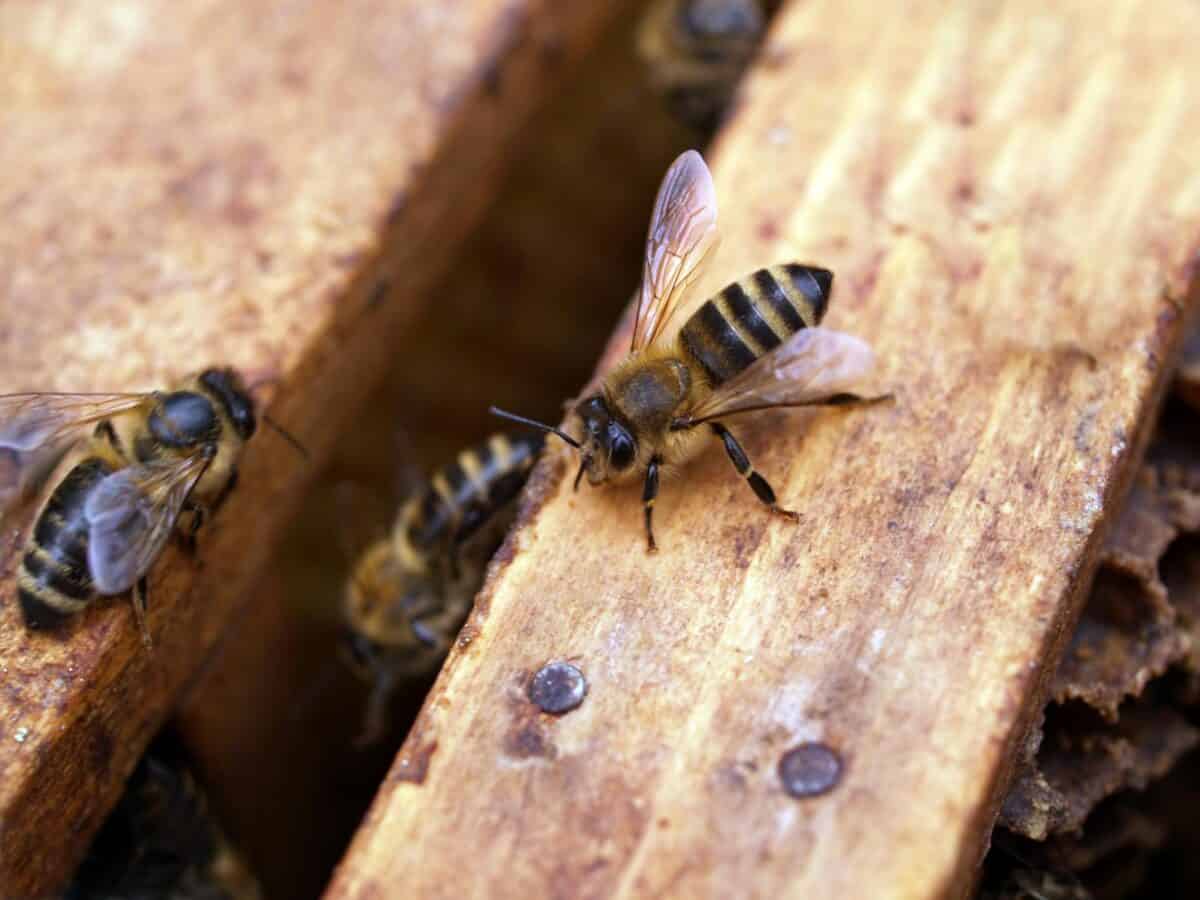
Training bees for mathematical experiments requires patience and methodical procedures. Researchers typically begin by marking individual bees with tiny colored dots or tags for identification. The training process utilizes classical conditioning, associating certain stimuli (like colored shapes representing addition or subtraction) with rewards (sugar water) or deterrents (bitter quinine solution). Scientists initially offer simplified versions of the task, gradually increasing complexity as bees demonstrate mastery. The training must accommodate bees’ natural behaviors and sensory capabilities—using colors bees can perceive and designing experiments that align with their foraging instincts. Each training session typically lasts 4-5 hours, and bees may require 100+ trials before demonstrating reliable mathematical performance. Importantly, researchers employ rigorous controls to ensure bees are genuinely calculating rather than responding to inadvertent cues or patterns.
Critiques and Controversies in Bee Cognition Research

Despite compelling evidence, some scientists remain skeptical about attributing true mathematical abilities to bees. Critics suggest that what appears to be arithmetic might actually be sophisticated pattern recognition or associative learning rather than abstract numerical understanding. Some question whether laboratory conditions accurately reflect bees’ natural cognitive processes or create artificial behaviors through intensive training. Others point out methodological challenges in controlling for all variables when working with insects. The definition of “calculation” itself becomes contentious—does a bee adding one to three understand the abstract concept of “four,” or is it simply following a trained rule? These debates highlight broader questions about animal cognition: how do we define mathematical thinking, and how can we truly know what happens in a non-human mind? The field continues to refine experimental methods to address these critiques.
Protecting Bee Intelligence: Conservation Implications

The discovery of mathematical abilities in bees adds another dimension to conservation urgency. Global bee populations face multiple threats, including habitat loss, pesticide exposure, climate change, and disease. These pressures not only threaten bees’ survival but potentially impact their cognitive functions. Research shows that neonicotinoid pesticides, for instance, can impair bees’ learning and memory capabilities, potentially affecting their mathematical abilities and other cognitive functions essential for foraging and navigation. As we recognize bees as cognitively sophisticated creatures rather than simple instinct-driven insects, ethical considerations around their treatment gain importance. Conservation efforts increasingly emphasize preserving not just bee numbers but also environments that support their full cognitive potential—including their remarkable capacity for numerical thinking.
Conclusion: Small Brains, Big Implications
The discovery that bees can perform basic mathematics fundamentally changes our understanding of cognition and brain requirements for complex thinking. These tiny creatures, with brains containing less than one million neurons, demonstrate that sophisticated cognitive processes don’t necessarily require large brains or mammalian brain structures. As we continue to explore the remarkable abilities of these insects, we’re forced to reconsider our assumptions about intelligence throughout the animal kingdom. The mathematical bee reminds us that nature has evolved multiple pathways to cognitive complexity, and that intelligence manifests in diverse and sometimes unexpected forms across species. Perhaps most profoundly, as we face the challenge of creating efficient artificial intelligence, the humble bee offers a compelling model of how sophisticated computation can emerge from elegantly simple neural architectures.

- How Penguins Navigate Without a Compass - August 18, 2026
- Why You Should Always Respect a Lone Bison - August 18, 2026
- The Secret World of Animals That Glow - August 18, 2026