


Bird migration stands as one of nature’s most spectacular phenomena. Every year, billions of birds embark on incredible journeys across continents and oceans, navigating with astonishing precision to reach their seasonal destinations. These feathered travelers overcome extraordinary challenges: treacherous weather, scarce food, predators, and the sheer physical demands of sustained flight. Among these determined migrants, certain species push the boundaries of what seems biologically possible, covering distances that leave scientists and bird enthusiasts in awe. In this article, we’ll explore 13 remarkable birds that undertake the longest migrations on the planet, examining their routes, adaptations, and the challenges they face during their epic journeys.
Arctic Tern The World’s Distance Champion

When discussing long-distance avian migration, the Arctic Tern (Sterna paradisaea) invariably tops the list. These small but mighty birds hold the undisputed record for the longest migration of any animal on Earth. Each year, Arctic Terns travel from their breeding grounds in the Arctic to wintering areas in Antarctica and back—a round trip of approximately 44,000 miles (70,800 kilometers). This pole-to-pole journey allows them to experience two summers each year and more daylight than any other creature on the planet. Using the prevailing wind patterns, these remarkable birds can live up to 30 years, potentially traveling a distance equivalent to going to the moon and back three times during their lifetime. Their migration route isn’t a straight line but follows an S-shaped pattern across the Atlantic Ocean, taking advantage of global wind systems to conserve energy during their incredible journey.
Bar-tailed Godwit Non-stop Flight Champion

The Bar-tailed Godwit (Limosa lapponica) demonstrates perhaps the most impressive single flight endurance of any bird. The Alaskan subspecies (L. l. baueri) makes an extraordinary non-stop journey from Alaska to New Zealand—covering approximately 7,000 miles (11,000 kilometers) without a single break for food, water, or rest. This marathon flight takes about nine days of continuous flying over the open Pacific Ocean. Before departing, these birds nearly double their body weight, converting the extra mass to fuel during their journey. In 2020, a satellite-tagged male Bar-tailed Godwit set a new record by flying 8,100 miles (13,000 kilometers) non-stop over 11 days from Alaska to New Zealand. What makes this feat even more remarkable is that, unlike seabirds that can rest on water, godwits must remain airborne throughout their entire oceanic crossing.
Sooty Shearwater The Global Circumnavigator
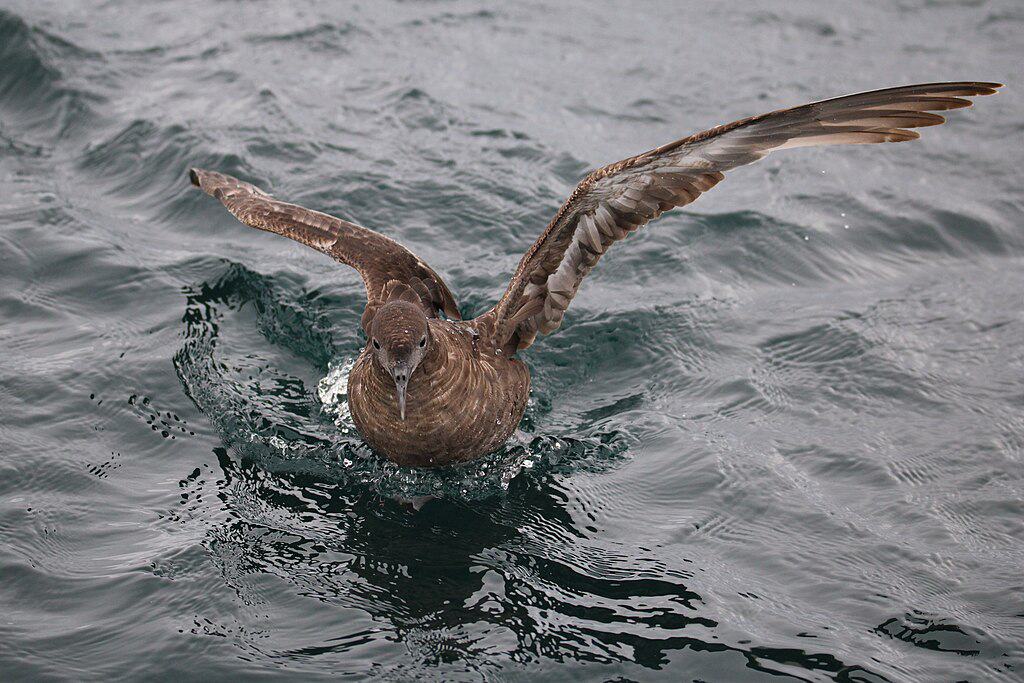
Sooty Shearwaters (Ardenna grisea) undertake one of the most impressive circular migration routes of any bird. These seabirds breed on islands in the Southern Hemisphere, including New Zealand, Australia, and Chile, before embarking on a figure-eight pattern that takes them across the Pacific Ocean to feeding grounds in the North Pacific. Their annual migration spans approximately 40,000 miles (64,000 kilometers), nearly rivaling the Arctic Tern’s journey. During their migration, Sooty Shearwaters follow a clockwise route in the Pacific Ocean, taking advantage of prevailing winds. Their massive flocks—sometimes numbering in the millions—create spectacular sights along coastal areas during migration. These birds can dive up to 200 feet (60 meters) underwater to catch prey, demonstrating remarkable adaptations for both flying and swimming. Despite their incredible migratory abilities, Sooty Shearwater populations have declined in recent decades due to climate change affecting ocean productivity and accidental capture in fishing gear.
Great Knot The Asian Long-distance Flyer

The Great Knot (Calidris tenuirostris) is a medium-sized shorebird that undertakes one of Asia’s most impressive migrations. Breeding in the harsh northeastern Siberian tundra, these birds travel about 10,000 miles (16,000 kilometers) to reach wintering grounds in Australia, Southeast Asia, and the Indian subcontinent. What makes their journey particularly challenging is their dependence on a few critical stopover sites, particularly in the Yellow Sea region between China and Korea. Here, the birds rest and refuel, nearly doubling their body weight before continuing their journey. The Great Knot’s migration strategy depends on precise timing to coincide with seasonal food abundance at these stopover sites. Unfortunately, coastal development and habitat loss at these crucial refueling stations have led to steep population declines, with the Great Knot now classified as endangered. Their plight highlights how habitat destruction in just a few key locations can threaten an entire migratory species.
Northern Wheatear The Small Bird with a Big Journey

The Northern Wheatear (Oenanthe oenanthe) may look unassuming, but this small songbird undertakes one of the most impressive migrations relative to its size. Weighing just 0.8 ounces (25 grams)—about as much as four pennies—some populations breed in Alaska and northeastern Canada before traveling across Eurasia to spend winters in sub-Saharan Africa. This round trip of approximately 18,000 miles (29,000 kilometers) is remarkable for a bird so small. What’s even more astonishing is that Northern Wheatears must cross vast stretches of inhospitable terrain, including the Greenland icecap, North Atlantic Ocean, and Sahara Desert. Young birds make this journey without any guidance from experienced adults, relying entirely on innate navigational abilities. Scientists have discovered that these birds use a combination of celestial cues, Earth’s magnetic field, and possibly even scent maps to navigate their complex route. The Northern Wheatear vividly demonstrates that impressive migratory abilities aren’t limited to large-bodied birds.
Ruddy Turnstone The Intercontinental Navigator
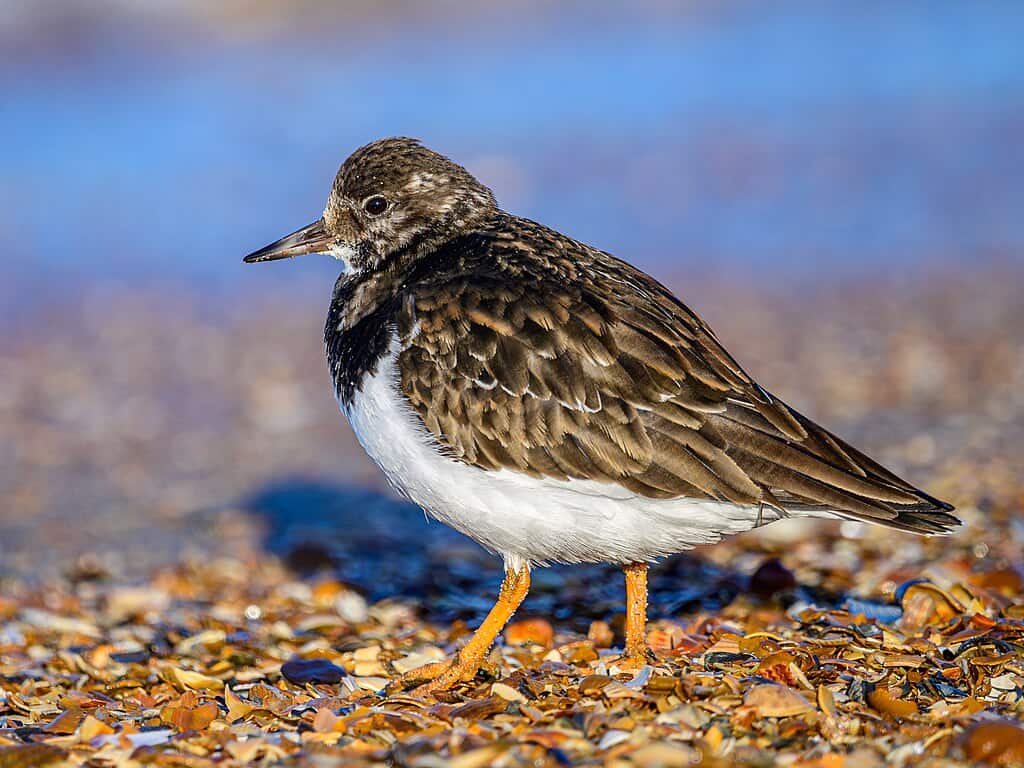
The Ruddy Turnstone (Arenaria interpres) is a stocky, brightly-patterned shorebird that migrates between Arctic breeding grounds and wintering areas that span coastlines across six continents. Some populations travel over 15,000 miles (24,000 kilometers) annually. These birds are named for their feeding behavior—turning over stones, shells, and debris to find invertebrates hiding beneath. During migration, Ruddy Turnstones make critical stopovers at specific coastal locations where they can rapidly increase their body mass by up to 70% before continuing their journey. Research has revealed that these birds possess remarkable navigational abilities, with some individuals returning to the exact same beach year after year, sometimes even to the same few square yards of shoreline. Their exceptional site fidelity helps them reliably locate productive feeding areas. Ruddy Turnstones can live up to 20 years, potentially covering over 300,000 miles (480,000 kilometers) in migration during their lifetime—a distance greater than traveling to the moon and halfway back.
Red Knot The Hemispheric Traveler

The Red Knot (Calidris canutus) is a medium-sized shorebird with six recognized subspecies, each undertaking impressive long-distance migrations. The most well-studied subspecies, C. c. rufa, breeds in the Canadian Arctic and winters as far south as Tierra del Fuego at South America’s tip—a one-way journey of roughly 9,300 miles (15,000 kilometers). What makes the Red Knot’s migration particularly noteworthy is its dependency on specific stopover sites where timing is critical. For example, rufa Red Knots famously congregate in massive numbers at Delaware Bay each spring to feast on horseshoe crab eggs, a rich food source that allows them to rapidly gain the weight needed for the final leg to their Arctic breeding grounds. This synchronization is so precise that the birds’ arrival coincides with horseshoe crab spawning, which itself is timed to spring high tides. Due to overharvesting of horseshoe crabs and habitat degradation at key stopover sites, Red Knot populations have declined dramatically, with the rufa subspecies now listed as threatened under the U.S. Endangered Species Act.
Hudsonian Godwit The Hemispheric Marathon Flyer
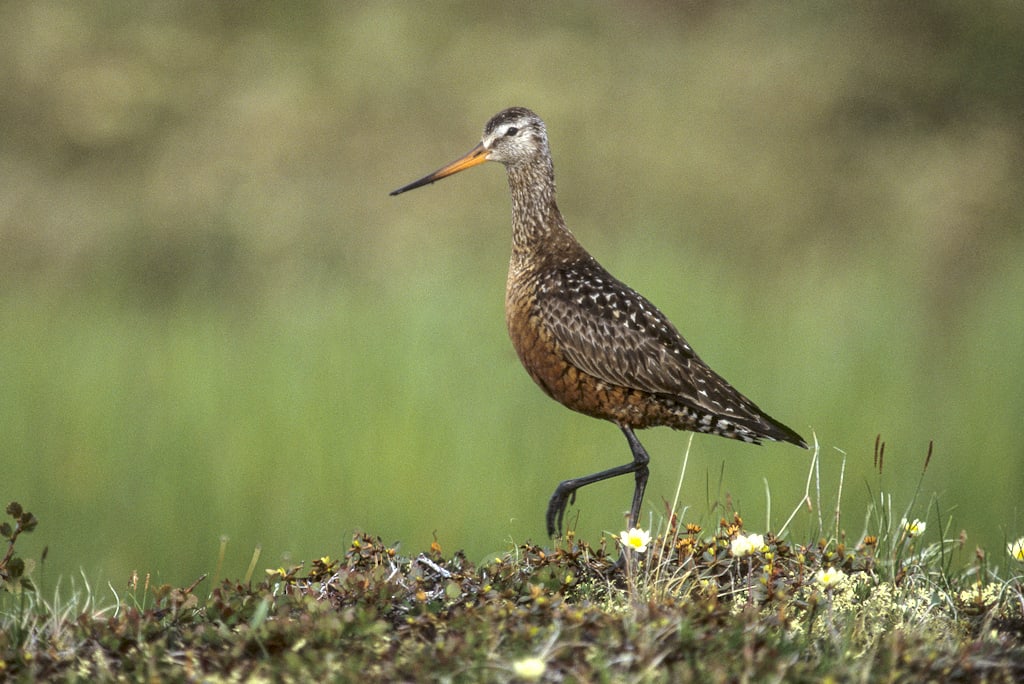
The Hudsonian Godwit (Limosa haemastica) undertakes one of the longest non-stop flights of any bird in the Western Hemisphere. These elegant shorebirds breed in the subarctic regions of Alaska and Canada before making their way to wintering grounds in southern South America, particularly Chile and Argentina. During their southbound migration, they are capable of flying non-stop for distances of up to 8,000 miles (12,900 kilometers) over the Atlantic Ocean. Before beginning this marathon flight, Hudsonian Godwits undergo remarkable physiological changes, reducing the size of their digestive organs to minimize unnecessary weight while dramatically increasing fat stores to fuel their journey. Their migration strategy involves precise timing to coincide with favorable wind conditions, as flying with tailwinds can significantly reduce energy expenditure. Research using geolocators has revealed that these birds can fly at altitudes of over 20,000 feet (6,000 meters) to take advantage of optimal wind patterns. Despite their impressive migratory abilities, Hudsonian Godwit populations face threats from habitat loss at their breeding, stopover, and wintering sites.
Pectoral Sandpiper The Intercontinental Breeding Champion

The Pectoral Sandpiper (Calidris melanotos) demonstrates an unusual migration pattern driven by its extraordinary breeding strategy. These medium-sized shorebirds breed across the Arctic tundra of North America and Siberia before wintering in South America and Australia—a journey of up to 19,000 miles (30,000 kilometers) annually. What makes male Pectoral Sandpipers truly remarkable is their breeding behavior. Research has shown that individual males may travel over 8,000 miles (13,000 kilometers) within a single breeding season, moving between potential breeding sites across the Arctic in search of receptive females. This “breeding migration” occurs on top of their already impressive annual migration. Scientists tracking these birds have recorded males flying non-stop for up to 60 hours during these breeding movements. This energetically costly strategy appears driven by intense competition for mates, with males willing to undertake extraordinary journeys for additional breeding opportunities. The Pectoral Sandpiper demonstrates how sexual selection can drive the evolution of extreme migratory behaviors beyond what might be expected for basic survival needs.
Eastern Curlew Asia’s Marathon Migrant

The Eastern Curlew (Numenius madagascariensis) is the largest migratory shorebird in the world and holds the record for the longest migration within the East Asian-Australasian Flyway. With its distinctive long, downward-curved bill, this impressive bird breeds in Russia and northeastern China before undertaking a journey of approximately 7,500 miles (12,000 kilometers) to reach wintering grounds in Australia. The Eastern Curlew relies on tidal mudflats along its migration route, where it uses its specialized bill to extract crabs and other prey buried deep in the mud. These birds demonstrate exceptional site fidelity, returning to the same sections of coastline year after year. Unfortunately, coastal development and reclamation of tidal mudflats throughout East Asia have severely impacted the species, with population declines of over 80% in the past 30 years. Now critically endangered, the Eastern Curlew highlights the vulnerability of long-distance migrants to habitat loss along their migration corridors. Conservation efforts focus on protecting remaining tidal habitats and international cooperation across the bird’s range.
Greater Snow Goose The High Flyer

The Greater Snow Goose (Anser caerulescens atlanticus) undertakes a remarkable twice-yearly migration between its Arctic breeding grounds and wintering areas along the Atlantic coast of the United States. These large, white birds breed in the northeastern Canadian Arctic, particularly on Bylot Island and other parts of the Canadian Arctic Archipelago, before traveling approximately 3,000 miles (4,800 kilometers) to coastal marshes and agricultural fields from New Jersey to North Carolina. What makes their migration particularly impressive is the altitude at which they travel. Snow Geese have been recorded flying at heights exceeding 20,000 feet (6,000 meters)—higher than Mount Everest’s base camp—where temperatures can plunge below -40°F (-40°C) and oxygen levels are significantly reduced. At these extreme altitudes, they can take advantage of favorable tailwinds while avoiding predators and obstacles. Their physiological adaptations for high-altitude flight include efficient hemoglobin that can extract oxygen from thin air and specialized lung structures. Unlike many migratory species that have declined, Greater Snow Goose populations have increased dramatically, creating management challenges in some areas.
Swainson’s Hawk The Insect Hunter

The Swainson’s Hawk (Buteo swainsoni) undertakes one of the longest migrations of any North American raptor. These birds of prey breed across western North America before traveling approximately 6,000 miles (9,700 kilometers) to their wintering grounds in the pampas of Argentina—a journey that can take two months to complete. What makes their migration particularly fascinating is that these hawks travel in large flocks, sometimes numbering in the thousands—unusual behavior for typically solitary raptors. During migration, Swainson’s Hawks transform their diet, shifting from mainly small mammals to insects, particularly grasshoppers and dragonflies. This dietary flexibility allows them to fuel their long journey by following insect outbreaks along their route. The hawks employ energy-efficient soaring flight, riding thermal updrafts to gain altitude before gliding long distances without flapping. As they funnel through Central America, the hawks create a spectacular natural phenomenon as vast kettles (groups) swirl overhead. Conservation concerns include habitat loss at both ends of their range and exposure to pesticides used on agricultural fields where they feed.
Conclusion: The Marvel and Fragility of Avian Migration

The epic journeys undertaken by these 13 migratory champions represent one of nature’s most awe-inspiring phenomena. These birds have evolved remarkable adaptations—from precise navigational abilities and extreme endurance to dramatic physiological transformations—that allow them to connect distant ecosystems across hemispheres and continents. Their migrations serve as living threads that stitch together the planet’s ecological tapestry, reminding us that nature recognizes no human borders. Unfortunately, many of these magnificent migrants face increasing threats from habitat destruction, climate change, and human development that disrupt their carefully calibrated journeys. Conservation of migratory birds requires international cooperation, as protecting these species means safeguarding habitat networks that span countries and continents. As we marvel at the distances covered by Arctic Terns skimming over polar seas or Bar-tailed Godwits flying non-stop across the Pacific, we must also recognize our responsibility to ensure these incredible journeys can continue for generations to come.

As a little kid, I fell in love with nature, wildlife, and animals. Living in the USA, South Africa, Italy, China and Germany gave me the opportunity to discover the world's Wildlife. My favorite animals are Mountain Gorillas, Siberian Tigers, and Great White Sharks.
I'm a certified PADI Open Water Diver, went to Everest Base Camp and Trekked Gorillas in Uganda. I hold a Master of Science in Economics and Finance.
Please send any feedback to feedback@animalsaroundtheglobe.com
- 16 Myths About Bison That Just Are Not True - August 15, 2026
- 13 Stunning Bird Migrations Threatened by Global Warming - August 14, 2026
- 15 Animals That Do Not Need Oxygen Like We Do - August 14, 2026