


The oceans cover over 70% of our planet, harboring some of the most remarkable predators on Earth. These marine hunters have evolved extraordinary strategies that allow them to thrive in environments ranging from shallow coral reefs to the darkest depths of the ocean. Far from simple brute force, these predators employ sophisticated techniques that showcase the incredible diversity of hunting adaptations in the marine world. From cooperative hunting strategies to bioluminescent lures and electrosensory capabilities, these 17 marine predators demonstrate nature’s most ingenious solutions to the universal challenge of finding food in the vast blue wilderness.
12. Orcas The Ocean’s Strategic Masterminds

Orcas (Orcinus orca), also known as killer whales, stand as perhaps the most sophisticated hunters in the ocean. These apex predators employ remarkable team-based hunting strategies that rival those of land predators like wolves and lions. Orcas have developed distinct cultural hunting techniques passed down through generations. Some pods specialize in “wave washing,” where they coordinate to create powerful waves that wash seals off ice floes. Others practice intentional beaching, temporarily stranding themselves to snatch prey from shorelines before sliding back into deeper water. What makes orcas truly exceptional is their ability to adapt their hunting methods to specific prey and environments, with different populations developing specialized techniques for hunting sharks, rays, and even large whales. Their hunting prowess is enhanced by their exceptional intelligence, with brain structures suggesting advanced cognitive capabilities for problem-solving and communication during coordinated hunts.
11. Great White Sharks Masters of the Ambush Attack

Great white sharks (Carcharodon carcharias) have perfected the art of the surprise attack through evolutionary refinement. These predators utilize a remarkable hunting strategy against seals and sea lions that combines stealth, power, and precision. When hunting, great whites patrol deep below their prey, often at depths of 30 feet or more, using their countershading (dark upper body, light underbelly) as natural camouflage against the ocean backdrop. When they spot a potential meal, they accelerate upward with explosive speed, sometimes breaching the surface entirely in a technique known as “polaris breach.” This vertical attack can propel a 2,000+ pound shark completely out of the water while clutching prey. Studies have revealed that great whites strike with such force that they can hit prey at over 25 mph, creating an impact that often immediately incapacitates the victim. What makes this hunting method particularly sophisticated is the shark’s ability to calibrate its attack based on the prey’s movement patterns, demonstrating remarkable spatial awareness and predictive capabilities.
10. Anglerfish The Deep Sea’s Deceptive Lure

The female anglerfish (family Lophiiformes) embodies one of the most specialized adaptations for hunting in the deep sea environment. Living in absolute darkness at depths exceeding 3,000 feet, these predators have evolved a biological fishing rod called an illicium topped with a bioluminescent lure known as an esca. This extraordinary adaptation contains symbiotic bacteria that produce light through a chemical reaction, creating a glow that attracts curious prey in the otherwise pitch-black environment. The anglerfish’s hunting strategy is entirely passive yet remarkably effective—it simply remains motionless, conserving precious energy while its glowing lure does the work of attracting prey. When small fish or crustaceans approach to investigate the light, the anglerfish’s enormous jaws snap shut with lightning speed. The mouth of an anglerfish can expand to swallow prey up to twice its own size, allowing it to capitalize on rare feeding opportunities in the food-scarce deep ocean. This specialized method of hunting through bioluminescent deception represents one of the most energy-efficient predation strategies in the marine world.
9. Mantis Shrimp The Underwater Knockout Artist

The mantis shrimp (order Stomatopoda) possesses what might be the most powerful pound-for-pound attack mechanism in the animal kingdom. These colorful crustaceans come in two hunting varieties: “spearers” that impale soft-bodied prey and “smashers” that deliver devastating blows to hard-shelled organisms. The smashing mantis shrimp’s specialized appendages, called dactyl clubs, can accelerate underwater at speeds comparable to a .22 caliber bullet—reaching up to 50 mph from a standing start. The impact generates cavitation bubbles that collapse with such force they produce temperatures nearly as hot as the sun’s surface and emit small bursts of light called sonoluminescence. This one-two punch of physical impact followed by cavitation can crack crab shells and shatter aquarium glass with ease. The mantis shrimp achieves this remarkable feat through a spring-loading mechanism in its appendages, storing energy in specialized structures before releasing it in an explosive strike. Perhaps most impressively, the mantis shrimp’s visual system, which includes up to 16 photoreceptors (compared to humans’ three), allows it to precisely target its prey with these lightning-fast strikes, making it one of the ocean’s most precisely calibrated predatory specialists.
8. Electric Eels Living Biological Weapons

The electric eel (Electrophorus electricus) employs one of the most unique hunting mechanisms in the natural world by generating its own electricity as a weapon. Despite its name, this Amazonian predator is actually a type of knifefish rather than a true eel. Electric eels possess specialized electric organs that make up approximately 80% of their body mass, containing thousands of electroplaques—modified muscle cells that function like tiny batteries arranged in series. When hunting, electric eels can discharge pulses of electricity reaching up to 860 volts with 1 ampere of current—enough power to stun or kill nearby fish and even incapacitate larger animals. Research has revealed that electric eels have evolved sophisticated hunting behaviors to maximize their electrical advantage. They can emit two types of electrical discharges: low-voltage pulses used as a sensory system to detect prey, and high-voltage pulses for hunting and defense. In particularly remarkable behavior documented in 2014, scientists discovered that electric eels will sometimes leap partially out of water to directly contact larger threats, concentrating the full electrical charge into the target by eliminating water resistance. This strategic use of bioelectricity represents one of the most unusual and effective hunting specializations in the animal kingdom.
7. Bobbit Worms Ambush Predators of the Ocean Floor

The Bobbit worm (Eunice aphroditois) represents one of the ocean’s most terrifying ambush predators, despite being relatively unknown to the general public. These segmented polychaete worms can grow to extraordinary lengths of 10 feet or more while remaining remarkably slender. Bobbit worms bury themselves in the ocean floor with only their powerful, scissor-like jaws (called antennae) exposed above the substrate. These specialized appendages contain toxins that can cause permanent numbness in humans and are lethal to many marine creatures. The Bobbit worm’s hunting strategy relies on incredible patience—it can remain motionless for hours or even days until suitable prey passes overhead. When a fish or other organism creates vibrations detected by the worm’s sensitive antennae, it strikes with such astonishing speed that high-speed cameras struggle to capture the movement. Studies have clocked their strike at under 20 milliseconds—faster than many fish can register danger. Once captured, prey is quickly pulled beneath the substrate where the Bobbit worm injects toxins that both immobilize and begin breaking down the victim’s tissues. This combination of stealth, speed, and toxic weaponry makes the Bobbit worm one of the most successful ambush predators in shallow tropical marine ecosystems.
6. Pistol Shrimp The Sonic Sniper of the Sea

The pistol shrimp (family Alpheidae) possesses what might be the most disproportionately powerful weapon relative to its size in the animal kingdom. Despite measuring just a few centimeters in length, these unassuming crustaceans can create one of the loudest sounds in the ocean using a specialized oversized claw. The hunting mechanism works through an extraordinary biomechanical process: the pistol shrimp rapidly closes its modified claw, shooting out a jet of water at speeds exceeding 60 mph. This action creates a vacuum bubble that, when it collapses, produces a sonoluminescent effect—generating both light and an acoustic shock wave that can reach 218 decibels (louder than a gunshot). The collapsing bubble momentarily creates temperatures nearly as hot as the sun’s surface at 8,000°F. This powerful shockwave stuns nearby prey, allowing the shrimp to capture and consume it at leisure. Some species of pistol shrimp have refined this hunting technique further by living in symbiotic relationships with certain goby fish. The fish acts as a lookout with its superior vision, while the shrimp maintains a burrow that provides shelter for both. This specialized hunting adaptation demonstrates how even small creatures can evolve remarkably effective predatory mechanisms when subjected to evolutionary pressure.
5. Thresher Sharks Tail-Whipping Hunters
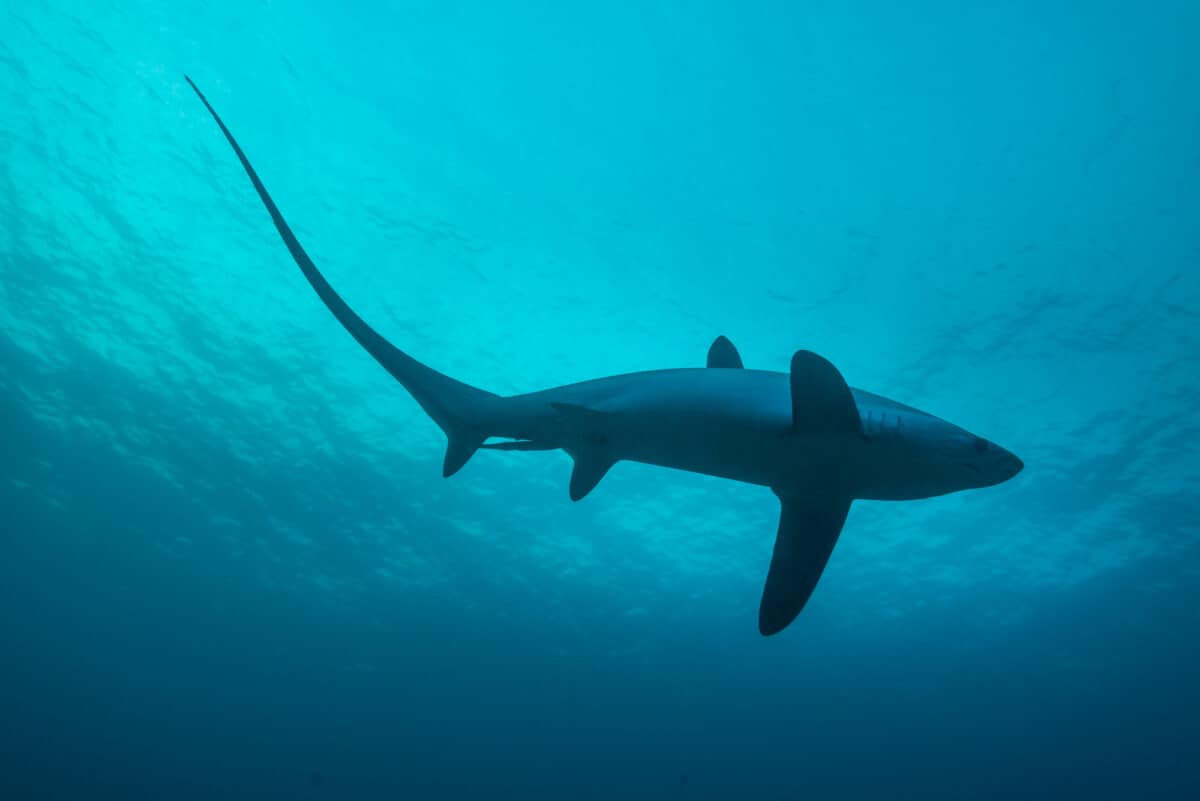
Thresher sharks (family Alopiidae) have developed perhaps the most distinctive hunting technique among all shark species by weaponizing their extraordinarily long tail fins. The upper lobe of a thresher shark’s caudal fin can equal the length of its entire body, effectively doubling the animal’s total length to up to 20 feet. Unlike most predatory sharks that rely on their jaws as their primary weapon, thresher sharks use their elongated tails like whips to stun and kill prey. When hunting schooling fish like sardines or mackerel, threshers approach from below and then perform a rapid deceleration while simultaneously swinging their tails overhead in a motion similar to a cracking whip. High-speed underwater cameras have captured this behavior, revealing that the tail tip can reach speeds of up to 80 mph—fast enough to create cavitation bubbles that produce additional shock waves. The impact often stuns or kills multiple fish at once, with the shark then circling back to consume the immobilized prey. Research published in PLOS ONE has shown that thresher sharks can use their tails with remarkable precision, targeting specific areas within a school of fish to maximize hunting success. This unique adaptation allows threshers to effectively hunt schooling prey without having to rely solely on speed or ambush tactics like many other shark species.
4. Archer Fish The Sharpshooters of Freshwater and Estuaries
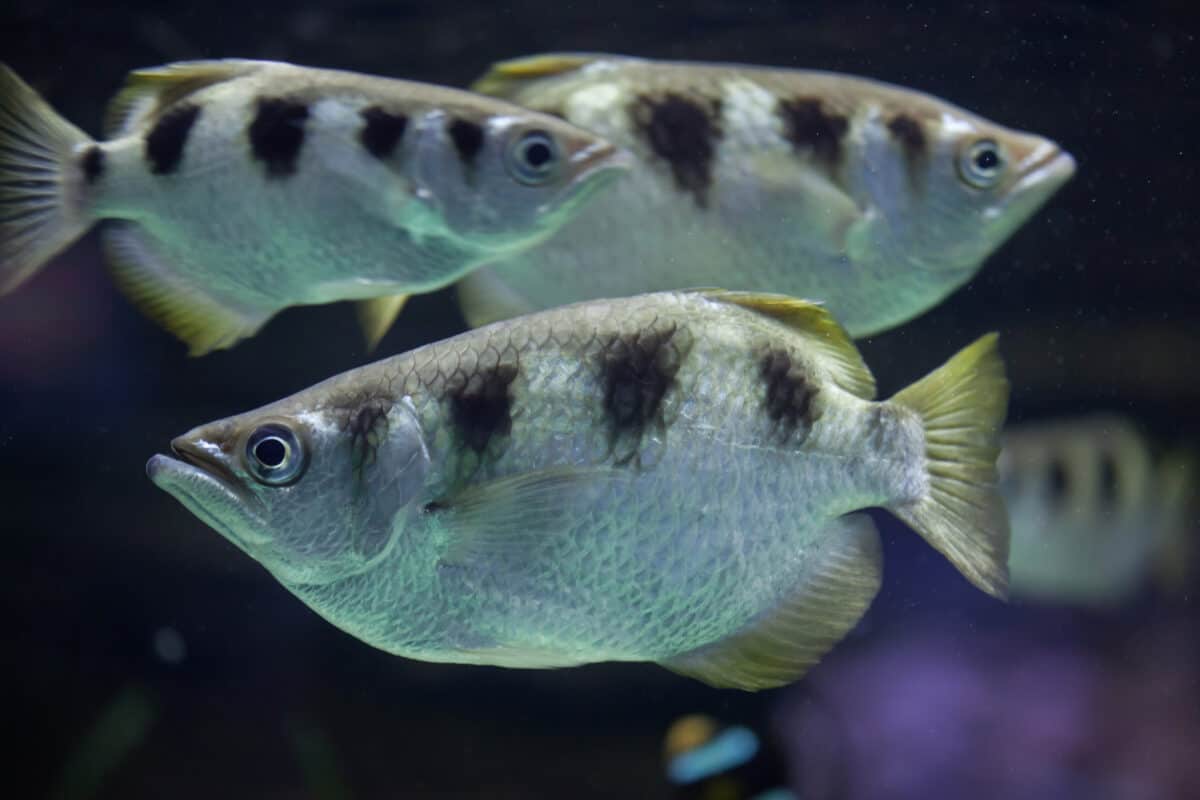
The archer fish (family Toxotidae) has evolved one of the most precise and mathematically complex hunting methods in the animal kingdom, despite having a relatively simple nervous system. These fish, native to brackish waters and estuaries of Southeast Asia and Australia, have developed the remarkable ability to shoot down insects and small lizards from overhanging vegetation by firing precisely aimed jets of water from their mouths. What makes this hunting technique truly extraordinary is the physics involved. Archer fish can accurately compensate for the refraction of light at the water-air interface—a complex optical problem that requires understanding how light bends when passing between mediums of different densities. Research published in Current Biology revealed that archer fish can hit targets up to 2 meters away with accuracy of just a few millimeters, adjusting their aim based on target height and distance. The mechanism behind the water jet is equally impressive: the fish creates a specialized channel with its tongue against the roof of its mouth, then rapidly closes its gills to generate pressure that propels water at speeds up to 6.6 feet per second. Young archer fish learn this complex behavior through observation of experienced adults, suggesting a sophisticated learning process beyond simple instinct. This combination of physics-defying calculation, physical adaptation, and learned behavior makes the archer fish’s hunting technique one of the most cognitively impressive in the aquatic world.
3. Cookie-Cutter Sharks The Ocean’s Parasitic Predators
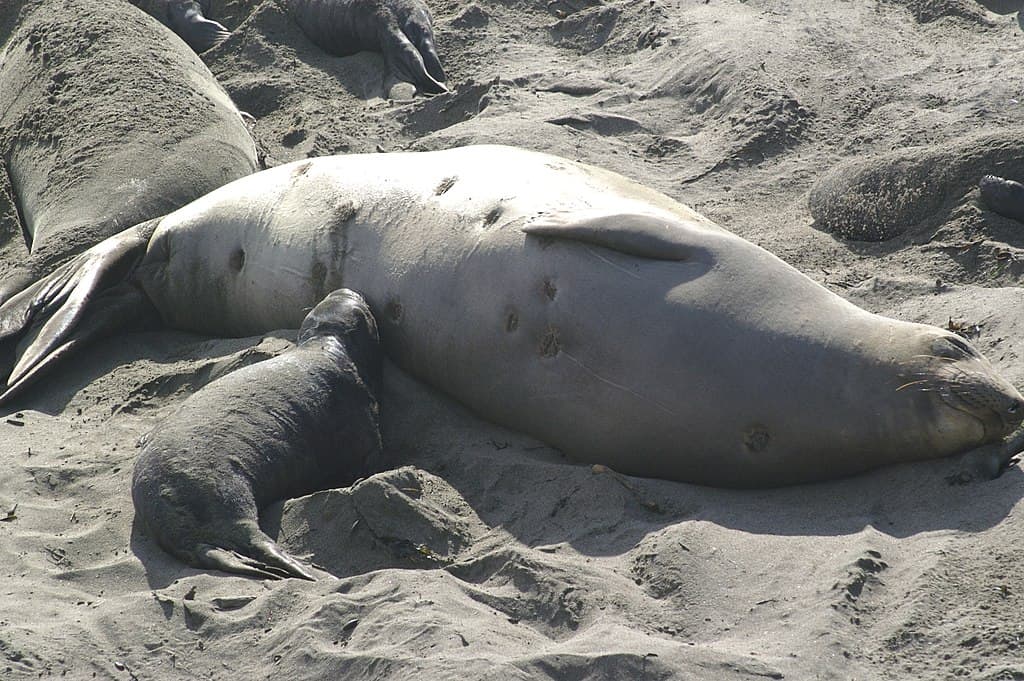
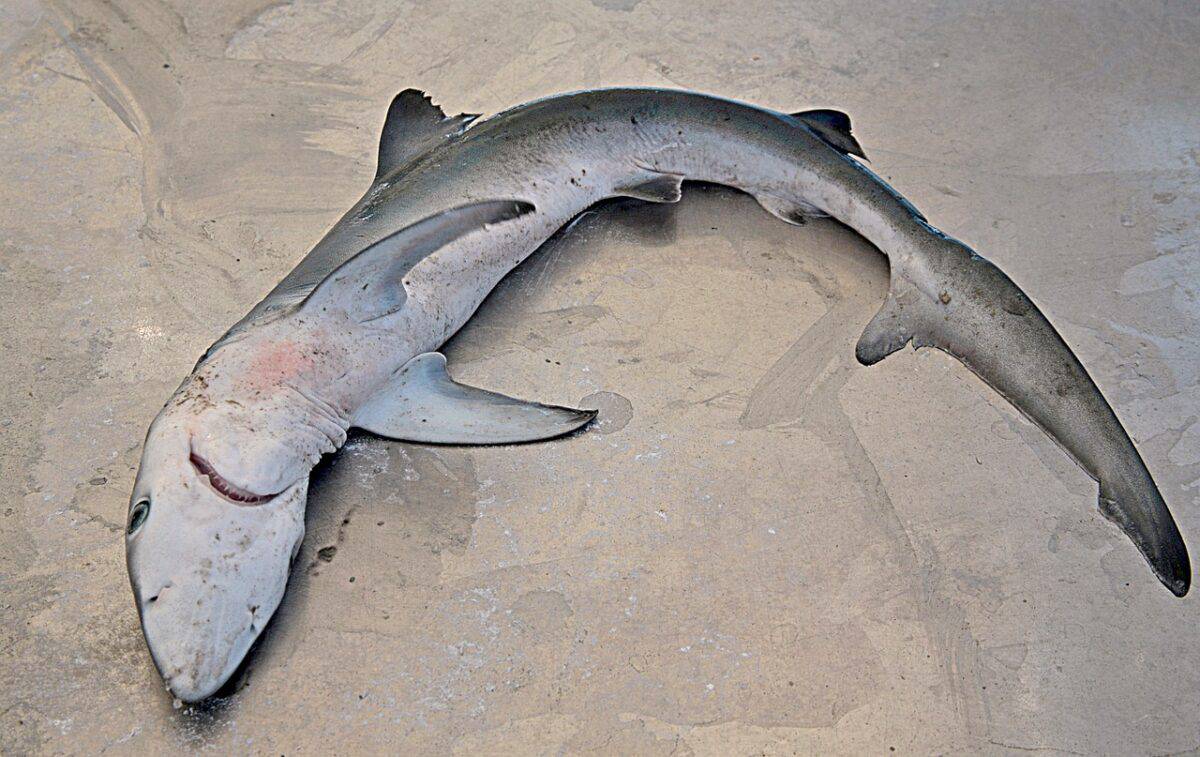
The cookie-cutter shark (Isistius brasiliensis) employs perhaps the most bizarre and specialized feeding strategy among all sharks—it’s effectively a parasitic predator that takes circular bites out of animals much larger than itself. This small, cigar-shaped shark (typically 16-22 inches long) has evolved a mouth resembling a suction cup rimmed with razor-sharp teeth. The lower jaw contains 25-26 triangular teeth that form an uninterrupted cutting edge, while the upper jaw has smaller pointed teeth that act as anchors. When hunting, cookie-cutters use a combination of stealth and bioluminescence to approach much larger prey, including tuna, dolphins, whales, and even nuclear submarines. The shark’s underside is covered with photophores (light-producing organs) except for a dark collar around its throat, which researchers believe creates the illusion of a small fish when viewed from below—an inverted form of camouflage called counterillumination. When a large predator approaches this apparent “small fish,” the cookie-cutter attaches its mouth to the victim and uses its powerful pharyngeal muscles to twist and extract a plug of flesh up to 3 inches across and 1 inch deep. It then swims away with its meal, leaving the larger animal with a distinct circular wound that heals into a crater-like scar. This extraordinary parasitic hunting strategy allows the cookie-cutter shark to feed on animals hundreds of times its size without having to kill them, representing one of the most unusual predatory adaptations in the ocean.
2. Gulper Eels The Ocean’s Expandable Vacuum

The gulper eel (Eurypharynx pelecanoides), also known as the pelican eel, has evolved one of the most dramatic feeding adaptations for life in the deep sea. This bizarre creature possesses a mouth that can expand to swallow prey larger than its own body—an extraordinary feat even by deep-sea standards. The gulper eel’s most striking feature is its enormous jaw structure, which makes up about one-quarter of the animal’s total length (which can reach up to 6 feet). Unlike most fish that use suction to draw in prey, the gulper eel’s jaw operates more like a net. When prey is detected, the eel can unfold its massive mouth in milliseconds, expanding it to create a balloon-like pouch that increases its volume by up to 10 times. This expansion is made possible by specialized jaw joints and a highly elastic esophagus supported by a pouch-like lower jaw similar to a pelican’s bill. The gulper eel hunts primarily by sensing vibrations in the water through its lateral line system, as vision plays a minimal role in the perpetual darkness of depths exceeding 3,000 feet. Recent deep-sea camera observations have revealed that gulper eels may use their bioluminescent tail tips as lures, waving them to attract curious prey before executing their lightning-fast engulfing motion. This combination of sensory specialization, anatomical adaptation, and potential bioluminescent deception represents an evolutionary solution to the challenges of hunting in the deep sea, where food is scarce and energy conservation is paramount.
1. Crocodiles Ancient Masters of the Ambush

Saltwater crocodiles (Crocodylus porosus) and American alligators (Alligator mississippiensis) represent the pinnacle of ambush predation in coastal and estuarine environments, having refined their hunting techniques over 200 million years of evolution. These reptilian predators combine extraordinary patience with explosive power in a hunting strategy that has remained largely unchanged since the time of dinosaurs. When hunting aquatic prey, crocodilians position themselves with only their eyes and nostrils breaking the water’s surface, using specialized transparent third eyelids to see underwater while remaining virtually invisible. They can remain motionless for hours, maintaining this position through precise control of their lungs and specialized hemoglobin that allows efficient oxygen use. When prey approaches, the crocodile launches with surprising speed—able to accelerate from zero to 20 mph in a fraction of a second. Their jaws snap shut with one of the most powerful bite forces in the animal kingdom, measured at up to 3,700 pounds per square inch in large saltwater crocodiles. Perhaps most remarkably, research has revealed sophisticated hunting behaviors beyond simple ambush tactics. Crocodiles have been documented using sticks as bait during bird nesting seasons, balancing twigs on their snouts to lure nest-building birds. They’ve also demonstrated coordinated group hunting strategies, with multiple individuals forming semi-circles to trap fish in shallows. These behaviors, combined with their ancient hunting adaptations, make crocodilians among the most successful.
Conclusion:
From the crushing claws of mantis shrimp to the strategic intelligence of orcas, the ocean’s top predators reveal an astonishing spectrum of evolutionary innovation. These creatures, diverse in form and strategy, highlight how the challenges of hunting in aquatic environments have produced some of nature’s most creative solutions. Whether relying on teamwork, deception, brute strength, or bioelectric weaponry, each predator exemplifies a unique adaptation finely tuned to its ecological niche. Together, they paint a vivid picture of the oceans not just as a realm of survival, but as a dynamic theater of evolutionary brilliance—where the race to hunt and be hunted has shaped some of the most formidable and fascinating life forms on Earth.

As a little kid, I fell in love with nature, wildlife, and animals. Living in the USA, South Africa, Italy, China and Germany gave me the opportunity to discover the world's Wildlife. My favorite animals are Mountain Gorillas, Siberian Tigers, and Great White Sharks.
I'm a certified PADI Open Water Diver, went to Everest Base Camp and Trekked Gorillas in Uganda. I hold a Master of Science in Economics and Finance.
Please send any feedback to feedback@animalsaroundtheglobe.com
- 14 Most Beautiful Bird Songs You Can Hear in America - July 15, 2026
- The Longest Snake Ever Found Slithering in the U.S. - July 15, 2026
- Why Humpback Whales Are Singing Louder Off U.S. Shores - July 15, 2026