

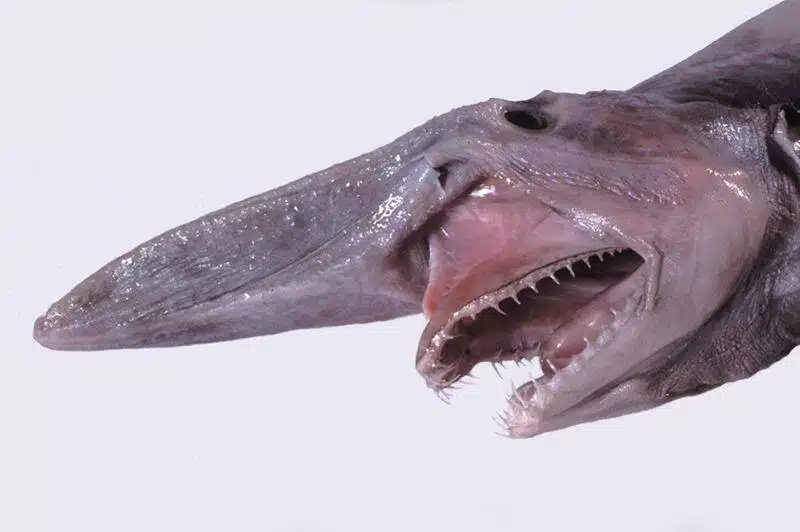
In the mysterious depths of our oceans lives a creature that could have stepped straight out of science fiction: the goblin shark (Mitsukurina owstoni). While all sharks are formidable predators, the goblin shark takes hunting to a nightmarish new level with its extraordinary ability to project its jaws forward from its face like an alien creature from the darkest horror films. This living fossil, virtually unchanged for millions of years, employs one of the most startling feeding mechanisms in the animal kingdom—a specialized anatomical feature called protrusible jaws that launch outward with lightning speed to capture prey. Far from the sleek, streamlined predators that typically represent sharks in our imagination, the goblin shark’s bizarre appearance and hunting technique make it one of the ocean’s most fascinating and unsettling inhabitants.
The Ancient Origins of the Goblin Shark

The goblin shark represents one of the most primitive shark lineages still swimming in our oceans today. Paleontological evidence suggests this species belongs to the Mitsukurinidae family, which dates back approximately 125 million years to the Early Cretaceous period. This makes the goblin shark a true “living fossil,” having survived relatively unchanged while dinosaurs rose and fell, and countless other species evolved or went extinct. The shark’s primitive features reflect its ancient heritage, with a body plan that has remained largely unaltered through epochs of evolutionary change.
Scientists believe the goblin shark’s unusual appearance and specialized feeding mechanism evolved early in its lineage and proved so effective for its deep-sea lifestyle that major modifications weren’t necessary. Its closest relatives are all extinct, leaving this bizarre creature as the sole survivor of its family. This evolutionary isolation contributes to the goblin shark’s uniqueness among modern sharks and provides researchers with a living window into ancient shark biology that would otherwise be accessible only through fossil records.
The Unmistakable Appearance of the Goblin Shark

The goblin shark’s appearance is so distinctive that it’s impossible to confuse with any other marine creature. Most immediately noticeable is its elongated, flattened snout (called a rostrum) that extends far beyond its mouth, resembling a sword or shovel. This protruding rostrum houses a network of specialized sensory organs called the ampullae of Lorenzini that detect the electrical fields generated by potential prey. Below this bizarre snout sits a mouth that appears almost comically underslung when at rest, contributing to the shark’s unsettling appearance.
The goblin shark’s coloration ranges from pinkish-gray to bubblegum pink due to blood vessels visible through its semi-transparent skin—an adaptation to its deep-water habitat where red light doesn’t penetrate. Growing up to 12 feet (3.8 meters) in length, these sharks have soft, flabby bodies with small fins and a tail that appears almost ratlike. Their eyes are small and often described as beady, reflecting their reduced reliance on vision in the deep, dark waters they inhabit. These unusual physical characteristics make the goblin shark appear more like a creature of fantasy than a real marine predator.
The Horror Movie Jaw Mechanism Explained

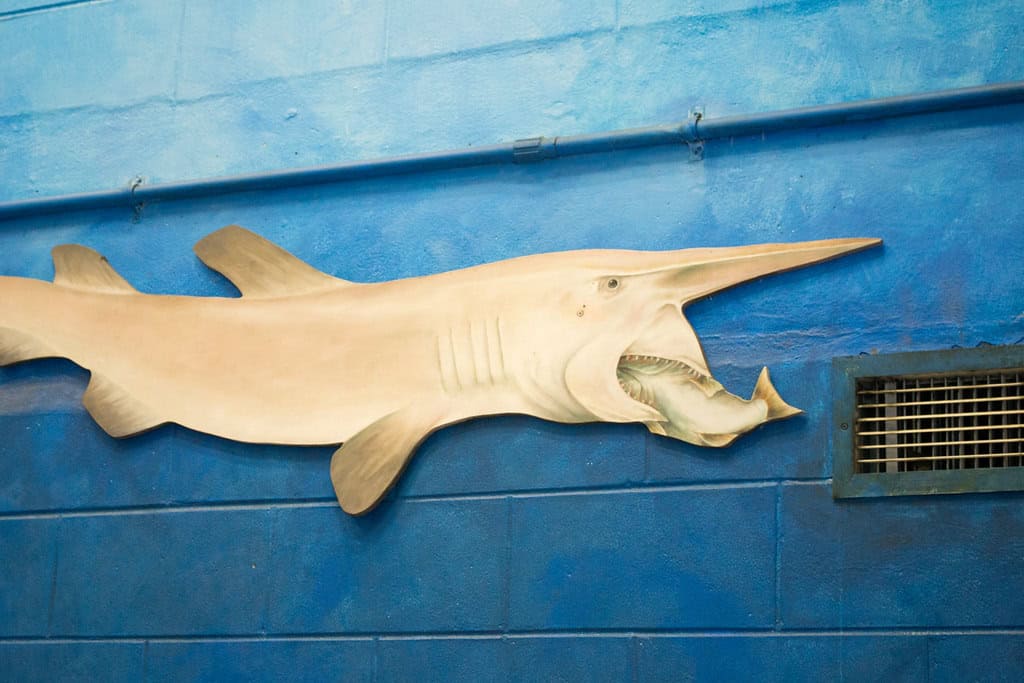
The goblin shark’s most dramatic feature—its projectile jaws—represents one of the most extreme feeding adaptations in the shark world. Unlike typical sharks that must swim forward to capture prey, the goblin shark has evolved a specialized jaw structure that can extend forward up to 9.4 inches (24 cm) from its face in less than a tenth of a second. This remarkable mechanism works through a complex arrangement of ligaments, cartilage, and muscle tissue that allows the entire jaw apparatus to detach from the skull and shoot forward when prey is detected nearby.
The process begins when specialized sensory organs in the shark’s rostrum detect the bioelectric fields of potential prey. Once a target is identified, the shark relaxes a set of ligaments that normally hold its jaws in place. Simultaneously, it contracts other muscles that propel the jaw forward with incredible speed, extending not just the jaw but also the pharynx (throat). After capturing prey, another set of muscles retracts everything back into place. High-speed camera footage has revealed that this entire extension and retraction process occurs in less than a second, making it one of the fastest known feeding strikes in the ocean.
The Science Behind Protrusible Jaws

The goblin shark’s jaw projection represents an extreme example of a feature called “jaw protrusion” that exists to varying degrees across many fish species. In most bony fishes and some sharks, jaw protrusion provides modest benefits for feeding efficiency. However, the goblin shark has evolved this mechanism to extraordinary levels through a process called hyper-protrusibility. The scientific term for this specialized adaptation is “slingshot feeding,” and it involves several anatomical modifications unique to the goblin shark.
Research published in Scientific Reports revealed that the goblin shark’s jaw mechanism depends on a specialized cranial structure where the upper jaw (maxilla) is not fused to the skull but instead connected by highly elastic ligaments. Additionally, the lower jaw (mandible) articulates with the upper jaw through a mobile joint system. The shark’s jaw cartilage is lighter and more flexible than in other shark species, allowing for rapid projection with minimal energy expenditure. This adaptation proves particularly valuable in the deep ocean environment where food is scarce and energy conservation is crucial. The entire system operates similar to a crossbow: tension is maintained until prey is detected, then released to launch the jaws forward with remarkable velocity.
Hunting in the Midnight Zone
The goblin shark’s bizarre feeding mechanism makes perfect sense when considered in the context of its deep-sea habitat. These creatures typically inhabit depths between 890 and 3,150 feet (270-960 meters), though they have been found as deep as 4,300 feet (1,300 meters)—regions known as the mesopelagic and bathypelagic zones, sometimes called the “midnight zone” because sunlight barely penetrates these depths. In this dark, high-pressure environment, energy conservation is paramount, and specialized hunting adaptations provide crucial advantages.
Rather than actively pursuing prey like surface-dwelling sharks, goblin sharks are believed to be ambush predators that conserve energy by moving slowly through the water. Their pinkish coloration provides effective camouflage in the deep ocean where red light wavelengths don’t penetrate, rendering them nearly invisible to prey. When potential meals like deep-sea fish, squid, or crustaceans approach, the goblin shark relies on its electroreceptive rostrum to detect them, even in complete darkness. Once prey is within range, the shark’s projectile jaws snap forward with lightning speed, compensating for its otherwise sluggish swimming and allowing it to capture fast-moving prey with minimal energy expenditure—a perfect adaptation for survival in the resource-scarce deep ocean.
Rare Encounters: The Elusive Nature of Goblin Sharks

Despite their distinctive appearance, goblin sharks remain one of the least-studied shark species due to their deep-sea habitat and rarity of sightings. Most scientific knowledge about these creatures comes from specimens accidentally caught in deep-sea fishing nets or occasionally washing ashore. The first scientific description of the goblin shark came in 1898 when a specimen was caught off the coast of Japan, where the species received its Japanese name “tengu-zame” after a mythical creature with a long nose and red face from Japanese folklore.
While once thought to have an extremely limited range near Japan, goblin sharks have since been documented in waters across the globe, including the Atlantic, Pacific, and Indian Oceans. However, encounters remain exceedingly rare. In 2014, a goblin shark made headlines when fishermen caught one off the coast of Florida—only the second documented capture in the Gulf of Mexico. Scientists estimate that fewer than 50 specimens have been properly examined by researchers worldwide, making each new sighting a valuable opportunity to learn more about these mysterious creatures and their bizarre feeding adaptations.
The Global Distribution of This Bizarre Predator

Though rarely encountered, goblin sharks appear to have a surprisingly widespread global distribution. Confirmed sightings and captures have occurred off the coasts of Japan, Australia, New Zealand, South Africa, Brazil, the Gulf of Mexico, and along both the Atlantic and Pacific coasts of the United States. This wide distribution suggests they may be more common than their rare encounters would indicate, living largely undetected in deep-water environments worldwide that remain largely unexplored by humans.
Despite this broad range, goblin sharks do not appear uniformly distributed throughout the world’s oceans. They seem most commonly found along continental slopes, submarine canyons, and seamounts—underwater features that create upwellings and concentrate nutrients and prey species. Their apparent rarity may partially result from sampling bias, as humans rarely explore or fish in the extreme depths these sharks inhabit. Given the vastness of deep-ocean environments and our limited ability to survey them comprehensively, goblin sharks may maintain stable populations throughout their range despite their perceived scarcity in scientific records.
Evolutionary Advantages of the Projectile Jaw

The goblin shark’s extraordinary jaw mechanism represents a remarkable evolutionary solution to the challenges of deep-sea hunting. In environments where food is scarce and energy must be conserved, the ability to capture prey with minimal movement provides a significant advantage. The projectile jaw allows these sharks to maintain their position with minimal swimming effort while extending their feeding range substantially. Research suggests this adaptation may compensate for the shark’s otherwise poor swimming efficiency, as its soft body and small fins aren’t designed for rapid pursuit.
This specialized feeding mechanism also allows goblin sharks to capture prey that might otherwise escape. The jaw projection occurs faster than many prey animals’ escape responses, giving these relatively slow-moving sharks an edge against more agile deep-sea creatures. Additionally, the protruding rostrum may serve as a sensory platform that extends the shark’s detection range, working in concert with the projectile jaws to create an effective hunting system. While other deep-sea sharks have evolved different strategies for survival, the goblin shark’s unique approach has proven successful enough to sustain this ancient lineage for millions of years with minimal evolutionary change.
Conservation Status and Human Interactions
Unlike many shark species facing critical threats from overfishing and habitat loss, goblin sharks appear less directly impacted by human activities due to their deep-water habitat. The International Union for Conservation of Nature (IUCN) currently lists the goblin shark as a species of “Least Concern,” though this classification partly reflects the limited data available rather than confirmed population stability. While not specifically targeted by commercial fisheries, goblin sharks occasionally become bycatch in deep-water trawling operations and longline fishing.
However, as fishing technology advances and operations extend into deeper waters, goblin sharks may face increasing pressure in the future. Their presumably slow growth rate, late maturity, and low reproductive output—characteristics typical of deep-sea species—would make them vulnerable to population depletion if fishing pressure increases. Additionally, emerging threats like deep-sea mining could potentially impact their habitat. Scientists emphasize the need for more research on goblin shark populations, reproduction, and life history to better assess their conservation needs and ensure this evolutionary marvel continues to patrol the deep ocean with its bizarre feeding mechanism intact.
Other Marine Creatures with Unusual Feeding Mechanisms

While the goblin shark’s projectile jaws represent one of the most dramatic feeding adaptations in the ocean, numerous other marine creatures have evolved equally bizarre methods for capturing prey. The stoplight loosejaw dragonfish, another deep-sea dweller, features a jaw connected to its skull by just a hinge and a modified vertebra, allowing it to open its mouth at more than 100 degrees—an adaptation similar in principle to the goblin shark’s but evolved independently. Gulper eels can expand their mouths to swallow prey larger than themselves, while frogfish use a modified dorsal fin spine as a fishing lure to attract prey before sucking them in with one of the fastest strikes in nature.
Even more commonplace marine creatures display remarkable feeding adaptations. Moray eels possess a second set of jaws (pharyngeal jaws) that launch forward from their throat to grab prey and pull it deeper into their digestive tract. Mantis shrimp strike with appendages that move so quickly they create cavitation bubbles capable of stunning prey even if the physical strike misses. These diverse feeding mechanisms demonstrate the extraordinary evolutionary arms race between predators and prey in marine environments, with the goblin shark’s “horror movie” jaws representing just one spectacular solution to the challenge of survival in the competitive underwater world.
What We Still Don’t Know About Goblin Sharks

Despite scientific fascination with the goblin shark’s bizarre anatomy, vast gaps remain in our knowledge about these creatures. Basic aspects of their biology, including lifespan, growth rate, age at maturity, and reproductive cycle, remain largely unknown. Scientists have never observed goblin sharks mating or giving birth, though based on related species, researchers believe they likely reproduce through internal fertilization and give birth to live young (viviparous reproduction). The gestation period, number of offspring, and frequency of reproduction all remain mysteries.
Similarly, little is known about goblin shark behavior beyond their feeding mechanism. Do they migrate vertically through the water column? Do they maintain territories or travel great distances? Do they interact socially with other goblin sharks? Their diet has been partially deduced from stomach content analyses of captured specimens, but comprehensive understanding of their feeding ecology remains elusive. The goblin shark thus represents one of many deep-sea species that highlight how much remains to be discovered in Earth’s largest and least-explored habitat. Each rare specimen provides valuable opportunities to chip away at these knowledge gaps and better understand this living fossil with the horror-movie feeding adaptation.
Conclusion: A Fascinating Evolutionary Marvel
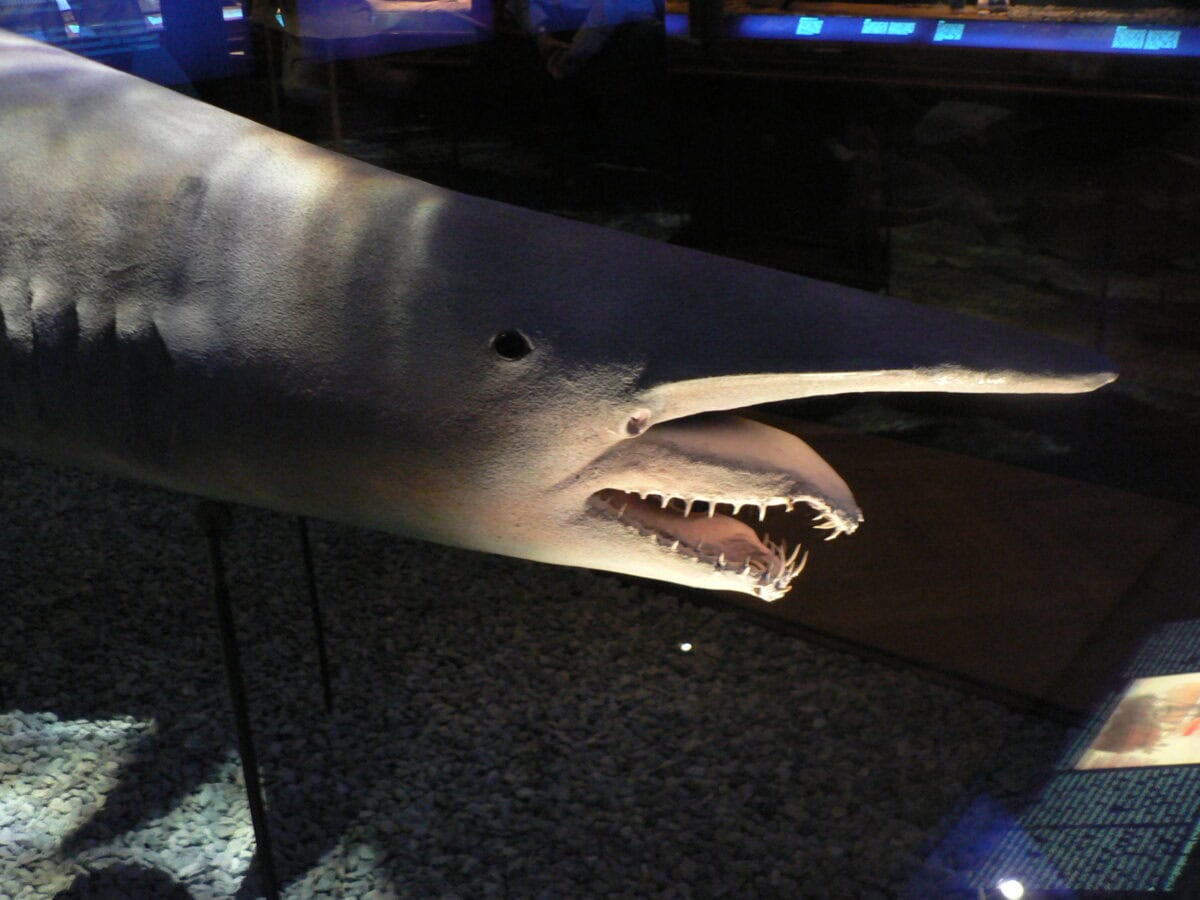
The goblin shark stands as a remarkable testament to the diverse and sometimes bizarre pathways of evolution. Its projectile jaws represent one of nature’s most specialized feeding adaptations, perfectly suited to the challenging deep-sea environment it inhabits. As a living fossil that has remained largely unchanged for millions of years, this strange creature provides scientists with a unique window into ancient shark lineages while simultaneously demonstrating how specialized adaptations can prove so effective that they require minimal modification over evolutionary time.
Despite its nightmarish appearance and feeding mechanism that would seem at home in a science fiction horror film, the goblin shark represents not a monster but a perfectly adapted deep-sea predator. Its bizarre features—from its elongated rostrum to its protrusible jaws—each serve specific functions that enable its survival in one of Earth’s most challenging habitats. As ocean exploration technology advances, we may gain new opportunities to study these elusive creatures in their natural environment, potentially uncovering more secrets about their behavior and ecology.
The goblin shark reminds us that the ocean’s depths still harbor creatures and adaptations beyond our imagination, with evolutionary solutions to survival challenges that continue to astonish scientists. In the meantime, this pink, flabby shark with the horror-movie jaws will continue to patrol the midnight zone of our oceans, largely unseen by human eyes but perfectly equipped for its deep-sea lifestyle—a true marvel of natural engineering and evolutionary success that has stood the test of time for millions of years.

From exploring the marine wonders in the Azores and witnessing the vast savannas of Kenya, to delving deep into the rich biodiversity of South Africa and traversing iconic landscapes in Australia and the US like Yellowstone, Chris's experiences are vast.
With a penchant for diving alongside sharks, the ocean holds a special place in his heart.
Through his academic insights, he champions wildlife conservation, striving with 'Animals Around The Globe' to cultivate a profound connection between humans and animals, enhancing our mutual appreciation.
Connect with him at Feedback@animalsaroundtheglobe.com.
- This Bizarre Shark Shoots Its Jaw Like a Horror Movie Monster - August 2, 2026
- 12 Ways to Help Your Senior Dog Stay Young - August 2, 2026
- What the World’s Most Endangered Bird Needs to Survive - August 2, 2026
Leave a comment
You must be logged in to post a comment.