

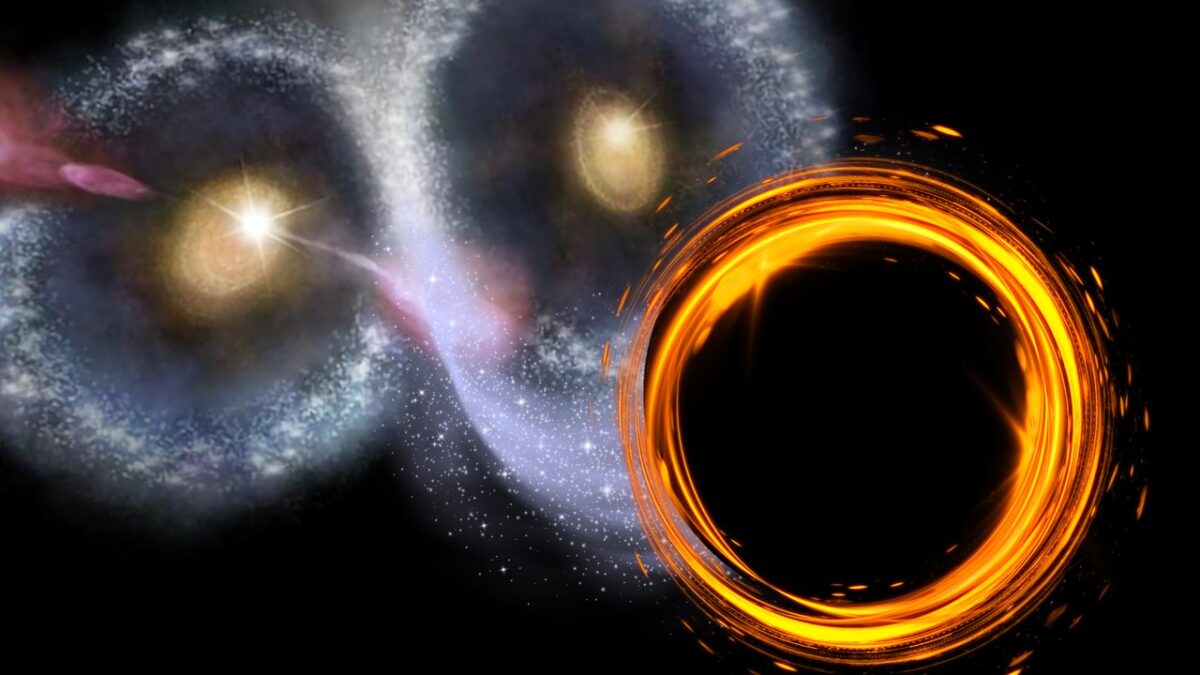
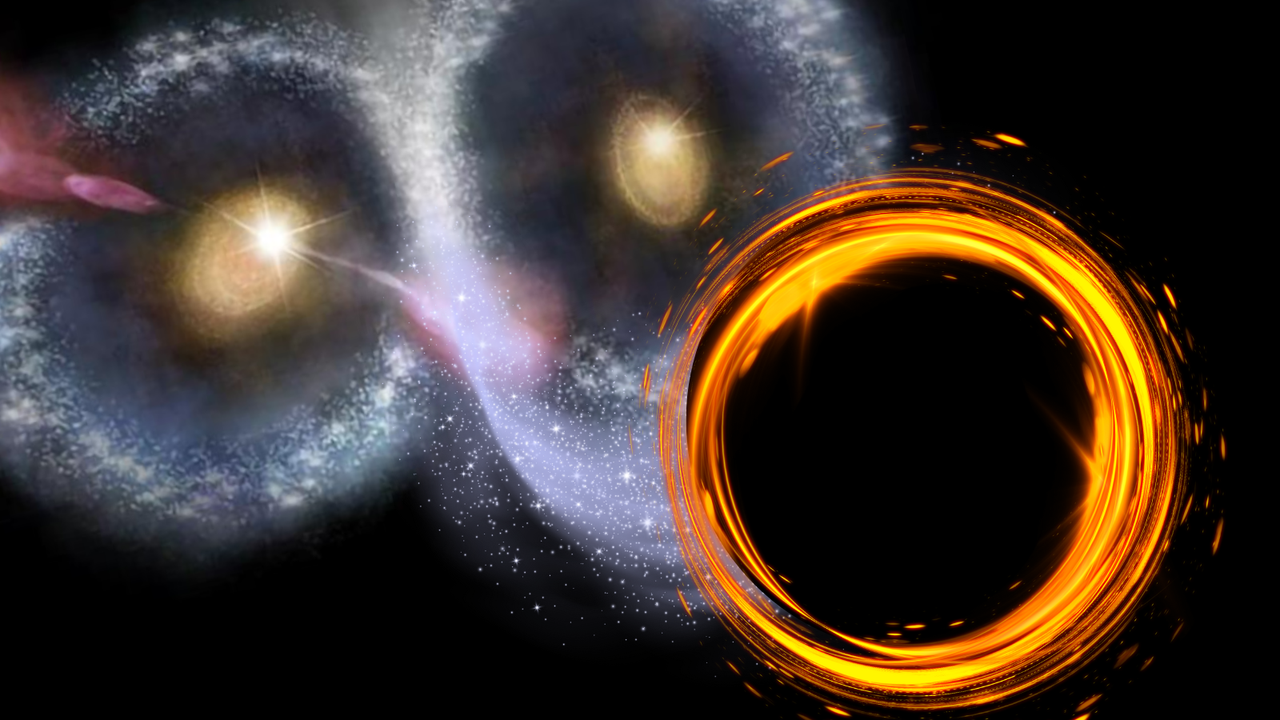
The Thrilling Confirmation of a Cosmic Fugitive (Image Credits: Cdn.mos.cms.futurecdn.net)
Astronomers have long theorized about supermassive black holes being ejected from their host galaxies, but recent observations have turned speculation into reality.
The Thrilling Confirmation of a Cosmic Fugitive
The James Webb Space Telescope recently provided definitive evidence of the universe’s first confirmed runaway supermassive black hole. This massive entity, estimated to be millions of times the mass of our sun, hurtles through space at an astonishing 2.2 million miles per hour. Researchers detected it within the intricate structure of the Cosmic Owl, a pair of colliding galaxies located billions of light-years away. The black hole’s rapid motion pushes vast amounts of interstellar gas and dust ahead of it, creating a luminous tail that stretches for thousands of light-years. This phenomenon not only marks a historic find but also challenges existing models of galactic dynamics.
Scientists first suspected the presence of such a wanderer through earlier telescope data, but JWST’s infrared capabilities offered the clarity needed for confirmation. The observations revealed a bow shock, a shockwave-like feature formed as the black hole plows through the intergalactic medium. This structure glows with newly formed stars, suggesting that the displaced material fuels bursts of stellar birth. The discovery highlights JWST’s power in peering into distant cosmic events that occurred billions of years ago. Experts describe the event as mind-bending, emphasizing the immense forces required to propel such a colossal object.
Unpacking the Cosmic Owl: A Galactic Collision Zone
The Cosmic Owl earned its nickname from the striking appearance of its two ring-shaped galaxies, which resemble the eyes and body of an owl when viewed together. This system, observed at a redshift indicating it formed about eight billion years ago, showcases the aftermath of a violent merger between the galaxies. Such collisions are common in the evolving universe, where gravitational interactions reshape cosmic structures over eons. In this case, the merger likely disrupted the central black holes of the involved galaxies, leading to the ejection of one. The surrounding environment teems with active galactic nuclei and stellar nurseries, adding layers of complexity to the scene.
Within the Cosmic Owl, the runaway black hole’s path carves through regions rich in gas clouds, compressing them and triggering star formation. This process mirrors smaller-scale events seen closer to home but on a grander scale. Astronomers note that the system’s “beak” region serves as a prolific site for new stars, illuminated by the energy from the collision. Understanding these interactions helps explain how galaxies grow and evolve over time. The JWST data paints a vivid picture of chaos turning into creation amid the merger’s turmoil.
Forces Behind the Black Hole’s Dramatic Escape
Ejecting a supermassive black hole demands extraordinary gravitational interplay, typically arising during galaxy mergers. When two galaxies collide, their central black holes can spiral toward each other, forming a binary system. If a third black hole or asymmetric merger intervenes, it can impart a powerful gravitational kick, slingshotting one black hole free. In the Cosmic Owl scenario, this kick accelerated the object to its current velocity, far exceeding typical galactic speeds. Such events, while rare, offer insights into the violent births of quasars and active galaxies.
The black hole now roams as an intergalactic nomad, no longer bound to a central bulge. Its speed, equivalent to over 1% of the speed of light, ensures it will continue its journey for billions of years. Researchers predict that similar ejections occur frequently in the early universe, influencing the distribution of matter on large scales. Detecting this one required precise spectroscopy to measure Doppler shifts in the light from surrounding material. The find underscores the universe’s capacity for dramatic, high-energy spectacles.
Broader Implications for Our Understanding of the Cosmos
This discovery reshapes theories on black hole growth and galaxy formation. Runaway black holes could explain the scarcity of supermassive ones in certain galaxy types, as they wander away from potential feeding grounds. The star-forming tail behind the fugitive suggests these objects seed new stellar populations across intergalactic voids. Future observations might uncover more such wanderers, refining models of cosmic evolution. Ultimately, the event reminds us of the universe’s dynamic nature, where destruction often paves the way for renewal.
Key Takeaways
- The first confirmed runaway supermassive black hole moves at 2.2 million mph through the Cosmic Owl galaxies.
- JWST observations reveal a star-forming tail and bow shock, confirming the ejection from a merger.
- This find highlights immense gravitational forces and their role in shaping galactic structures.
As JWST continues to unlock these cosmic mysteries, discoveries like this one expand our view of the universe’s hidden mechanics. What aspects of this runaway black hole intrigue you most? Share your thoughts in the comments below.

From exploring the marine wonders in the Azores and witnessing the vast savannas of Kenya, to delving deep into the rich biodiversity of South Africa and traversing iconic landscapes in Australia and the US like Yellowstone, Chris's experiences are vast.
With a penchant for diving alongside sharks, the ocean holds a special place in his heart.
Through his academic insights, he champions wildlife conservation, striving with 'Animals Around The Globe' to cultivate a profound connection between humans and animals, enhancing our mutual appreciation.
Connect with him at Feedback@animalsaroundtheglobe.com.
- This Monkey Has a Mustache - July 21, 2026
- How Steve Irwin Changed the World’s View of Wildlife - July 21, 2026
- The Catfish That Caused Earthquakes in Japanese Folklore - July 21, 2026