

Picture something weighing less than a penny completing a journey longer than the distance from New York to Los Angeles. Now imagine that creature has never made the trip before, has no parent to guide it, yet somehow knows exactly where to go. Welcome to the bewildering world of butterfly migration, where tiny insects perform navigational feats that continue to baffle scientists.
Eastern monarch butterflies fly between 2,000 to 3,000 miles to an overwintering location in South-Central Mexico, relying on abilities coded deep within their genetic blueprint. These journeys reveal one of nature’s most profound mysteries: how do creatures with brains smaller than a pinhead navigate across an entire continent? Let’s dive into the science behind this remarkable phenomenon.
The Sun Compass That Ticks Like a Clock

Monarch butterflies navigate south using a time-compensated sun compass, processing skylight cues such as the sun itself and polarized light through both eyes, likely integrated in the brain’s central complex. Think of it as having a GPS system powered by sunshine and internal timing mechanisms.
Time compensation is provided by circadian clocks that have a distinctive molecular mechanism and that reside in the antennae. Here’s the thing: most animals keep their biological clocks in their brains, but monarchs store theirs in their antennae. It’s hard to say for sure, but this unusual placement might allow for faster, more direct processing of navigational data during flight.
Monarchs use their large, complex eyes to monitor the sun’s position in the sky, but the sun’s position is not sufficient to determine direction – each butterfly must also combine that information with the time of day to know where to go. The coordination between what they see and what time their internal clock says it is creates a constantly updating compass bearing.
A Genetic Program No One Taught Them

The remarkable navigational abilities of monarch butterflies are part of a genetic program that is initiated in migrants – it is not learned, as the butterflies migrating are always on their virgin journey, and those that migrate south are at least two generations removed from the previous generation of migrants. Let’s be real: that’s absolutely mind-blowing.
It typically takes up to three generations of butterflies to make the complete journey, which means that the navigation information is genetically programmed. No butterfly completes a full round trip. The ones flying south in autumn will never see their northern breeding grounds again. Their grandchildren or great-grandchildren will make that return journey, guided by the same inherited instructions.
Monarch migration is instinctive, performed without prior knowledge or experience, and because of the short life cycle of the butterfly, none of the individuals that set off to Mexico have ever made the journey before. The precision of this inherited knowledge rivals anything found in nature.
When Clouds Block the Sun

Navigation based on the sun sounds great until you remember that weather exists. So what happens when thick clouds roll in?
Butterflies are known to be able to use polarized light on partly cloudy days to calculate the position of the sun, and they still fly in the right direction on completely overcast days, likely thanks to a sort of magnetic compass also in the insect’s brain. Scientists suspect monarchs have backup systems, though the details remain fuzzy.
Monarchs may also use a magnetic compass, because they possess two cryptochromes that have the molecular capability for light-dependent magnetoreception. Cryptochromes are special proteins sensitive to magnetic fields, giving these butterflies an additional layer of navigational sophistication. When sunlight is limited or obscured, monarchs rely on geomagnetic cues by detecting Earth’s magnetic field through specialized molecular receptors to maintain their directional heading.
The Compass Activates Only in Flight

Recent research has uncovered something genuinely surprising about when this navigation system actually works. A recent study, which looked at the monarchs’ brain activity, has determined that the compass is only activated once the butterfly takes flight.
The nerve cells change their coding strategy during flight, so that the neural network represents the heading direction of the butterflies relative to the Sun in a similar way to a compass, and this only happens when the animals can control their own direction of flight. It’s as if the navigation computer boots up mid-air and shuts down when they land.
This discovery suggests that the act of flying itself triggers specific neural pathways. The butterflies aren’t constantly running their compass system while resting or feeding. Instead, it switches on during active migration, conserving mental resources when navigation isn’t immediately necessary.
Cold Weather Flips the Navigation Switch

Biologists at the University of Cincinnati found that monarch butterflies have an internal compass that is influenced by temperature to help navigate, and butterflies exposed to 24 days of cold temperatures like the kind they experience in their overwintering grounds reorient to the north, suggesting their internal compass is recalibrated by the cold. Temperature doesn’t just tell monarchs when to leave – it actually resets their directional preferences.
The model suggests a simple explanation why monarch butterflies are able to reverse course in the spring and head northeast back to the United States and Canada: the four neural mechanisms that transmit information about the clock and the sun’s position would simply need to reverse direction, and when that happens, their compass points northeast instead of southwest. Nature’s elegance shows itself in this simple flip-switch mechanism controlled by temperature.
Ultralight Transmitters Reveal New Secrets
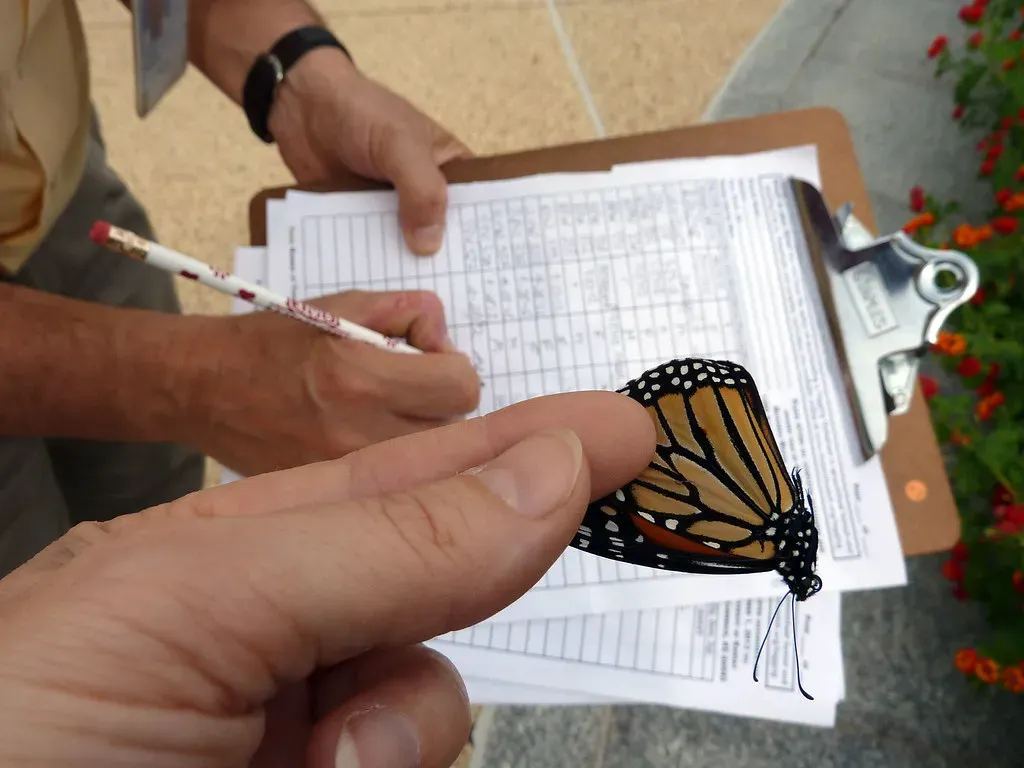
Project Monarch, a collaborative effort founded by Cellular Tracking Technologies and the Cape May Point Arts & Science Center, united over 20 partner organizations to deploy over 400 BlūMorpho transmitters on migrating monarchs during fall 2025, providing scientists with high-resolution, near-real-time data on individual butterflies as they navigate their epic journey south. For the first time, researchers can watch individual butterflies travel in real time.
Monarchs weigh less than a gram, and conventional tracking technology was simply too heavy, making this technological breakthrough years in the making. Everything changed in November 2024 when a butterfly named Lionel, equipped with a new additional bit of programming code dubbed Blū+, was released in Cape May Point and provided the first high-resolution track of monarch migration ever recorded, with hundreds of detections to St. Augustine, Florida.
These tiny solar-powered transmitters are revolutionizing our understanding of migration routes, stopover sites, and how individual butterflies respond to weather conditions. Scientists now have unprecedented detail about how these journeys actually unfold day by day across thousands of miles.
Conclusion

The monarch butterfly’s navigational abilities remain one of biology’s most captivating puzzles. We’ve unraveled pieces of the mystery – sun compasses, magnetic sensing, temperature-triggered direction changes – yet the complete picture eludes us. How does genetic code translate into such precise navigation? What other backup systems might exist that we haven’t discovered?
Mexican partners hope to deploy transmitters on monarchs leaving Mexico in spring 2026, tracking their return journey north, which could provide crucial insights into how the northward migration differs from the southward trek. Each discovery seems to raise more questions than it answers.
The fact that something so small, fragile, and short-lived can accomplish feats that seem nearly impossible reminds us how much we still don’t understand about the natural world. These butterflies are performing calculations and following instructions written into their DNA millions of years ago, without a single lesson or practice run. What do you think drives such precision in nature? Tell us in the comments.
