

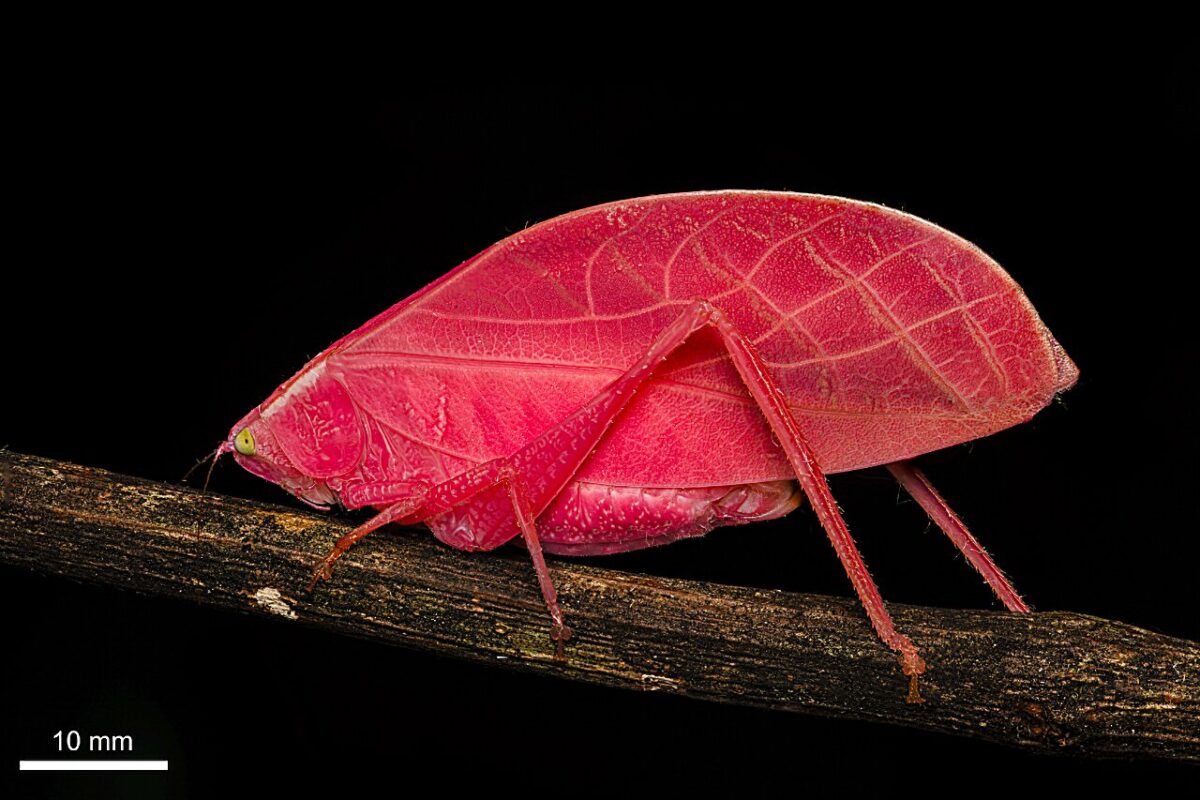
Arota festae before Transformation (Image Credits: University of St Andrews, University of Reading, the Smithsonian Tropical Research Institute, and University of Amsterdam)
In the dense tropical forests of South America, survival often depends on the ability to disappear. Camouflage has evolved in countless forms across the animal kingdom, but a recently studied insect has revealed a particularly striking strategy—standing out before blending in. Scientists have discovered that a vibrant pink rainforest insect can transform its color dramatically, shifting from bright pink to leafy green as it matures.
The unusual transformation highlights how nature sometimes uses bold visibility as part of camouflage rather than avoiding it entirely. Researchers say this insect’s changing colors mimic the life cycle of rainforest leaves, allowing it to remain hidden from predators despite appearing highly conspicuous at first glance. The discovery sheds new light on the complexity of insect camouflage and evolutionary adaptation.
A Rainforest Insect That Starts Life in Bright Pink
The insect at the center of the discovery is Arota festae, a leaf-mimicking katydid often described as a bush cricket. It inhabits tropical forests in countries such as Panama, Colombia and Suriname, environments where dense vegetation and abundant predators create strong pressure for effective camouflage.
When young, however, this insect seems to ignore the usual rule of blending in. Juvenile individuals display a vivid hot-pink coloration that makes them highly visible against the surrounding greenery. At first glance, the bright hue appears counterproductive for an animal that relies on camouflage for survival.
Yet scientists discovered that this bold color is actually part of a clever disguise strategy tied to plant growth cycles within rainforest ecosystems.
Mimicking the Colors of Young Leaves
Many tropical plants produce new leaves that appear reddish, pink, or copper before turning green as they mature. These early leaf stages often contain protective pigments that shield delicate tissues from sunlight or herbivores.
The juvenile stage of Arota festae appears to imitate exactly this stage of plant growth. By matching the pink or reddish tones of newly sprouting leaves, the insect can remain unnoticed among fresh foliage despite its striking coloration.
Rather than hiding in green vegetation, the insect hides among plant tissues that naturally stand out in the forest canopy. Predators scanning for prey may simply perceive the insect as part of the plant itself.
A Rapid Color Transformation
One of the most remarkable aspects of this insect’s camouflage is how quickly its appearance changes. Researchers observed that the katydid shifts from bright pink to green within roughly two weeks.
As the insect grows and molts into later developmental stages, its body gradually adopts the familiar green coloration seen in many leaf-dwelling insects. This transformation aligns with the maturation of rainforest leaves, which also transition from colorful juvenile forms to green foliage.
The timing suggests that the insect’s coloration is not random but carefully synchronized with the visual environment in which it lives.
Camouflage That Evolves with the Environment
This discovery highlights a broader concept in evolutionary biology: camouflage is not static. Instead, many organisms adapt their appearance throughout different life stages to match shifting ecological conditions.
For Arota festae, the transition from pink to green represents a two-phase disguise. The insect first mimics young leaves when it is small and vulnerable, then blends into mature foliage as it grows larger and moves through the forest canopy.
Such stage-dependent camouflage strategies are rarely documented in such visually dramatic ways, making the insect a fascinating case study for evolutionary biologists.
Why Standing Out Can Be a Form of Hiding
At first glance, bright pink seems like the worst possible color for avoiding predators in a green forest. Yet this discovery demonstrates that effective camouflage depends on context rather than simply matching the most common background.
In complex ecosystems like tropical rainforests, plants display a wide variety of colors, shapes and textures. By mimicking a specific stage of leaf development, the insect exploits a visual niche that predators may overlook.
This strategy illustrates how evolutionary pressures can lead to unexpected adaptations where visibility itself becomes part of the disguise.
What This Discovery Reveals About Evolution
The research provides a striking example of how natural selection shapes organisms in subtle ways. Camouflage is often associated with simple color matching, but the pink-to-green transformation shows that timing and developmental changes can be equally important.
Scientists believe that studying insects like Arota festae can deepen our understanding of how visual deception evolves in nature. The findings also highlight how much remains undiscovered in tropical ecosystems, where countless species have evolved intricate survival strategies.
Such insights are especially valuable as biodiversity faces increasing pressure from habitat loss and climate change.
Conclusion: Nature’s Most Unexpected Disguises
The bright pink katydid reminds us that evolution rarely follows obvious rules. In a world where camouflage is usually associated with dull greens and browns, this insect has evolved a strategy that begins with bold color and ends with perfect mimicry.
What makes this discovery particularly compelling is the elegance of the solution. Instead of blending into a single environment, the insect changes its disguise as its surroundings change. The result is a dynamic camouflage system synchronized with the rhythms of rainforest plant life.
In many ways, this tiny insect represents the ingenuity of evolution itself. It proves that survival in nature is not just about hiding—it is about knowing exactly when to stand out and when to disappear.

- Urban Coyotes Show Remarkable Adaptability, Learning to Thrive in City Environments - July 22, 2026
- Beavers Are Nature’s Engineers, Creating Vital Habitats for Other Wildlife Species - July 21, 2026
- The Recovery of the California Condor Offers Hope for Other Critically Endangered Birds - July 21, 2026