

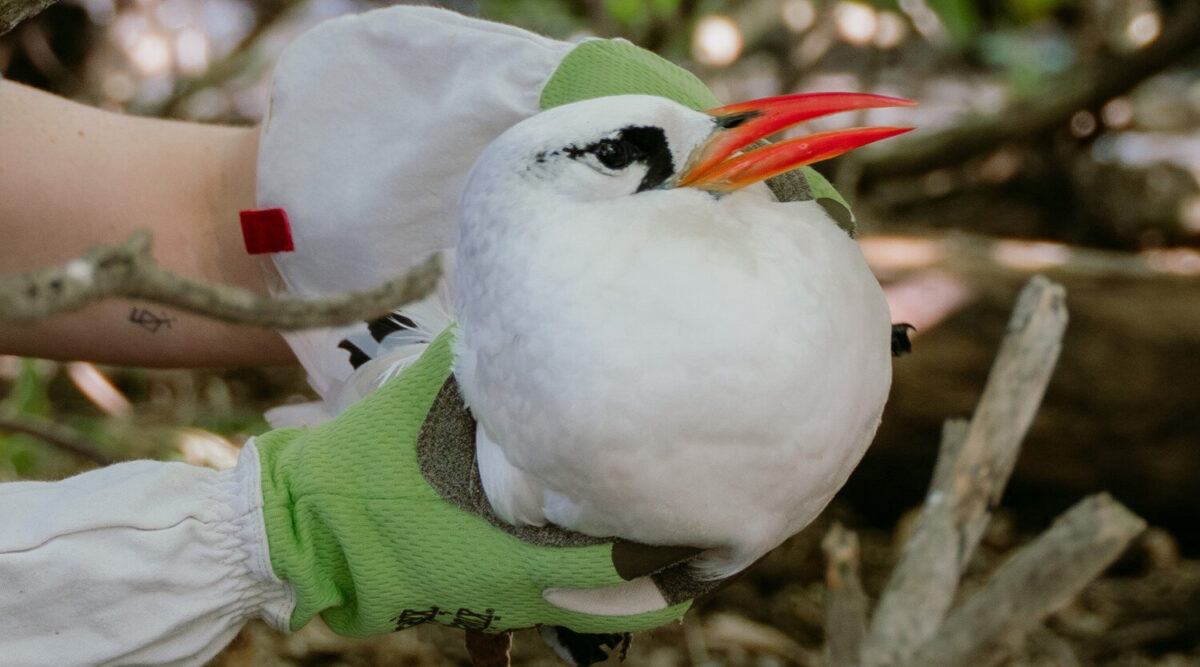
These Birds Travel Extraordinary Distances to Find Suitable Partners (Image Credits: University of the Sunshine Coast)
In the remote waters surrounding Australia’s Great Barrier Reef, a small seabird is performing an astonishing feat of endurance in the name of love. Scientists studying one of the country’s smallest seabird colonies have discovered that these birds travel extraordinary distances—sometimes thousands of kilometers—just to find suitable partners and maintain healthy populations.
The discovery reveals a remarkable strategy for avoiding inbreeding in tiny island colonies. Even though only a handful of breeding pairs live on a small coral island, genetic evidence shows that individuals frequently travel vast distances between colonies across the Indian and Pacific oceans to reproduce.
A Tiny Island Colony With a Big Mystery
At the southern tip of the Great Barrier Reef lies Lady Elliot Island, home to a surprisingly small colony of the seabird species red-tailed tropicbird. Despite suitable habitat, the colony has remained tiny for decades, with only about six to ten breeding pairs recorded in recent years.
Because the colony is so small and isolated, scientists initially suspected that the birds might suffer from inbreeding problems. Limited mate choice often leads to reduced genetic diversity, which can weaken populations and make them more vulnerable to disease or environmental change.
However, when researchers examined the birds more closely, the results were far more surprising.
Genetic Clues Reveal Long-Distance Romance
Researchers from the University of the Sunshine Coast conducted genetic testing on the island’s birds to understand how such a small colony could remain healthy. Instead of finding signs of inbreeding, they discovered that the birds possessed genetic diversity comparable to much larger colonies.
This finding indicated something extraordinary was happening. The birds of this tiny colony were not isolated at all—they were connecting with other populations across vast distances of ocean.
In fact, scientists believe individuals may travel up to about 2,000 kilometers between breeding sites in order to find partners and maintain healthy gene flow between colonies.
Traveling Across the Reef to Find a Mate
The research suggests that some birds from the small colony may fly long distances to larger colonies to breed. Likewise, birds from distant populations occasionally travel to the island and raise chicks there.
Important partner colonies include sites such as Ashmore Reef and Raine Island, both known breeding grounds for red-tailed tropicbirds. These journeys require crossing thousands of kilometers of open ocean.
Such long-distance movement is remarkable for birds that return to the same nesting sites year after year. Many seabirds display strong “site fidelity,” meaning they repeatedly breed at the same location.
Why Seabirds Travel So Far
The motivation behind these journeys is simple but vital: avoiding inbreeding. When populations become too isolated, mating between closely related individuals can reduce genetic health over time.
By occasionally moving between distant colonies, the birds effectively exchange genes across their range. This natural mixing helps maintain strong and resilient populations even in very small colonies.
Seabirds are especially well adapted for this strategy. Many species are capable of traveling enormous distances over the ocean using efficient gliding flight powered by wind currents.
Habitat Restoration Made the Colony Possible
The presence of this colony itself is the result of conservation efforts. In the past, human activities such as guano mining damaged vegetation and nesting habitat on the island.
Revegetation programs gradually restored the island’s ecosystem, creating suitable nesting areas for seabirds once again. Eventually, red-tailed tropicbirds returned and began breeding there in the 1980s.
Today, the colony serves as a powerful example of how habitat restoration can revive wildlife populations that once disappeared.
A Window Into Seabird Conservation
The findings are encouraging for conservationists working to protect seabirds across Australia and the wider Indo-Pacific. Some populations of red-tailed tropicbirds are considered vulnerable, making genetic connectivity between colonies particularly important.
By demonstrating that birds naturally travel between colonies, the study suggests that protecting multiple nesting sites across large geographic areas may be essential for long-term population health.
It also highlights the importance of protecting islands, reefs, and open ocean habitats that seabirds rely on during these journeys.
Conclusion The Ocean Is a Highway for Love and Survival
The discovery that small seabirds fly thousands of kilometers to find mates is a powerful reminder of how interconnected nature truly is. A tiny island colony that appears isolated is, in reality, part of a vast biological network stretching across oceans.
In an era when wildlife habitats are increasingly fragmented by human activity, this study offers a hopeful message. Nature has its own strategies for survival—if we give it the space to work. Protecting nesting islands, restoring degraded habitats, and safeguarding ocean ecosystems may allow these remarkable birds to continue their long-distance journeys of love for generations to come.

- Urban Coyotes Show Remarkable Adaptability, Learning to Thrive in City Environments - July 22, 2026
- Beavers Are Nature’s Engineers, Creating Vital Habitats for Other Wildlife Species - July 21, 2026
- The Recovery of the California Condor Offers Hope for Other Critically Endangered Birds - July 21, 2026