

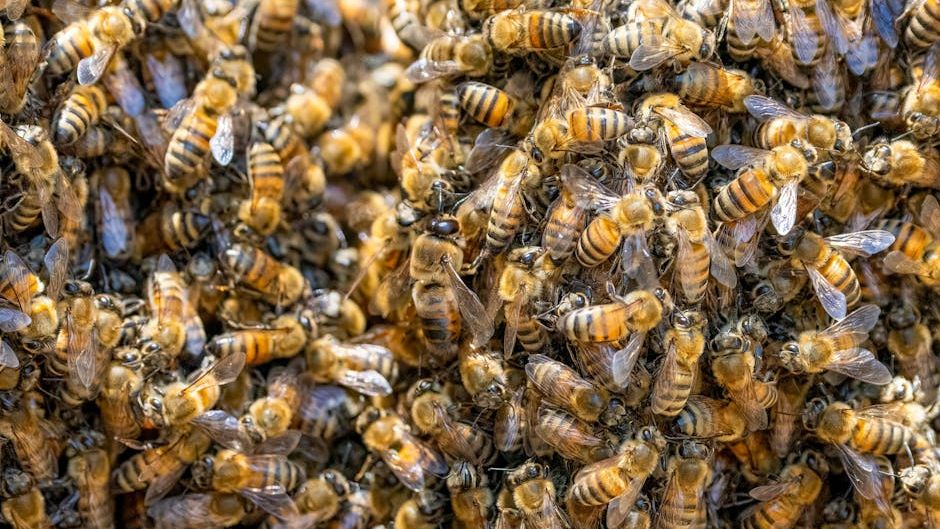
Upstate New York — Researchers from Cornell University recently identified an extraordinary congregation of bees beneath the grounds of East Lawn Cemetery, estimating a population of 5.5 million Andrena regularis individuals across just 1.5 acres.[1]
This discovery stands out as one of the largest documented bee aggregations worldwide, highlighting the hidden ecological riches in unexpected urban spaces. The site lies less than half a mile from Cornell Orchards, a research facility established in 1910 that grows apples, grapes, and stone fruits.[1]
Uncovering the Underground Hive
Steve Hoge, an undergraduate researcher at Cornell, led the effort that revealed this massive bee population. The team deployed emergence traps — specialized glass jars fitted with funnels — to capture insects as they surfaced from the soil. These devices not only snagged flies and beetles but overwhelmingly collected Andrena regularis specimens.[1]
By analyzing the capture rates, the researchers calculated bees emerging per square meter of ground. They then scaled this figure across the approximately 6,000 square meters of suitable habitat, yielding a population range of 3 to 8 million, with 5.5 million as the midpoint estimate. The findings appeared in the journal Apidologie, marking a rare deep dive into this bee species, whose last significant study dated to 1978.[1]
The Life Cycle of Andrena regularis
Andrena regularis belongs to the miner bee family, solitary ground-nesters that dig tunnels in soil for their homes. More than 70 percent of bee species worldwide follow this lifestyle, the most common among their kind, according to senior author Bryan Danforth.[1]
These bees overwinter as adults, a less common trait that prompts their early spring emergence, perfectly synced with nearby apple blossoms for pollination. Ground-nesters like them support 80 percent of the planet’s flowering plants through their foraging. Hoge noted, “This [species] overwinters as adults, which is relatively rare, and that’s part of the reason why they come up out of the ground so early in the spring, timed to the apple bloom.”[1]
Scale and Global Context
This cemetery colony likely ranks among the world’s largest known bee gatherings, at least according to published records. Hoge observed, “I’m sure there are other large bee aggregations that exist around the world that we just haven’t identified, but in terms of what is in the literature, this is one of the largest.” The sheer density — millions in such a confined area — underscores how little we know about solitary bees despite their ubiquity.[1]
Danforth, who has studied bees globally, emphasized the prevalence of ground-nesting habits: “it’s the most common [lifestyle] for bees.” Yet uncertainties remain in the estimate, derived from extrapolations rather than a full census, and ground bees’ elusive nature complicates precise counts.[1]
| Aspect | Details | Uncertainties |
|---|---|---|
| Population Estimate | 5.5 million (avg.); 3-8 million range | Based on trap extrapolations |
| Aggregation Size | 1.5 acres (6,000 sq m) | Exact boundaries approximate |
| Study Method | Emergence traps | Captures other insects too |
Cemeteries as Unexpected Sanctuaries
East Lawn Cemetery supports more than bees; its superintendent, Keven Morse, has observed deer, geese, hawks, foxes, and coyotes over the years. Morse once remarked, “I just felt bad having to mow in certain areas,” reflecting awareness of the site’s wildlife. Such places often preserve biodiversity thanks to their protected status and minimal disturbance.[1]
A 2023 study in Conservation Biology equated cemeteries’ value for local flora and fauna to that of urban parks. This find reinforces their role as refuges amid development pressures, especially for underappreciated pollinators near agricultural hubs like Cornell Orchards.[1]
While this discovery illuminates the vitality of ground-nesting bees, it also signals gaps in research on these essential insects. As urbanization advances, preserving such incidental habitats could prove vital for pollination networks that sustain crops and wild plants alike. Cornell’s work invites further exploration into other overlooked corners where nature persists quietly below the surface.[1]

- Urban Coyotes Show Remarkable Adaptability, Learning to Thrive in City Environments - July 22, 2026
- Beavers Are Nature’s Engineers, Creating Vital Habitats for Other Wildlife Species - July 21, 2026
- The Recovery of the California Condor Offers Hope for Other Critically Endangered Birds - July 21, 2026