

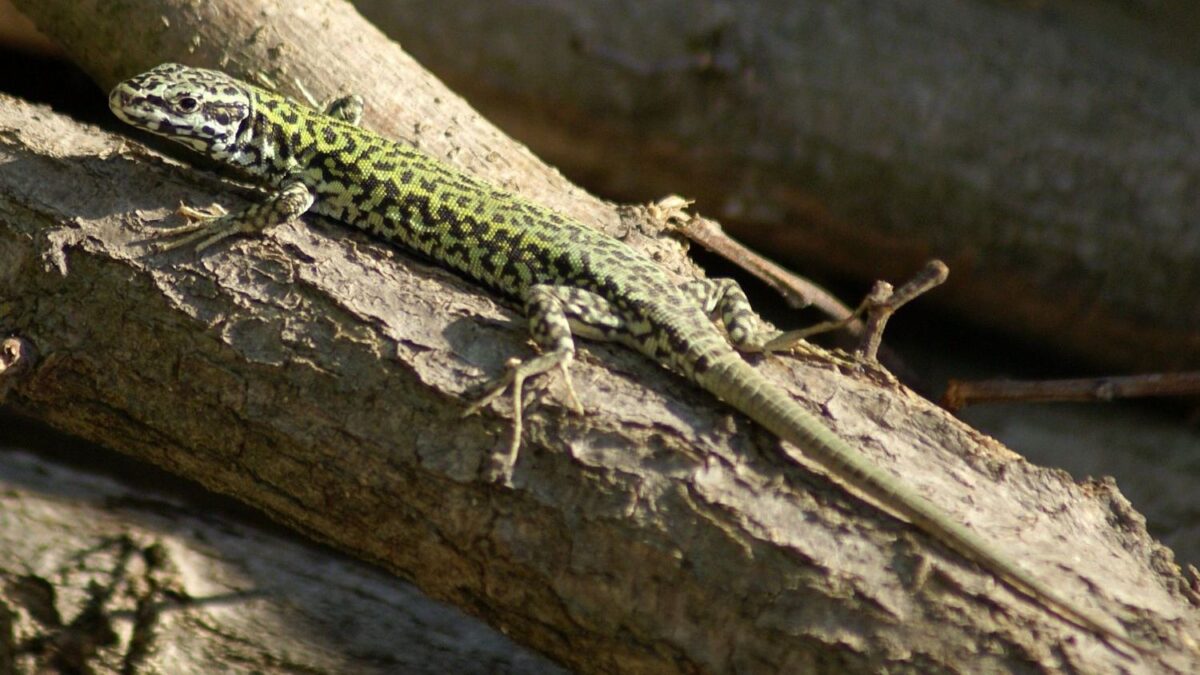
Italy — Stone walls across the Mediterranean countryside once teemed with wall lizards flashing throats of white, yellow, or orange during fierce competitions for territory and mates. These distinct color morphs coexisted for millions of years, each embodying a unique survival strategy in a delicate evolutionary equilibrium. Researchers now report that a bold green newcomer, dubbed the “Hulk” lizard for its aggressive prowess, has upended this system, driving yellow and orange variants to extinction in invaded areas.[1][2]
A Timeless Palette of Throat Colors
The common wall lizard (Podarcis muralis) thrives throughout the Mediterranean, clinging to rocks and ruins in search of insects and sunlight. Males display one of three genetically determined throat colors: white, yellow, or orange. These morphs did not arise by chance; each linked to behavioral traits that fostered coexistence.
White-throated lizards often pursued aggressive territorial defense, while yellow and orange variants adopted subtler tactics, such as sneaking or cooperating in complex social dynamics. This balance resembled a natural rock-paper-scissors game, where no single strategy dominated indefinitely. Scientists long viewed it as a model of stable polymorphism, enduring through ice ages and environmental shifts.[3]
The Emergence of a Dominant Green Force
Around the Rome region, a striking new variant appeared: larger lizards with vibrant green bodies accented by bold black patterns and white throats. Nicknamed “Hulk” lizards, they exhibited unmatched aggression and sexual dominance. These traits formed a “sexually selected syndrome,” giving them an edge in battles for mates and space.
As Hulk lizards expanded outward, they reshaped local lizard societies. Their relentless challenges overwhelmed rivals, preventing yellow and orange males from accessing resources or females. In hybrid populations, the green-and-black phenotype spread similarly, amplifying the effect beyond the original lineage.[3]
Unprecedented Scale: Insights from 240 Populations
A comprehensive study, published in Science, surveyed more than 10,000 lizards across roughly 240 populations in Italy and beyond. Led by Tobias Uller, professor of evolutionary biology at Lund University, the team cataloged color frequencies and genomic markers. The pattern emerged unequivocally: wherever Hulk lizards arrived, yellow and orange morphs vanished, leaving populations dominated by white-throated individuals.[1][2]
“We are seeing how the coexistence of several different color morphs, something that has been stable for millions of years, is being lost over a very short evolutionary time scale,” Uller observed. The analysis revealed no simple genetic takeover; instead, heightened aggression disrupted the social frameworks that sustained diversity. Collaborators from the Max Planck Institute for Evolutionary Biology and the University of Tasmania contributed genomic data and fieldwork, confirming the Hulk’s role in 220 to 240 sites.[4]
Nathalie Feiner, from the Max Planck Institute, noted the genetic underpinnings: “Only because we had detailed knowledge about how the green-and-black body pattern and the throat colours are genetically encoded were we able to connect the dots.” This section of the research stood out for its breadth, blending field observations with molecular evidence to trace the invasion’s footprint.
Key Study Findings:
- Over 10,000 lizards examined across 240 populations.
- Yellow and orange morphs eradicated in Hulk-invaded areas.
- Hulk morph linked to aggression disrupting social coexistence.
- Effect extends to hybrid lineages acquiring green-black traits.
Lessons from a Fragile Equilibrium
The Hulk phenomenon challenges assumptions about evolutionary stability. Long-cherished polymorphisms proved vulnerable to a single disruptive force. “The aggressive behavior disrupts the finely tuned social systems that previously enabled several color strategies to coexist,” Uller explained.[5]
Senior author Geoff While, from the University of Tasmania, added: “As the ‘Hulk’ lizard spreads across the landscape, it appears to fundamentally alter how lizards interact.” This rapid transformation underscores how new traits can cascade through ecosystems, rewriting competitive rules in generations rather than eons.
Biologists now ponder broader applications. Could similar dynamics explain losses of diversity elsewhere? The wall lizard saga serves as a vivid caution: evolution favors the fierce, but at the cost of variety that once defined a species.

- Urban Coyotes Show Remarkable Adaptability, Learning to Thrive in City Environments - July 22, 2026
- Beavers Are Nature’s Engineers, Creating Vital Habitats for Other Wildlife Species - July 21, 2026
- The Recovery of the California Condor Offers Hope for Other Critically Endangered Birds - July 21, 2026