

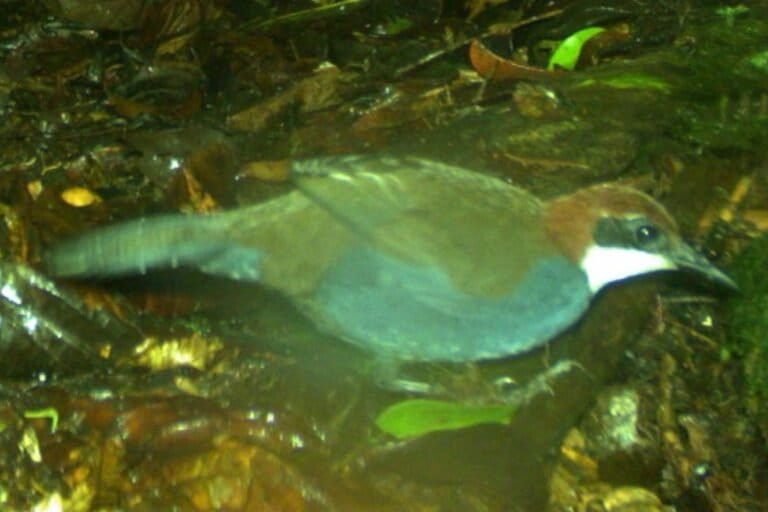

A Groundbreaking Find in Remote Terrains (Image Credits: Imgs.mongabay.com)
Papua New Guinea – Deep within the rugged karst forests of the Southern Fold Mountains, a elusive avian wonder has emerged from obscurity, captivating researchers with its vibrant plumage and precarious existence.
A Groundbreaking Find in Remote Terrains
Ornithologists recently unveiled the hooded jewel-babbler, a species long concealed by the dense undergrowth of Papua New Guinea’s montane rainforests. Camera traps placed strategically over nearly a decade captured fleeting glimpses of this bird, marking the first documented evidence of its presence. These automated devices, set up in challenging limestone landscapes, revealed fewer than 10 individuals between 2017 and 2024, underscoring the bird’s extreme rarity.
The discovery stemmed from persistent fieldwork that combined photographic sequences, vocal recordings, and genetic analysis. Specimens collected during expeditions confirmed the bird’s distinct identity, separate from its close relatives in the Ptilorrhoa genus. This breakthrough highlights how much of New Guinea’s biodiversity remains unexplored, even in well-studied regions.
Distinctive Traits That Set It Apart
The hooded jewel-babbler stands out with its striking coloration, featuring a chestnut nape and crown that contrasts sharply against a black facial mask. Males display an all-blue underbody, while females exhibit a mix of olive green and blue below the neck – a rare case of sexual dichromatism in the family. The mask’s shape, which stops at the ear-coverts, further distinguishes it from other jewel-babblers.
These features not only aid in identification but also suggest adaptations to its forested habitat, where camouflage and display play key roles in survival. Researchers noted the bird’s shy demeanor, often foraging on the ground amid leaf litter, which explains its elusiveness to human observers. Genetic data reinforced its uniqueness, placing it as one of five recognized species in its genus.
The Perils of a Tiny, Isolated Range
Confined to a mere 100-hectare patch of rugged terrain, the hooded jewel-babbler inhabits an area vulnerable to environmental pressures. Estimates suggest a global population of just 50 to 100 birds, making it critically endangered from the outset. Logging, mining activities, and habitat fragmentation pose immediate risks to this localized population.
Over the monitoring period, sightings remained sparse, with no evidence of expansion beyond the initial site. Climate change adds another layer of concern, as shifting weather patterns could alter the karst forests that sustain the species. Conservationists emphasize that without swift intervention, this new find could vanish as quickly as it appeared.
Efforts to Safeguard a Fragile Marvel
Field teams have ramped up monitoring through expanded camera trap networks and community partnerships with local Indigenous groups. These collaborations provide vital insights into the bird’s behavior and habitat needs. Genetic studies continue to inform breeding programs, though the small population limits immediate options.
Protecting the Southern Fold Mountains requires integrated strategies, including anti-poaching measures and sustainable land-use policies. International organizations urge recognition of the species under global conservation frameworks to secure funding and legal safeguards. Early actions, such as designating the area as a protected zone, could buy time for this jewel of biodiversity.
Key Takeaways
- The hooded jewel-babbler represents a rare addition to Papua New Guinea’s avifauna, known from limited camera trap evidence.
- Its tiny range and low numbers classify it as critically endangered, demanding urgent habitat protection.
- Ongoing research and local involvement offer hope for preserving this species amid broader environmental threats.
As this discovery reminds us of nature’s hidden treasures and their fragility, safeguarding the hooded jewel-babbler calls for global vigilance. What steps do you believe are essential to protect such vulnerable species? Share your thoughts in the comments.

- Urban Coyotes Show Remarkable Adaptability, Learning to Thrive in City Environments - July 22, 2026
- Beavers Are Nature’s Engineers, Creating Vital Habitats for Other Wildlife Species - July 21, 2026
- The Recovery of the California Condor Offers Hope for Other Critically Endangered Birds - July 21, 2026