

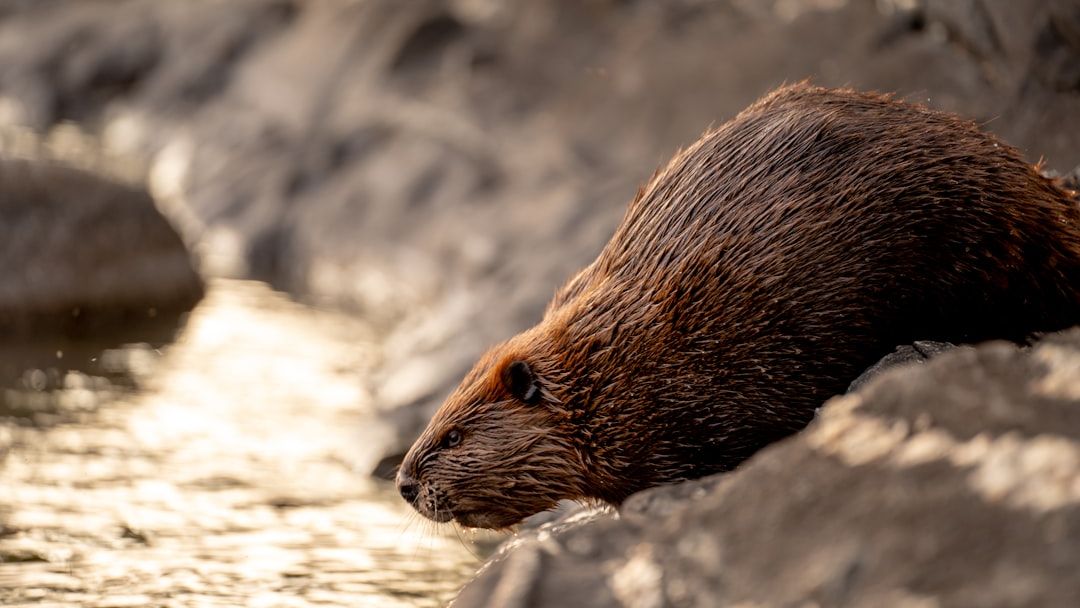
Canada’s Northwest Territories – In the stark expanse of the Inuvialuit Settlement Region, where willow shrubs cling to thawing permafrost, faint scars on branches tell a story of transformation. Researchers have turned to these marks, etched by the industrious North American beaver, to document an unexpected northward push. A recent study in the journal Ecosphere combines ancient tree-ring techniques with modern satellite data to reveal how these rodents have begun reshaping the tundra landscape.[1][2]
Unraveling Beaver History Through Wood and Waves
Scientists surveyed 60 sites featuring beaver lodges and dams along a 130-kilometer stretch of the Inuvik-to-Tuktoyaktuk Highway in the Mackenzie Delta. They collected samples from willow and alder shrubs, focusing on distinctive gnaw marks left by beavers. Dendrochronology, the study of growth rings in trees and shrubs, served as a natural timeline, cross-referenced against undisturbed plants to date the activity precisely.[1]
Satellite imagery complemented this ground work by tracking changes in surface water over time. The approach pinpointed when beavers first arrived and how their engineering efforts altered hydrology. Shrub rings spanned from 1968 to 2023, providing decades of context for the invasion. This dual method offered a reliable baseline in a region where historical records are scarce.[2]
Timeline of an Unlikely Frontier Push
Evidence showed continuous beaver presence in the region since at least 2008, with activity extending to the shores near Tuktoyaktuk on the Arctic Ocean. A sharp increase in gnaw scars aligned with a surge in surface water between 2015 and 2019 at a major lodge-dam complex. By 2020, beavers occupied every lake and creek in the lower Mackenzie Delta, with sightings rising in communities like Inuvik, Aklavik, and Paulatuk.[1]
The study, conducted in partnership with Inuvialuit communities and Imaryuk Monitors, confirmed this expansion reached farther north than previously documented in Alaska. Climate-driven shrub growth provided the woody food and building materials beavers needed. Still, researchers noted gaps in earlier data, emphasizing the need for ongoing monitoring.[2]
Engineering a New Arctic Landscape
Beavers, known as ecosystem engineers, build dams that pool water upstream while drying channels downstream. In the tundra, these structures flood lowlands, thaw permafrost, and create ponds that persist year-round. Such changes release stored carbon as methane, a potent greenhouse gas, and alter soil stability. Satellite data captured an abrupt rise in water coverage, underscoring the scale of these modifications.[1]
This phenomenon contributes to broader borealization, as southern species like moose and river otters follow suit. In Alaska, beavers have formed over 12,000 ponds since the 1950s, with models predicting further spread. The Northwest Territories case highlights how one species can accelerate environmental shifts in vulnerable biomes. Lead author Georgia Hole observed, “Beavers effectively write their history into the landscape with each shrub they cut and every pond they create.”[1]
Permafrost thaw not only enables beaver habitat but amplifies their effects, creating feedback loops. Fish populations face disruption as warmer, shallower waters change spawning grounds. Vegetation patterns shift too, favoring wetland plants over tundra grasses. These dynamics demand careful study to predict long-term outcomes.
Impacts Echo Through Indigenous Lands
Local communities report practical challenges from the beaver surge. Rivers and lakes dry up, forcing hunters to reroute travels and seek new fishing spots. Drinking water quality declines in affected areas. By 2017, trappers’ committees raised alarms over these disruptions to traditional practices.[1]
Imaryuk Monitor Kevin Arey described the changes vividly: “Our travelling routes are changed. A lot of it’s due to rivers drying out, lakes drying out… The beaver problem here is real. It needs to be taken seriously.” Senior author Helen Wheeler stressed the human dimension: “Their impacts on lakes, rivers, fish populations and traditional practices make understanding these dynamics a priority for the Inuvialuit community.”[1]
Key Findings at a Glance
- Beaver activity dated to 2008 onward in Inuvialuit Settlement Region.
- Surface water spiked 2015–2019, matching gnaw mark surge.
- 60 sites surveyed; dams reach Arctic Ocean shores.
- Climate shrubification fuels expansion; permafrost thaw follows.
As beavers embed themselves deeper into the Arctic, their dams stand as both harbingers and accelerators of change. This research equips communities and scientists with tools to navigate the evolving north, where a rodent’s ambition redraws the map.

- Urban Coyotes Show Remarkable Adaptability, Learning to Thrive in City Environments - July 22, 2026
- Beavers Are Nature’s Engineers, Creating Vital Habitats for Other Wildlife Species - July 21, 2026
- The Recovery of the California Condor Offers Hope for Other Critically Endangered Birds - July 21, 2026