

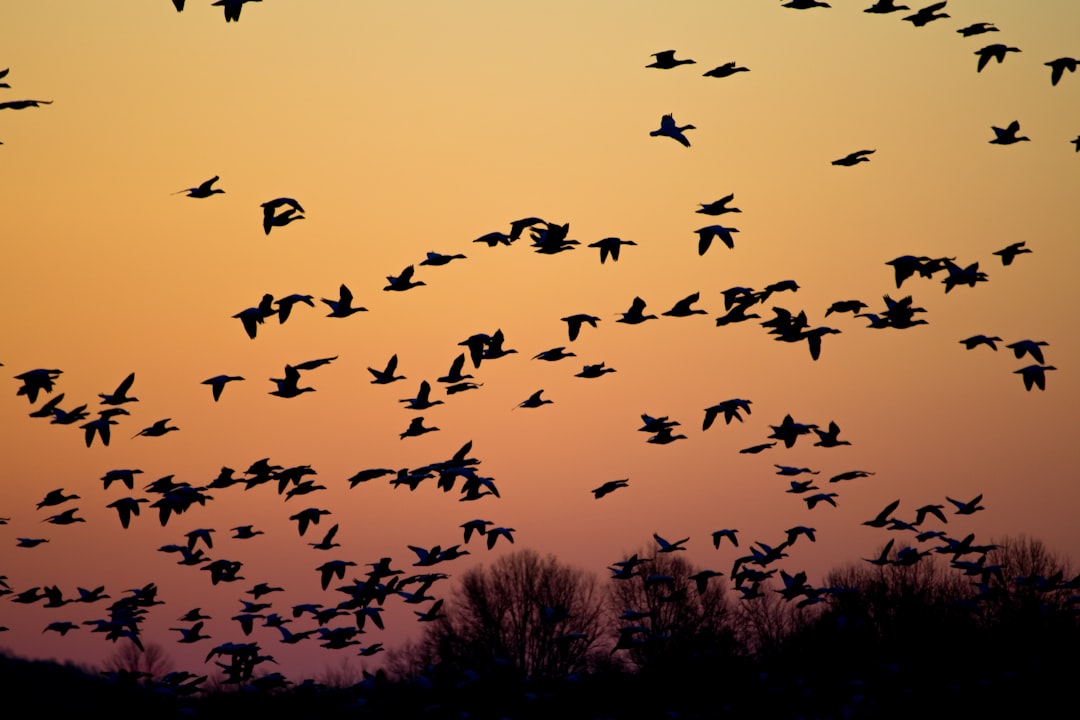
Michigan – Spring bird migration gained momentum this week as millions of avian travelers crossed the state under cover of darkness. Purdue University’s AeroEco Lab forecasted particularly heavy traffic, with up to 5.5 million birds expected over Michigan on Wednesday and Thursday nights.[1][2] These nocturnal journeys highlight a critical vulnerability: artificial outdoor lights that draw birds off course and heighten collision risks. Simple actions from residents could make a profound difference during peak season, which spans March 1 to June 15.[1]
Massive Waves Already Underway
On Monday night, approximately 1.6 million birds traversed Michigan, according to the BirdCast migration dashboard operated by Cornell Lab of Ornithology.[3] By early Tuesday, another 2 million filled the skies, peaking at over 2 million in flight at altitudes reaching 15,000 feet.[1] Flight speeds averaged around 39 miles per hour, heading northward in many instances.
Forecasts pointed to escalating numbers nationally, with 201 million birds anticipated across the U.S. on Tuesday night, rising to 266 million Wednesday and 252 million Thursday.[2] In Michigan, the AeroEco Lab’s models singled out Wednesday as the heaviest local night, underscoring the state’s role as a key corridor for over 380 species during spring flights.[1]
Lights Disrupt Ancient Navigation
Night-migrating birds rely on stars, the Earth’s magnetic field, and subtle sounds to chart their paths across continents.[1] Bright outdoor lights interfere with these cues, attracting flocks from several kilometers away and trapping them in disorienting circles around illuminated structures.[4] This phenomenon exhausts the birds’ energy reserves, diverts them from rest stops, and elevates dangers like window strikes.
Researchers at Purdue’s AeroEco Lab, which specializes in radar-based studies of migration patterns, documented how such light pollution alters flight behaviors and phenology.[5] High-intensity nights, comprising just 10% of the season, carry over half of total migrant traffic, amplifying the stakes when lights remain on.[2]
Species in the Spotlight
Current migrants over Michigan included Northern house wrens, Forster’s terns, blue-gray gnatcatchers, pectoral sandpipers, American tree sparrows, and Caspian terns.[1] These songbirds and shorebirds represent the vanguard of spring arrivals, joining summer residents like American robins, red-winged blackbirds, and Kirtland’s warblers.
Michigan’s diverse habitats – from forests to wetlands – offer vital refueling grounds, supporting more than 450 species statewide.[1] Protecting these passages preserves populations strained by habitat loss and climate shifts, as tracked through the lab’s long-term radar analyses.
Practical Steps for Residents
Purdue’s AeroEco Lab advised: “If your city is within its peak migration window, dim or turn off non-essential outdoor lighting from 11 p.m. to 6 a.m., and close shades to reduce skyglow.”[1] These measures lower collision risks, conserve energy, and maintain darker nights essential for wildlife rest.
- Switch off porch, garage, and landscape lights during forecasted high-migration periods.
- Opt for motion-sensor fixtures to minimize constant glow.
- Draw curtains or blinds to curb indoor light spillover.
- Support “Lights Out” programs in urban areas for coordinated efforts.
- Check forecasts nightly to time actions effectively.
| Night | Michigan Birds (est.) | National Total (est.) |
|---|---|---|
| Tuesday, Apr 21 | Low intensity | 201 million |
| Wednesday, Apr 22 | Up to 5.5 million | 266 million |
| Thursday, Apr 23 | Up to 5.5 million | 252 million |
Tools to Track the Spectacle
The BirdCast Michigan dashboard delivers real-time summaries, estimating totals, directions, and intensities from weather radar data updated every six hours.[3] Users see peaks two to three hours post-sunset, with color-coded maps signaling low, medium, or high activity.[6]
Visit AeroEco Lab’s Lights Out page for alerts tailored to regions like Michigan, integrating forecasts with action guidance.[2] These resources empower birders and citizens to witness – and safeguard – one of nature’s grandest annual events.
- Heavy migration peaks mid-week, with 5.5 million birds over Michigan.
- Turn off lights 11 p.m.–6 a.m. to prevent disorientation and collisions.
- Monitor BirdCast for live data and forecasts.
As these millions navigate Michigan’s skies, collective efforts to darken the night could save countless lives and sustain biodiversity. Small changes yield big impacts for feathered travelers. What steps will you take to support the migration? Tell us in the comments.

- Urban Coyotes Show Remarkable Adaptability, Learning to Thrive in City Environments - July 22, 2026
- Beavers Are Nature’s Engineers, Creating Vital Habitats for Other Wildlife Species - July 21, 2026
- The Recovery of the California Condor Offers Hope for Other Critically Endangered Birds - July 21, 2026